
Flexible packaging materials are designed to protect products during transportation, storage, and daily handling. However, repeated bending, folding, twisting, and compression can gradually damage barrier structures and create microscopic defects that are difficult to detect visually. ISO 7854 provides a standardized approach for evaluating the resistance of flexible materials to repeated flexing, helping manufacturers understand how films and laminates perform under mechanical stress.
En pålitelig ISO 7854 test allows engineers to measure the durability of flexible barrier materials by simulating repeated deformation and analyzing changes in physical integrity or barrier properties. Using a professional flex test system, laboratories can identify weaknesses in packaging structures, optimize material combinations, and improve product reliability. For applications requiring accurate simulation of handling stress, a crumple flex tester provides controlled and repeatable testing conditions for evaluating material endurance.
What Is ISO 7854 Flex Testing?
ISO 7854 is an international test method used to determine the resistance of flexible sheet materials to repeated flexing. The method evaluates how materials respond when subjected to mechanical deformation similar to conditions experienced during packaging conversion, transportation, distribution, and consumer use.
Flexible packaging often contains multiple layers, including polymer films, aluminum foil, coatings, adhesives, and barrier layers. Although these structures may demonstrate excellent performance under static conditions, repeated movement can cause:
- Micro-cracks in barrier layers
- Delamination between composite layers
- Loss of gas barrier performance
- Increased moisture transmission
- Formation of pinholes
- Reduced package protection capability
The purpose of an ISO 7854 evaluation is not simply to measure mechanical strength but to understand how materials maintain functionality after repeated flexing.
This information is especially valuable for packaging engineers developing high-barrier structures where even small defects can affect shelf life and product safety.
Why ISO 7854 Testing Is Important for Flexible Packaging Quality
Modern packaging materials must withstand complex mechanical stresses throughout their lifecycle. A pouch may experience folding during filling, vibration during transportation, compression during storage, and repeated handling by consumers.
Traditional tensile or puncture tests cannot fully represent these real-world conditions because they measure single-event failures. Flex durability testing provides additional insight into long-term material performance.
Key benefits of ISO 7854 testing include:
Detecting Hidden Barrier Damage
Many packaging failures begin with microscopic damage that cannot be observed by visual inspection. Repeated flexing can create small channels through barrier layers, allowing oxygen, moisture, or other gases to penetrate.
Flex testing helps manufacturers identify these weaknesses before products reach the market.
Improving Material Selection
Packaging developers often compare different structures, such as:
| Material Structure | Typical Evaluation Purpose |
|---|---|
| PET/PE laminate | Assess resistance to repeated handling |
| PET/Aluminum foil/PE | Evaluate foil cracking resistance |
| EVOH multilayer films | Verify barrier durability |
| Metallized films | Analyze coating damage after flexing |
The test results help engineers select the most suitable material combination for specific applications.
Supporting Packaging Reliability
For industries such as food, pharmaceuticals, and medical devices, packaging integrity directly affects product safety. ISO 7854 testing supports quality control programs by providing measurable durability data.
Testing Principle of ISO 7854 Flex Test
The basic principle of an ISO 7854 flex test is to repeatedly deform a flexible specimen under controlled mechanical conditions and evaluate whether the material develops damage.
During testing, the specimen experiences movements such as:
- Folding
- Bending
- Twisting
- Komprimering
- Stretching
The repeated deformation reproduces mechanical fatigue that flexible materials may encounter during real-world use.
After completing the required number of cycles, the tested material can be evaluated through different methods depending on the application requirements.
Common evaluation methods include:
- Visual inspection for cracks or pinholes
- Gas transmission testing
- Water vapor transmission testing
- Electrical detection methods
- Microscopic analysis
For barrier packaging, changes in oxygen transmission rate (OTR), carbon dioxide transmission rate (CO₂TR), or water vapor transmission rate (WVTR) can provide quantitative information about damage caused by flexing.
How Is ISO 7854 Flex Testing Performed?
A typical ISO 7854 testing process includes several important stages.
Klargjøring av prøver
The test begins with preparing standardized specimens from the material being evaluated.
Important factors include:
- Sample dimensions
- Conditioning environment
- Material orientation
- Number of specimens
Proper sample preparation ensures repeatable and comparable results.
Specimen Installation
The flexible material is securely mounted onto the test fixture. The mounting method must prevent slipping while allowing the specimen to experience controlled deformation.
A professional crumple flex tester uses precision fixtures to maintain consistent movement throughout the test.
Applying Repeated Flexing Motion
The testing equipment applies programmed flex cycles according to the selected test method.
The machine controls:
- Flexing frequency
- Movement distance
- Rotation angle
- Number of cycles
This controlled mechanical action allows laboratories to compare different materials under identical conditions.
Failure Evaluation
After testing, engineers analyze the specimen for signs of deterioration.
Typical evaluation results include:
- Number of defects generated
- Changes in barrier properties
- Crack formation level
- Overall flex resistance
The final data helps determine whether the material meets internal quality requirements or customer specifications.
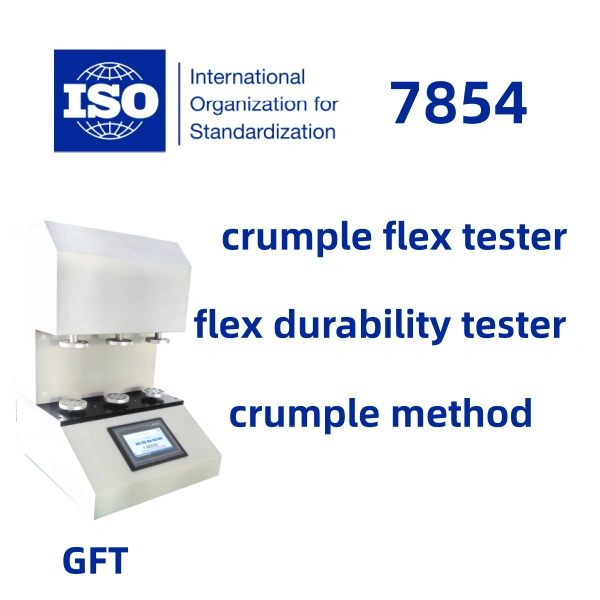
GFT Flex Durability Tester for ISO 7854 Flex Testing Applications
Den GFT Flex Durability Tester is designed for laboratories that require accurate evaluation of the durability of flexible packaging. It provides controlled repeated flexing operations to simulate mechanical stresses encountered during transportation and handling.
The system is suitable for evaluating:
- Flexible barrier films
- Multilayer laminates
- Coated films
- Medical packaging materials
- Beskyttelsesfilmer til industriell bruk
The tester applies combined mechanical deformation, including twisting and compression movements, to reproduce severe handling conditions.
Its automated operation improves testing consistency and reduces operator influence compared with manual flex evaluation methods.
Technical Features of Advanced Flex Test Equipment
En moderne flex test system should provide accurate movement control, repeatability, and efficient laboratory operation.
The GFT Flex Durability Tester includes several features designed for professional testing environments.
Programmable Testing Modes
Different materials require different testing conditions. Multiple preset programs allow laboratories to perform quick screening tests or extended durability evaluations.
Typical test modes include:
| Mode | Purpose |
|---|---|
| Short-cycle testing | Rapid material comparison |
| Medium-cycle testing | Routine quality inspection |
| Long-duration testing | High endurance evaluation |
Multi-Station Testing Capability
Multiple testing stations allow laboratories to evaluate several samples simultaneously.
Advantages include:
- Higher testing efficiency
- Better comparison between materials
- Reduced testing time
- Improved laboratory productivity
PLC Control and Touchscreen Operation
Industrial PLC control provides stable operation, while the touchscreen interface simplifies parameter setup.
Operators can easily adjust:
- Test cycles
- Movement parameters
- Testing programs
- Operating conditions
Applications of ISO 7854 Flex Testing
Food Packaging Industry
Flexible food packaging requires strong barrier performance to maintain freshness and prevent contamination.
Applications include:
- Vacuum pouches
- Retort packaging
- Snack packaging
- High-barrier laminates
Flex testing helps verify that packaging maintains protection after transportation and handling.
Medical and Pharmaceutical Packaging
Medical packaging must maintain sterile conditions throughout distribution.
ISO 7854 evaluation helps assess:
- Sterile pouches
- Emballasje for medisinsk utstyr
- Pharmaceutical barrier bags
Material durability testing supports regulatory compliance and product safety.
Industrial Packaging
Industrial films often experience harsh mechanical conditions.
Examples include:
- Protective membranes
- Landbruksfilmer
- Chemical-resistant packaging
- Heavy-duty flexible barriers
Flex durability analysis helps manufacturers improve service life.
Materials Suitable for ISO 7854 Flex Evaluation
ISO 7854 testing is commonly applied to:
- Polyetylen (PE)-filmer
- Polypropylene (PP) films
- Polyester (PET) films
- EVOH barrier films
- Metallized films
- Aluminum foil laminates
- Coated packaging materials
- Composite flexible structures
For multilayer packaging, flex testing is especially important because different layers may respond differently to mechanical stress.
ISO 7854 and Related Packaging Test Standards
ISO 7854 focuses on flex resistance evaluation, but packaging laboratories often combine it with other tests to obtain a complete understanding of material performance.
| Standard | Testing Area |
|---|---|
| ISO 7854 | Resistance of flexible materials to repeated flexing |
| ASTM F392 | Flex durability of flexible barrier materials |
| ISO 15106 | Water vapor transmission testing |
| ASTM D3985 | Oxygen transmission testing |
| ASTM D882 | Strekkegenskaper hos tynne plastplater |
Combining multiple evaluation methods allows engineers to analyze both mechanical durability and barrier performance.
How ISO 7854 Testing Supports Quality Control and Product Development
For manufacturers, flex durability testing provides valuable information throughout the product development cycle.
During R&D, engineers use results to:
- Compare new material structures
- Optimize laminate combinations
- Select suitable barrier layers
During production quality control, testing helps:
- Verify incoming materials
- Monitor supplier consistency
- Prevent packaging failures
During customer validation, test data provides technical evidence that packaging can withstand expected distribution conditions.
En pålitelig ISO 7854 testing process reduces the risk of product recalls, improves customer confidence, and supports continuous packaging improvement.
Choosing the Right ISO 7854 Testing Solution
When selecting flex testing equipment, laboratories should consider:
- Required testing standards
- Sample types
- Testing frequency
- Number of daily tests
- Data recording requirements
- Future application expansion
An advanced crumple flex tester should provide stable mechanical performance, accurate cycle control, and compatibility with different flexible materials.
Cell Instruments provides professional material testing solutions, including flexible packaging testing equipment, customized fixtures, and automated testing systems designed for laboratories and industrial quality control applications.
Technical Specifications of GFT Flex Durability Tester
| Parameter | GFT-02 Crumple Flex Tester | GFT-01 Crumple Flex Tester |
|---|---|---|
| Bøyelig vinkel | 440° (90 mm) eller 400° (80 mm) | 440° (90 mm) eller 400° (80 mm) |
| Kapasitet | 3.5 N·m | 2.5 N·m |
| Horisontalt strek | 155 mm eller 80 mm | 155 mm eller 80 mm |
| Testing Stations | 3 | 4 |
| Utvalgsstørrelse | 280 mm × 200 mm | 280 mm × 200 mm |
| Strømforsyning | 110–220V | 110–220V |
Reliable flex durability testing helps manufacturers develop stronger packaging structures, reduce material failures, and ensure product protection throughout the supply chain. Cell Instruments provides advanced flex test equipment, including crumple flex tester solutions designed for flexible packaging research, quality control, and industrial testing applications. Contact our technical team to explore suitable testing configurations, customized fixtures, and professional solutions for your material evaluation requirements.