
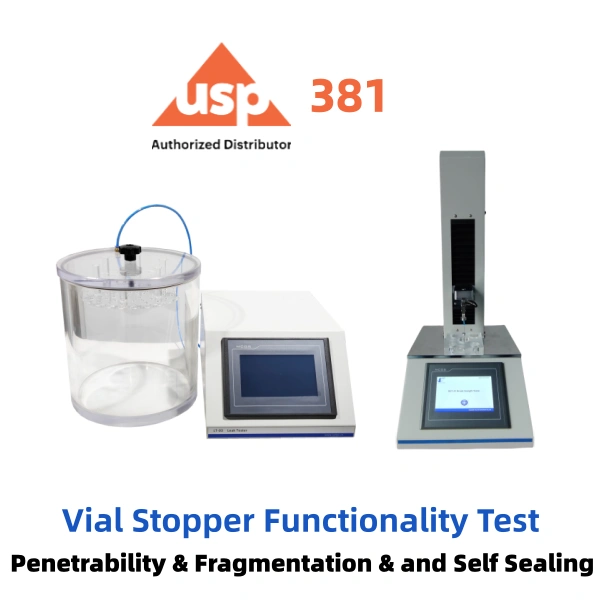
Understanding USP 381 and Its Role in Pharmaceutical Packaging
USP 381 defines the performance requirements for elastomeric closures used in injectable drug packaging. These closures must maintain container integrity while allowing repeated needle access without compromising sterility. The standard focuses on three critical functionality evaluations: penetrability, fragmentation, and self-sealing capacity.
Pharmaceutical manufacturers and quality control teams rely on USP 381 to ensure closures perform consistently during clinical use. Failures in these parameters can lead to contamination, dosage inaccuracies, or patient safety risks. Therefore, laboratories must implement precise and repeatable testing procedures aligned with the standard.
Vial Stopper Functionality Test Under USP 381
The vial stopper functionality test evaluates how closures behave when exposed to real-world use conditions involving hypodermic needle punctures. The test requires pre-treated samples and standardized needles with controlled geometry.
Key considerations include:
- Use of lubricated long bevel needles (12 ± 2°)
- Controlled puncture positions and frequency
- Accurate measurement of force, particle generation, and sealing integrity
These tests simulate clinical usage, ensuring closures maintain both mechanical performance and sterility assurance.
Penetrability Test for Vial Stopper
The penetrability test for vial stopper measures the force required for a needle to pierce the closure. This parameter directly affects usability in healthcare settings.
Test Principle
Operators fill vials to nominal volume, apply closures, and puncture each stopper using a standardized needle. The system records the force required during penetration.
Acceptance Criteria
- Maximum allowable force: ≤ 10 N
- Measurement accuracy: high precision required (±0.25 N)
Practical Insight
A lower and consistent penetration force ensures:
- Reduced operator fatigue
- Minimized risk of needle slippage
- Improved injection safety
Instrument Recommendation
The NPT-01 Needle Penetrability Tester provides:
- High-precision force measurement (up to 200 N range)
- Adjustable test speed for compliance with USP 381
- Stable motion control using ball screw and stepper motor
This system ensures repeatability and compliance with strict pharmaceutical QC requirements.
Fragmentation Evaluation in USP 381
Fragmentation assesses whether rubber particles detach from the closure during repeated puncturing.
Test Overview
- Each stopper undergoes multiple punctures at different locations
- Liquid is filtered through a fine membrane (≤0.5 μm)
- Visible particles are counted
Acceptance Criteria
- No more than five visible fragments
Why It Matters
Fragmentation poses a direct contamination risk. Particles introduced into injectable solutions can lead to:
- Patient safety hazards
- Regulatory non-compliance
- Product recalls
Laboratories must ensure both needle integrity and controlled testing conditions to avoid false results.
Self Sealing Test for Vial Stopper
The self sealing test for vial stopper evaluates whether closures reseal effectively after multiple punctures.
Test Method
- Each stopper is punctured 10 times
- Vials are immersed in a methylene blue solution
- Vacuum is applied and then released
Acceptance Criteria
- No dye ingress detected in any vial
Technical Interpretation
This test simulates real-world pressure fluctuations during storage and handling. A failure indicates compromised container closure integrity (CCI).
Instrument Recommendation
The LT-03 Leak Tester supports this test by:
- Generating controlled vacuum conditions (up to -90 kPa)
- Providing clear visual leak detection
- Allowing parameter storage for repeatability
It enhances reliability when validating sealing performance under USP 381 conditions.
FAQs
1. What is the purpose of USP 381?
It defines performance requirements for elastomeric closures used in injectable packaging, focusing on safety and functionality.
2. Why is penetrability important in vial stoppers?
It ensures that healthcare professionals can safely and easily puncture closures without excessive force or risk.
3. How does fragmentation affect drug safety?
Detached particles can contaminate injectable drugs and pose serious health risks to patients.
4. When is the self sealing test required?
It is required for closures used in multi-dose containers, where repeated puncturing occurs.
5. What instruments are suitable for USP 381 testing?
Systems like the NPT-01 Needle Puncture Tester and LT-03 Leak Tester provide accurate, repeatable, and compliant testing solutions.