
Paper and paperboard used in corrugated packaging, folding cartons, and industrial paper products must withstand compressive forces during converting, stacking, transportation, and storage. ISO 9895 defines a standardized method for evaluating the compressive strength of paper and paperboard using a short-span compression test. Unlike conventional compression methods, ISO 9895 focuses on the intrinsic fiber strength of the material by minimizing buckling effects, making it one of the most reliable indicators of paper quality.
For laboratories, packaging manufacturers, paper mills, and R&D departments, ISO 9895 provides repeatable and comparable data that supports material development, process optimization, and quality assurance. A modern short span compression test machine allows engineers to obtain highly accurate compression strength values within seconds, improving production efficiency and confidence in material performance.
What Is ISO 9895?
ISO 9895 specifies the laboratory method for determining the short-span compression strength of paper and paperboard in both the machine direction (MD) and cross direction (CD).
The method measures the maximum compressive force required to cause failure in a narrow specimen with an extremely short unsupported span. Because the unsupported length is only about 0.70 mm, the test minimizes bending and buckling, allowing the measured force to reflect the true compressive strength of the fiber network.
The standard is primarily intended for:
- Containerboard
- Kraft linerboard
- Testliner
- Corrugating medium
- Folding boxboard
- Industrial paperboard
- Specialty packaging papers
Most testing laboratories apply the method to materials with grammage between 100 g/m² and 400 g/m², although other materials may also be evaluated depending on application requirements.
Why Is ISO 9895 Important?
Compression strength directly influences how packaging materials perform throughout the supply chain.
Manufacturers use ISO 9895 because it provides valuable information for:
- Raw material evaluation
- Paper machine process control
- Product consistency verification
- Corrugated board quality prediction
- Packaging performance optimization
- Supplier qualification
- Research and development
Compared with conventional compression tests, short-span compression strength testing offers better repeatability because the specimen fails by fiber compression rather than structural instability.
The test is especially valuable for predicting how linerboard and medium contribute to the final compression performance of corrugated boxes.
How Does Short-Span Compression Testing Work?
The principle behind short-span compression testing is straightforward but highly precise.
A specimen measuring 15 mm wide is securely clamped between two high-friction jaws. The unsupported span between the clamps is only 0.70 mm.
During the test:
- The sample is positioned between the clamps.
- A constant clamping force securely holds the specimen.
- The movable clamp advances toward the stationary clamp.
- Compression force increases until the specimen fails.
- The maximum force is recorded.
- Compression strength is calculated according to ISO 9895.
Because the unsupported span is extremely short, failure occurs primarily through compression rather than bending, resulting in highly reproducible measurements.
How To Ensure Accurate Results
A professional short span compression test machine incorporates several design features that directly affect testing accuracy.
Key characteristics include:
| Feature | Benefit |
|---|---|
| Precision clamping system | Prevents sample slippage |
| Parallel jaws | Ensures uniform compression |
| Constant clamping force | Improves repeatability |
| Adjustable testing speed | Supports various materials |
| High-resolution load cell | Captures accurate peak force |
| PLC control with touchscreen | Simplifies operation |
| Pneumatic clamping | Reduces operator influence |
| Automatic data recording | Improves traceability |
These features allow laboratories to generate consistent results while minimizing operator variability.
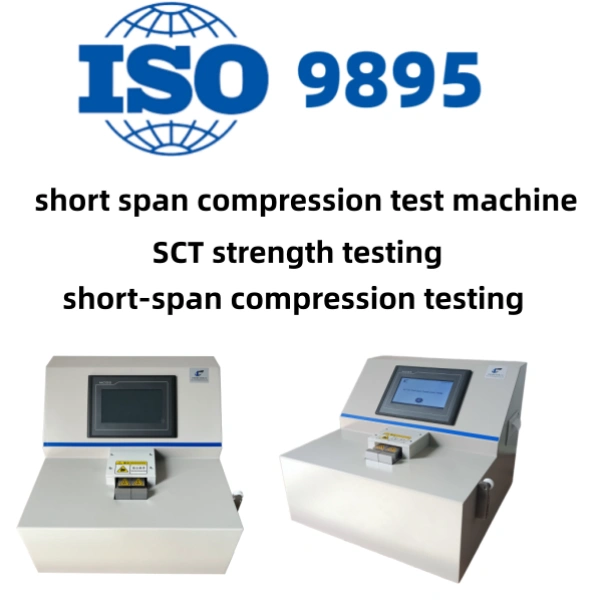
SCT-01 Short Span Compression Tester
The SCT-01 Short Span Compression Tester from Cell Instruments is specifically designed to perform ISO 9895 short-span compression testing for paper and paperboard used in packaging applications.
The instrument combines precision mechanics with intelligent control to provide dependable laboratory performance.
Main Features
- PLC-controlled testing system
- User-friendly HMI touchscreen
- Pneumatic specimen clamping
- Adjustable clamping force
- Adjustable compression speed
- Emergency stop protection
- Overload protection
- Multi-unit result display (N, kgf, lbf)
- Built-in thermal printer
- Optional RS-232 communication interface
- High testing repeatability
Its robust construction makes it suitable for routine quality control as well as research laboratories.
Technical Specifications
| Parameter | Specification |
|---|---|
| Test Range | 1–500 N (customizable) |
| Compression Distance | 0.3–2 mm |
| Clamping Length | 30 ± 0.5 mm |
| Test Speed | 3 ± 0.1 mm/min |
| Resolution | 0.01 N |
| Sample Size | 15 × 75 mm |
| Air Pressure | 0.4–0.7 MPa |
| Gas Connection | Φ6 mm |
| Power Supply | AC 110–220 V, 50/60 Hz |
These specifications satisfy the requirements of ISO 9895 while supporting reliable laboratory operation.
Test Procedure According to ISO 9895
Although laboratories may establish their own operating procedures, a typical workflow includes:
Sample Preparation
Prepare specimens with:
- Width of 15 mm
- Length of approximately 75 mm
- Clean, undamaged edges
- Proper conditioning before testing
Instrument Setup
Configure:
- Test speed
- Clamping pressure
- Compression distance
- Load cell selection
- Test direction (MD or CD)
Testing
Insert the specimen between the jaws.
The pneumatic clamps apply the specified force before compression begins. The moving jaw compresses the specimen until failure occurs.
Result Analysis
The software records:
- Maximum compression force
- Compression strength
- Average values
- Standard deviation
- Statistical summaries
- Printable reports
Testing multiple specimens improves statistical confidence.
Applications of ISO 9895 Short-Span Compression Strength Testing
Short-span compression strength testing plays an important role throughout the paper and packaging industries.
Paper Mills
- Fiber quality evaluation
- Refining optimization
- Process monitoring
- Grade development
Corrugated Board Manufacturers
- Incoming liner quality inspection
- Medium evaluation
- Supplier comparison
- Process consistency
Packaging Manufacturers
- Material qualification
- Product development
- Cost optimization
- Quality assurance
Research Laboratories
- Fiber modification studies
- Additive evaluation
- New material development
- Performance comparison
Interpreting Test Results
Higher compression values generally indicate stronger fiber bonding and better resistance to compressive loading.
Engineers often compare:
- Machine direction vs. cross direction
- Different paper grades
- Production batches
- Raw material sources
- Moisture conditions
- Manufacturing parameters
Rather than evaluating one measurement alone, laboratories use trends over time to monitor production stability and identify opportunities for improvement.
Related Test Methods
While ISO 9895 evaluates intrinsic compressive strength, other standardized methods assess complementary paper properties.
| Standard | Test Focus |
|---|---|
| TAPPI T826 | Short-span compression strength of paper and paperboard |
| DIN 54518 | Short-span compression testing |
| BS 7325 | Compression strength of paper and board |
| GB/T 2679.10 | Short-span compression method |
Using several standardized methods together provides a comprehensive understanding of material performance.
Why Choose the SCT-01 for ISO 9895 Testing?
Selecting the right short span compression test machine affects laboratory productivity, testing accuracy, and long-term reliability.
The SCT-01 offers:
- Compliance with international standards
- Excellent repeatability
- Stable pneumatic clamping
- High measurement accuracy
- Intuitive touchscreen operation
- Flexible reporting capabilities
- Optional software connectivity
- Durable construction for continuous laboratory use
Whether used for routine production inspection or advanced material research, the SCT-01 delivers dependable ISO 9895 testing results that help manufacturers improve paper quality and optimize packaging performance.
Conclusion
Accurate ISO 9895 testing helps manufacturers evaluate paper strength, optimize production processes, and improve packaging performance with confidence. Cell Instruments provides the SCT-01 Short Span Compression Tester along with customized fixtures, automated testing systems, and application-specific solutions to meet diverse laboratory requirements. Contact our technical team to discuss your testing challenges, request product specifications, or discover the ideal short-span compression testing solution for your quality control and R&D programs.