
Reliable heat seals are essential for protecting packaged products throughout transportation, storage, and consumer use. ASTM F2029 provides a standardized laboratory method for preparing heat seals under controlled conditions, allowing manufacturers to evaluate the heat sealability of flexible packaging materials before production. Whether developing a new packaging structure or optimizing an existing sealing process, ASTM F2029 helps engineers determine the ideal sealing parameters that produce consistent, high-quality seals.
The HST Series Heat Seal Tester from Cell Instruments is designed specifically for ASTM F2029 testing. It precisely controls sealing temperature, dwell time, and sealing pressure to simulate real production conditions, making it an ideal heat seal tester for research laboratories, quality control departments, packaging converters, and material manufacturers.
What Is ASTM F2029?
ASTM F2029 is the standard test method for making laboratory heat seals of flexible barrier materials. Instead of measuring seal strength directly, the standard specifies how standardized seals should be prepared so they can later be evaluated using seal strength tests such as ASTM F88.
By producing repeatable laboratory seals under controlled conditions, ASTM F2029 allows manufacturers to:
- Determine the optimal sealing temperature window
- Compare different sealant materials
- Evaluate multilayer packaging structures
- Optimize production sealing conditions
- Improve package reliability before commercial manufacturing
Because sealing performance depends on multiple variables, ASTM F2029 provides a repeatable procedure that minimizes testing variation and improves result consistency.
Why Is ASTM F2029 Important?
Heat sealing is one of the most critical operations in flexible packaging production. Poor seals can lead to leakage, contamination, shortened shelf life, and customer complaints.
Implementing ASTM F2029 testing offers several advantages:
- Optimize sealing parameters before production
- Reduce packaging failures during transportation
- Improve production efficiency
- Reduce material waste
- Ensure repeatable laboratory testing
- Support package validation programs
- Meet customer and regulatory quality requirements
For manufacturers producing food, pharmaceutical, medical, or industrial packaging, laboratory heat sealing significantly reduces production risks.
Applications of ASTM F2029 Heat Seal Testing
The HST Series supports heat seal strength for flexible packaging development across numerous industries.
Typical applications include:
| Industry | Typical Products |
|---|---|
| Food Packaging | Snack bags, frozen food pouches, coffee bags |
| Pharmaceutical Packaging | Sachets, strip packs, medical foil laminates |
| Medical Packaging | Sterile pouches, Tyvek® packages |
| Beverage Packaging | Spouted pouches, drink sachets |
| Personal Care | Cosmetic pouches, refill packs |
| Industrial Packaging | Chemical bags, protective films |
| Pet Food | Stand-up pouches |
| Agriculture | Seed packaging |
Materials Suitable for ASTM F2029 Testing
The tester evaluates virtually all heat-sealable flexible materials, including:
- Polyethylene (PE)
- Polypropylene (PP)
- Cast Polypropylene (CPP)
- BOPP films
- PET/PE laminates
- PET/CPP laminates
- Nylon laminates
- Aluminum foil laminates
- Coextruded barrier films
- Medical packaging materials
- Composite films
- Paper/polymer laminates
- Biodegradable packaging films
How Does the ASTM F2029 Heat Seal Tester Work?
The HST Series reproduces industrial heat sealing by precisely controlling the three critical sealing variables:
- Temperature
- Pressure
- Sealing Time
The testing procedure typically includes:
Preheat
The upper and lower sealing jaws are heated to the specified temperature and stabilized before testing.
Position the Sample
The packaging material is placed evenly between the heated sealing jaws.
Apply Pressure
The pneumatic system lowers the upper sealing jaw, applying a preset sealing pressure.
Maintain Heat and Pressure
The material remains under controlled temperature and pressure for the programmed dwell time.
Complete the Seal
After the sealing cycle finishes, the sealing jaw automatically returns to its starting position, producing a standardized laboratory seal ready for further testing.
The resulting specimens can then undergo heat seal strength for flexible packaging evaluation using tensile testing equipment according to ASTM F88.
HST Series Heat Seal Tester Models
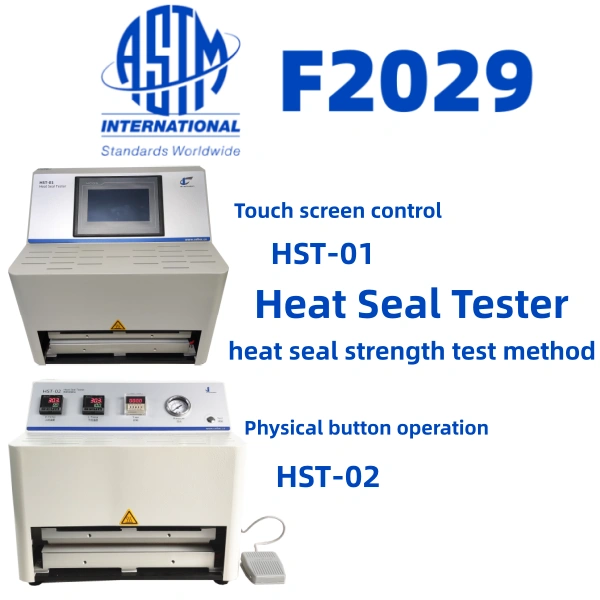
To meet different laboratory preferences and budgets, the HST Series is available in two models. Both provide the same sealing performance and technical specifications, with the primary difference being the control interface.
| Model | Operation | Features |
|---|---|---|
| HST-01 | Touchscreen Control | Color touchscreen interface, programmable parameters, intuitive operation, ideal for modern laboratories |
| HST-02 | Manual Button Control | Traditional push-button operation, simple and reliable, suitable for routine quality control |
Both models offer identical sealing capabilities, accuracy, sealing jaw dimensions, and compliance with ASTM F2029.
Key Features
The HST Series heat seal tester offers several features designed for laboratory precision:
- High-accuracy temperature control
- Stable pneumatic sealing pressure
- Adjustable sealing time
- Uniform heat distribution
- Consistent laboratory seal preparation
- Durable sealing jaws
- Easy parameter adjustment
- Compact laboratory footprint
- Excellent repeatability
- Suitable for R&D and quality control
Technical Specifications
| Parameter | Specification |
|---|---|
| Sealing Temperature | Ambient to 300°C |
| Temperature Accuracy | ±0.2°C |
| Sealing Time | 0.1–9999 s |
| Sealing Pressure | 0.15–0.7 MPa |
| Seal Jaw Size | 330 × 10 mm |
| Gas Supply Pressure | 0.7 MPa |
| Air Port | Φ6 mm PU Hose |
| Power Supply | AC 220V, 50Hz |
Optimizing Heat Seal Strength for Flexible Packaging
Producing consistent seals requires balancing several process variables.
| Variable | Effect on Seal Quality |
|---|---|
| Temperature | Determines seal initiation and fusion |
| Pressure | Ensures intimate contact between seal layers |
| Dwell Time | Controls heat transfer into materials |
| Material Structure | Influences sealing window |
| Sealant Layer | Determines ultimate seal performance |
Using ASTM F2029 laboratory testing, engineers can establish the optimal sealing window before production begins, reducing costly trial-and-error adjustments on packaging lines.
Related Testing Standards
Although ASTM F2029 focuses on preparing standardized laboratory heat seals, it is often used alongside complementary packaging test standards.
| Standard | Purpose |
|---|---|
| ASTM F88 | Seal strength testing |
| ASTM F1140 | Internal pressurization burst testing |
| ASTM F2054 | Burst testing of flexible packages |
| ASTM D3078 | Bubble leak detection |
| ASTM F2096 | Bubble emission leak test |
| JIS Z 0238 | Heat sealing evaluation |
| YBB 001220 | Pharmaceutical packaging heat sealing |
Together, these standards provide comprehensive evaluation of packaging sealing performance.
Why Choose the HST Series Heat Seal Tester?
Cell Instruments has extensive experience developing laboratory testing equipment for flexible packaging, pharmaceutical packaging, medical packaging, and industrial materials.
The HST Series provides:
- Compliance with ASTM F2029
- Highly repeatable laboratory heat sealing
- Accurate control of temperature, pressure, and dwell time
- Easy operation for both R&D and QC laboratories
- Pneumatic sealing for consistent pressure
- Two operation options to suit different user preferences
- Custom sealing jaw sizes and fixtures available for specialized applications
Whether developing new packaging materials, validating production processes, or performing routine quality control, the HST Series provides reliable and repeatable laboratory heat sealing for demanding testing applications.
Conclusion
Reliable heat sealing begins with accurate laboratory testing. The HST Series Heat Seal Tester enables packaging engineers to optimize sealing conditions, improve package integrity, and generate repeatable results in accordance with ASTM F2029. Whether you require the advanced touchscreen interface of the HST-01 or the straightforward push-button operation of the HST-02, Cell Instruments can provide the right solution. Contact us to learn more about our heat seal testing equipment, customized fixtures, and complete packaging material testing solutions.