
Geomembranes play a critical role in containment systems such as landfills, mining operations, reservoirs, and environmental protection facilities. These flexible polymeric sheets must resist mechanical damage during installation and service. One of the most important mechanical properties evaluated in quality control is tearing resistance. ASTM D5884 provides a standardized method for measuring the tearing strength of internally reinforced geomembranes using a controlled laboratory procedure.
Understanding the ASTM D5884 test method helps engineers, quality inspectors, and manufacturers evaluate material durability and ensure reliable long-term performance in demanding environments.
ASTM D5884 and the Tear Resistance Test of Geomembranes
The tear resistance test of geomembranes evaluates how well reinforced geomembranes resist propagation of a tear once a cut or defect occurs. Reinforced geomembranes contain internal textile structures that improve strength and dimensional stability, but their tear performance depends strongly on reinforcement type and orientation.
The ASTM D5884 method measures the maximum force required to propagate a tear through a prepared specimen. The test focuses on internally reinforced geomembranes, where the textile reinforcement significantly influences tear behavior.
Key aspects of the ASTM D5884 standard include:
- Measurement of tearing strength in both machine direction (MD) and cross-machine direction (CMD)
- Use of standardized specimen geometry and controlled displacement rate
- Determination of peak tearing load during specimen separation
- Calculation of average values from multiple specimens for reliable evaluation
Because tearing resistance may vary depending on reinforcement distribution, fiber orientation, and strain rate, ASTM D5884 results serve as a comparative index rather than a direct predictor of field performance.
Tongue Tear Method for Reinforced Geomembranes
The tongue tear method specified in ASTM D5884 creates a controlled tear path that propagates across the specimen width. This method allows researchers and quality control personnel to evaluate how the reinforcement structure resists tear propagation.
In this procedure:
- A rectangular specimen is cut with a central slit forming two tongues
- Each tongue is clamped in opposite grips of a tensile testing machine
- The grips move apart at a constant speed
- The tear propagates along the slit while the system records force
The maximum load measured during this process represents the tearing strength of the geomembrane.
The tongue tear method is particularly effective for reinforced materials because it forces the tear to pass through the internal textile structure. As a result, the test highlights the contribution of reinforcement fibers and bonding structures.
Geomembranes Tongue Tear Test Procedure
The geomembranes tongue tear test defined in ASTM D5884 follows a precise procedure to ensure repeatable and comparable results.
1. Specimen Preparation
- Prepare specimens with standardized dimensions.
- Introduce a 75 mm cut to form the tongue shape.
- Ensure specimens represent both machine and cross-machine directions.
2. Test Setup
The specimen is mounted in a tensile testing machine with:
- Grip separation of 75 mm
- Each tongue centered in opposing clamps
The grips are positioned approximately 38 mm from the end of the cut, ensuring consistent tear initiation.
3. Test Execution
The machine operates at a constant rate of: 50 ± 2 mm/min
During the test:
- The instrument records the force required to propagate the tear.
- The test continues until the tear extends approximately 75–100 mm.
If tearing occurs outside the intended path or abnormal results appear (more than 25% deviation), the specimen is discarded and retested.
4. Result Calculation
According to ASTM D5884, the tearing strength is defined as:
- Peak load recorded during separation
For each material sample:
- At least five specimens per direction are tested.
- The average tearing strength, standard deviation, and coefficient of variation are calculated.
Significance of ASTM D5884 Testing
The ASTM D5884 test method provides valuable insight into the structural integrity of reinforced geomembranes. It is widely used for:
- Material development and comparison
- Quality control during manufacturing
- Verification of reinforcement performance
- Evaluation of directional strength differences
Because reinforced geomembranes rely on internal textiles, tear resistance can vary depending on:
- Fiber type and weave structure
- Adhesion between layers
- Reinforcement orientation
- Manufacturing processes
The geomembranes tongue tear test therefore allows manufacturers and project engineers to identify the most durable reinforcement structures for specific applications.
Recommended Equipment for ASTM D5884 Testing
Reliable measurement of tearing strength requires a precise and stable testing system. A universal tensile testing machine with accurate speed control and data acquisition is essential for performing ASTM D5884 tests.
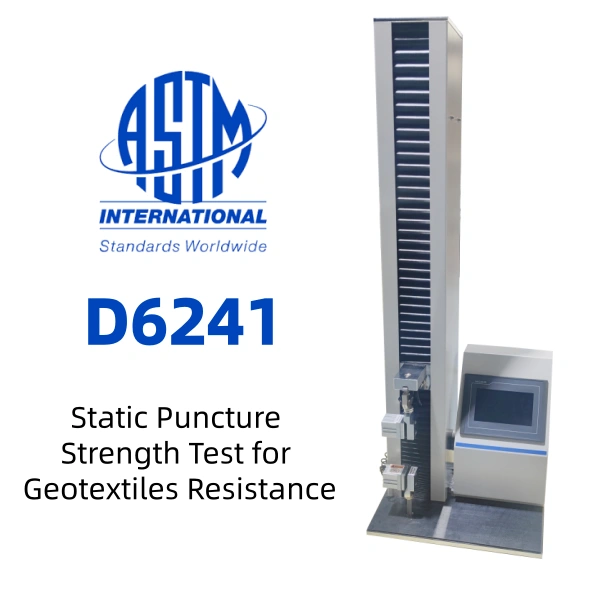
The Cell Instruments TST-01 Tensile Tester provides an effective solution for laboratories performing geomembrane tear testing.
Important capabilities include:
- High-precision ball screw drive for stable displacement control
- Adjustable test speeds (1–500 mm/min) suitable for ASTM D5884 requirements
- PLC control with 7-inch HMI touchscreen for intuitive operation
- Real-time force-displacement curves for accurate tear analysis
- Multi-fixture compatibility enabling tear, tensile, peel, and puncture testing on a single platform
With 0.5% full-scale accuracy and customizable fixtures, the TST-01 allows laboratories to perform geomembranes tongue tear tests with excellent repeatability and data reliability.
Improving Quality Control with ASTM D5884
For manufacturers and quality inspection agencies, ASTM D5884 testing is an essential part of geomembrane evaluation. Consistent tear strength testing helps organizations:
- Identify weaknesses in reinforcement structures
- Compare materials from different suppliers
- Validate production consistency
- Support engineering decisions in containment system design
When integrated into routine quality control programs, the tear resistance test of geomembranes ensures that reinforced geomembranes maintain the mechanical integrity required for demanding environmental and civil engineering applications.