
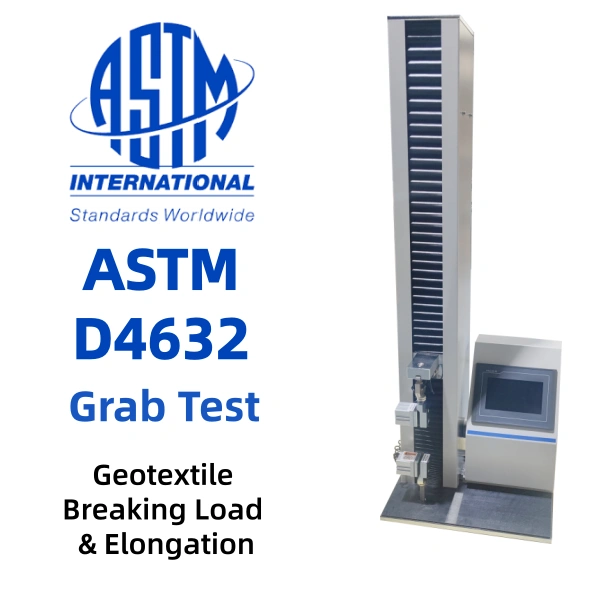
ASTM D4632 defines a standardized method to evaluate the breaking load and elongation of geotextiles using the grab method. This approach measures the effective strength of a fabric by gripping only a portion of the specimen width, simulating real-world stress conditions.
Unlike strip testing, ASTM D4632 reflects the contribution of adjacent fibers, making it highly relevant for quality control and acceptance testing. However, results apply mainly to materials with similar structures, as fabric construction significantly influences performance.
Key takeaway:
ASTM D4632 provides a reliable index test for comparing geotextile strength under controlled tensile loading conditions.
Grab Strength Test: Principle and Key Parameters
The grab strength test involves applying a continuously increasing tensile force until the specimen ruptures. The method captures two critical parameters:
- Breaking Load (Grab Strength): Maximum force sustained before failure
- Elongation at Break: Deformation corresponding to peak load
Core Testing Conditions
- Gauge length: 75 ± 1 mm
- Test speed: 300 mm/min
- वातावरण: 21 ± 2°C, 65 ± 5% RH
- Specimen alignment: Centered in clamps
The test runs in both machine direction (MD) and cross-machine direction (CD) to capture anisotropic behavior.
Important:
Improper clamping, slippage, or edge failure invalidates results and requires retesting.
Geotextile Grab Test Procedure and Data Interpretation
The geotextile grab test follows a structured sequence to ensure repeatability:
Step-by-Step Overview
- Condition specimens under standard atmospheric conditions
- Mount sample centrally in clamps
- Apply tensile load at controlled speed
- Record load-extension curve
- Identify peak load and elongation
- Repeat for multiple specimens
Data Reporting
Results must include:
- Average breaking load (MD & CD)
- Average elongation at break
- Standard deviation
Interpretation Insight:
Higher grab strength indicates better resistance to localized stress, while elongation reflects flexibility and deformation capacity.
CRT Tensile Testing Machine for ASTM D4632
A CRT tensile testing machine plays a critical role in ensuring accurate and repeatable ASTM D4632 results. Precision in speed control, displacement, and force measurement directly impacts test validity.
Why Equipment Matters
To comply with ASTM D4632, the testing system must provide:
- Stable load application
- Accurate elongation measurement
- Consistent speed control
- Reliable data acquisition
Recommended Solution: Cell Instruments TST-01
The Cell Instruments TST-01 Tensile Tester is engineered to meet these requirements:
- PLC-controlled system with HMI for real-time curve visualization
- High-precision ball screw for stable displacement control
- Wide speed range (1–500 mm/min) for ASTM compliance
- Multi-fixture adaptability for tensile, peel, and puncture tests
- Robust structure ensuring long-term reliability
This makes it an ideal CRT tensile testing machine for laboratories handling geotextile testing and broader material evaluation.
Significance of ASTM D4632 in Quality Control
ASTM D4632 remains essential for:
- Incoming material inspection
- Supplier qualification
- Production consistency verification
Because the grab method reflects localized stress behavior, it closely aligns with real application conditions such as:
- Soil reinforcement
- Road construction
- Drainage systems
Critical Note:
ASTM D4632 should not be used alone for design decisions; complementary tests (e.g., strip tensile tests) are recommended.
Common Testing Challenges and Optimization Tips
Frequent Issues
- Specimen slippage in clamps
- Edge tearing instead of central failure
- Inconsistent sample preparation
Best Practices
- Use appropriate jaw surfaces to prevent slippage
- Ensure precise specimen alignment
- Maintain standard environmental conditions
- Regularly calibrate the testing machine
FAQs
1. What is ASTM D4632 mainly used for?
ASTM D4632 evaluates the grab strength and elongation of geotextiles, primarily for quality control and comparison purposes.
2. How is the grab test different from strip tensile testing?
The grab test measures localized strength including adjacent fiber support, while strip testing evaluates the full-width tensile strength.
3. Why is a CRT tensile testing machine important?
A CRT tensile testing machine ensures accurate load application, speed control, and data recording, which are critical for ASTM compliance.
4. Can ASTM D4632 results be used for design calculations?
No. ASTM D4632 is an index test, and additional methods are required for engineering design.
5. What causes invalid test results in ASTM D4632?
Common causes include slippage, edge breakage, or improper clamping, all of which require retesting.