
ASTM D1922 Tear Resistance Test Using Elmendorf Tear Tester
When selecting flexible packaging materials, industrial films, or laminated structures, ASTM D1922 is one of the most widely recognized standards for evaluating tear resistance of plastic film. A material may exhibit excellent tensile strength yet fail unexpectedly once a small cut or notch develops during manufacturing, transportation, or end use. Measuring tear resistance helps manufacturers understand how a crack propagates under load and whether the material can withstand real-world handling.
Den tearing test by pendulum method described in ASTM D1922 provides a reliable and repeatable way to quantify tear propagation energy. Using an Elmendorf-rivhållfasthetsprovare, laboratories can compare different film formulations, optimize production processes, and establish quality control specifications for plastic films and thin sheeting.
What Is ASTM D1922?
ASTM D1922 is the standard test method for determining the propagation tear resistance of plastic film and thin sheeting by the pendulum method. Rather than measuring the force required to initiate a tear, the method evaluates the energy needed to continue tearing a specimen that already contains a precisely prepared slit.
This distinction is important because many packaging failures begin with small defects created during converting, sealing, transportation, or consumer use. Understanding tear propagation provides valuable insight into product durability.
The standard is commonly applied in:
- Flexible packaging
- Jordbruksfilmer
- Stretch and shrink films
- Barrier laminates
- Filmer för medicinsk förpackning
- Skyddsfilmer för industriellt bruk
- Plastic sheets up to approximately 1 mm thick
Why Measure Tear Resistance of Plastic Film?
Den tear resistance of plastic film directly influences product performance throughout manufacturing, logistics, and final use.
Typical quality concerns include:
- Package tearing during filling
- Film damage during transportation
- Consumer opening performance
- Machine-direction versus transverse-direction durability
- Material consistency between production batches
By evaluating tear resistance, manufacturers can:
- Improve product durability
- Reduce packaging failures
- Compare different resin formulations
- Optimize film thickness
- Verify supplier quality
- Support new product development
Principle of the Tearing Test by Pendulum Method
Den tearing test by pendulum method is based on measuring the energy absorbed while a pendulum continues tearing a pre-notched specimen.
The test sequence includes:
- A standard specimen is prepared.
- A precisely controlled slit is introduced.
- The specimen is clamped securely.
- The pendulum is released.
- As the pendulum swings, it tears the remaining material.
- The loss of pendulum energy is converted into tear resistance.
Because the measurement is based on energy rather than continuous force, the method provides highly repeatable results for thin plastic films.
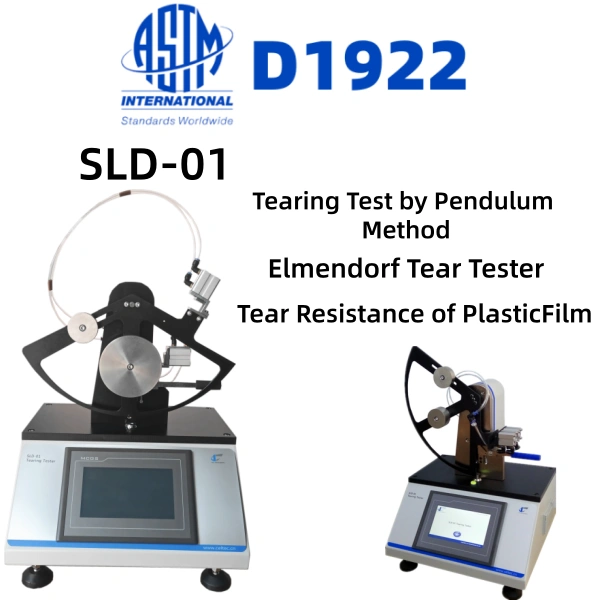
Test Equipment: Elmendorf Tear Tester
En Elmendorf-rivhållfasthetsprovare is specifically designed to perform ASTM D1922 testing.
Typical instrument components include:
| Component | Function |
|---|---|
| Pendulum | Supplies tearing energy |
| Pneumatic clamps | Secure the specimen uniformly |
| Specimen cutter | Produces the standard slit |
| PLC controller | Controls testing sequence |
| Touchscreen HMI | Simplifies operation |
| Calibration weights | Verify measurement accuracy |
| Data processing software | Calculates average tear values |
Modern electronic systems improve repeatability while reducing operator influence compared with traditional mechanical designs.
ASTM D1922 Test Procedure
Although laboratories should always follow the official standard, the general procedure includes the following steps.
1. Förberedelse av provexemplar
Film specimens are cut to the required dimensions.
A standard slit is produced so that the tear will propagate over a defined distance.
Proper specimen preparation is critical because slit quality directly affects repeatability.
2. Specimen Installation
The specimen is mounted in the clamps of the Elmendorf-rivhållfasthetsprovare.
Proper alignment prevents twisting and ensures uniform tear propagation.
3. Pendulum Release
The pendulum is released automatically.
Gravity accelerates the pendulum through the specimen, continuing the tear.
4. Energy Measurement
The instrument measures the pendulum’s energy loss during tearing.
The absorbed energy is converted into tear resistance values, typically expressed in grams-force (gf) or millinewtons (mN).
5. Statistical Analysis
Multiple specimens are tested.
The software automatically calculates:
- Average tear strength
- Maximum value
- Minimum value
- Standardavvikelse
- Coefficient of variation
These statistics help evaluate manufacturing consistency.
Factors Affecting ASTM D1922 Results
Several variables influence ASTM D1922 measurements.
Material Structure
- Polymer type
- Molecular orientation
- Resin formulation
- Additives
Film Processing
- Extrusion conditions
- Blown film ratio
- Cast film process
- Annealing
Thickness
Thicker materials generally require more energy to propagate a tear, although material structure also plays an important role.
Testing Environment
Temperature and humidity may influence some plastic materials, making standardized laboratory conditions essential.
Typiska tillämpningar
Den tear resistance of plastic film is important across many industries.
Flexible Packaging
- Food pouches
- Snack packaging
- Frozen food bags
- Retort packaging
Medicinska förpackningar
- Sterile barrier systems
- Pharmaceutical packaging
- Medical device pouches
Industrial Films
- Protective films
- Stretch wrap
- Jordbruksfilmer
- Construction membranes
Consumer Products
- Shopping bags
- Garbage bags
- Household storage bags
How to Interpret ASTM D1922 Results
Higher tear resistance generally indicates greater resistance to crack propagation.
However, the optimal value depends on the application.
Till exempel:
| Tillämpning | Desired Tear Performance |
|---|---|
| Shopping bags | High tear resistance |
| Medical easy-open pouches | Controlled tear |
| Agricultural film | High durability |
| Industrial protective film | Excellent tear resistance |
| Consumer packaging | Balanced strength and opening performance |
Therefore, test results should always be interpreted alongside tensile strength, puncture resistance, seal strength, and barrier performance.
ASTM D1922 Compared with Related Standards
Different standards evaluate tear performance using different principles.
| Standard | Testmetod | Typical Materials |
|---|---|---|
| ASTM D1922 | Pendulum tear propagation | Plastic film |
| ISO 6383-1 | Pendulum tear | Plastic film |
| ASTM D1004 | Initial tear resistance | Plastic sheet |
| ASTM D689 | Internal tearing resistance | Papper |
| ISO 1974 | Elmendorf paper tear | Paper and board |
Selecting the appropriate standard depends on the material type and intended application.
Quality Control Benefits of ASTM D1922
Routine ASTM D1922 testing helps manufacturers:
- Detect process variation
- Compare production batches
- Evaluate new resin formulations
- Optimize multilayer film structures
- Verify incoming materials
- Reduce customer complaints
- Support regulatory documentation
- Improve product reliability
Many packaging manufacturers integrate tear testing into incoming inspection, production quality control, and product development programs.
Cell Instruments SLD-01 Tear Tester Solution
For laboratories performing ASTM D1922 testing, the SLD-01 Tear Tester from Cell Instruments provides a modern solution based on the Elmendorf-rivhållfasthetsprovare principle.
Key features include:
- PLC control with intuitive touchscreen interface
- Automatic pneumatic specimen clamping
- Automatic pendulum release for improved repeatability
- Multiple pendulum capacities (200–6400 gf)
- Integrated statistical calculations
- Calibration weight verification
- Optional RS-232 communication
- Optional professional software for advanced analysis and reporting
- Paper-specific outputs including mN and tear index when required
The instrument is suitable for testing plastic films, composite materials, paper, paperboard, textiles, and nonwoven materials while supporting laboratory quality management and routine production testing.
Best Practices for Accurate Testing
To obtain reliable ASTM D1922 results:
- Prepare specimens using standardized cutting tools.
- Verify pendulum calibration regularly.
- Maintain clean and properly aligned clamps.
- Test sufficient replicates for statistical confidence.
- Control laboratory temperature and humidity.
- Follow specimen orientation requirements (MD and TD).
- Perform periodic instrument verification using calibration weights.
Following these practices improves repeatability and supports long-term quality assurance.
Slutsats
ASTM D1922 remains one of the industry’s most important standards for measuring the tear resistance of plastic film. Genom att använda tearing test by pendulum method, manufacturers obtain reliable, repeatable data that supports material selection, product development, process optimization, and quality control.
Modern Elmendorf-rivhållfasthetsprovare systems further enhance testing efficiency through automated specimen handling, electronic data processing, and statistical analysis. Whether evaluating flexible packaging, medical films, industrial laminates, or specialty plastic sheeting, ASTM D1922 provides engineers and quality professionals with a dependable method for assessing tear propagation performance and ensuring product reliability.