
Flexible packaging materials often perform well during basic laboratory evaluations, yet their barrier performance can decline after repeated bending, twisting, transportation vibration, and handling stress. For packaging engineers and quality laboratories, measuring only tensile strength or seal performance is not enough to understand long-term package durability.
ASTM F392 provides a recognized method for evaluating the flex durability of flexible barrier materials by simulating repeated mechanical stress that packaging may experience throughout manufacturing, distribution, and end use. A reliable ASTM F392 flex durability tester helps engineers identify weaknesses such as micro-cracking, loss of barrier properties, and material fatigue before these issues affect product protection.
Cell Instruments’ GFT Flex Durability Tester is designed for laboratories that require accurate, repeatable, and efficient flex resistance evaluation. The system automates the 젤보 플렉스 테스트 process, allowing users to analyze how flexible films, laminates, coatings, and composite structures respond to repeated mechanical deformation.
Why ASTM F392 Testing Matters
Modern packaging relies heavily on multilayer films and high-barrier structures. Materials such as PET, PE, PP, EVOH, aluminum-coated films, and specialty barrier laminates protect against oxygen, moisture, and contaminants. However, these protective properties can be compromised when the material experiences repeated flexing.
During transportation and handling, packages may undergo:
- Folding and bending during filling operations
- Compression and vibration during logistics
- Twisting during storage or consumer use
- Repeated mechanical deformation in flexible pouches
These stresses may create invisible defects before obvious physical damage appears.
An ASTM F392 test provides valuable information about:
- Barrier film durability under mechanical fatigue
- Resistance to flex-induced pinhole formation
- Structural reliability of multilayer packaging
- Material selection suitability for demanding applications
- Packaging design improvements
For R&D engineers, this data supports material optimization. For quality engineers, it provides a practical method for monitoring production consistency. For purchasing teams, it helps verify whether packaging materials meet performance expectations.
What Is an ASTM F392 Flex Durability Tester?
An ASTM F392 flex durability tester is laboratory equipment designed to reproduce controlled mechanical flexing conditions on flexible barrier materials. The instrument applies a combination of twisting and compression movements to simulate repeated handling stress.
Unlike simple bending tests, the ASTM F392 method creates a more realistic deformation pattern by combining:
- Rotational twisting movement
- Horizontal compression movement
- Repeated flex cycles under controlled conditions
This combined motion challenges the material structure and reveals weaknesses that may not appear during static testing.
The GFT Flex Durability Tester from Cell Instruments provides automated control of the flexing process, enabling laboratories to perform consistent evaluations across different materials and packaging designs.
How the ASTM F392 Gelbo Flex Test Works
그리고 젤보 플렉스 테스트 is widely used for evaluating flexible barrier materials because it reproduces the type of repeated stress that packaging encounters in real-world environments.
During testing, a specimen is mounted between fixed and moving components. The tester then applies controlled twisting and compression cycles.
The typical testing process includes:
샘플 준비
A flexible film specimen is prepared according to the testing requirements. The sample is mounted securely to ensure consistent movement during flexing.
Mechanical Flexing Process
The tester performs a programmed flex motion involving:
- A twisting action of approximately 440° over a defined distance
- A horizontal compression stroke
- Repeated cycles at controlled speed
This movement creates mechanical stress throughout the sample structure.
Performance Evaluation
After flexing, engineers evaluate whether the material has developed:
- Pinholes
- 균열
- Barrier property deterioration
- Structural damage
Depending on the application, the flexed samples may be further analyzed through gas transmission or moisture barrier testing.
GFT Flex Durability Tester: Designed for Efficient Laboratory Testing
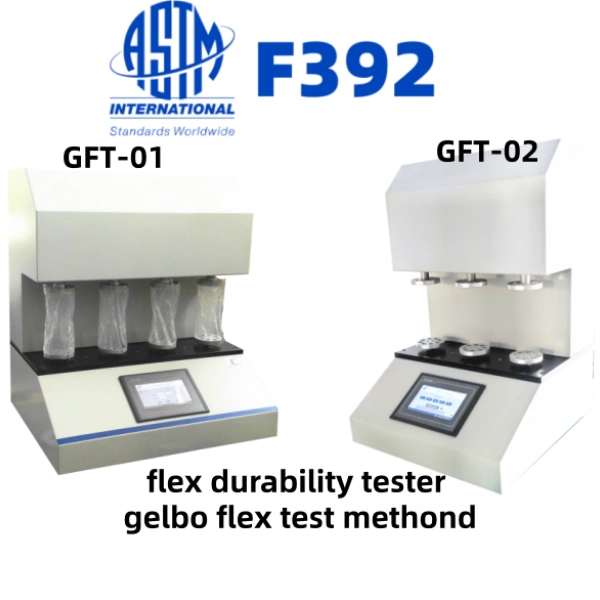
The GFT Flex Durability Tester provides a professional solution for laboratories performing ASTM F392 evaluations. The system combines automated operation, flexible testing modes, and multi-station capability to improve testing efficiency.
Automated ASTM F392 Testing Control
The instrument integrates PLC control and touchscreen operation, allowing operators to easily configure testing parameters and monitor the test process.
다음과 같은 혜택이 있습니다:
- Reduced operator influence
- 반복성 향상
- Faster test setup
- Simplified laboratory workflow
For laboratories handling multiple material evaluations, automation helps maintain consistent testing conditions.
Multi-Station Testing Capability for Higher Productivity
Material development often requires comparison between multiple samples, formulations, or suppliers.
The GFT system supports multi-station testing:
| 모델 | 테스트 스테이션 | Application Advantage |
|---|---|---|
| GFT-01 플렉스 내구성 테스터 | 4 stations | Suitable for comparative testing and higher laboratory throughput |
| GFT-02 플렉스 내구성 테스터 | 3 stations | Suitable for flexible packaging evaluation and routine testing |
Multiple stations allow laboratories to test different materials under identical conditions, improving comparison accuracy.
Programmable Flex Test Modes for Different Evaluation Needs
Different applications require different levels of mechanical stress. The GFT Flex Durability Tester provides multiple programmable test modes:
| Mode | Cycle Condition | Typical Purpose |
|---|---|---|
| A | 2700 cycles | Extended durability evaluation |
| B | 900 cycles | Standard material comparison |
| C | 270 cycles | Development screening |
| D | 20 cycles full flex | Quick damage observation |
| E | 20 cycles partial flex | Specific deformation analysis |
These options allow engineers to select suitable testing conditions based on material type and evaluation goals.
Applications of ASTM F392 Testing Across Industries
The ASTM F392 method is especially important for industries where packaging reliability directly affects product safety and shelf life.
식품 포장
Flexible food packaging requires strong barrier performance to maintain freshness and prevent contamination. ASTM F392 testing helps evaluate:
- Retort pouches
- Vacuum packaging films
- High-barrier laminates
- Snack and beverage packaging
Medical and Pharmaceutical Packaging
Medical packaging must maintain protection throughout transportation and sterilization processes.
Flex durability testing supports evaluation of:
- Sterile barrier pouches
- 의료 기기 패키징
- Pharmaceutical laminate structures
Industrial Flexible Materials
Industrial films may experience repeated mechanical stress during installation, storage, or operation.
Applications include:
- Protective films
- Agricultural films
- Barrier membranes
- Specialty composite materials
Materials Suitable for ASTM F392 Flex Testing
The ASTM F392 flex durability evaluation can be applied to various flexible barrier structures, including:
| Material Type | Typical Evaluation Purpose |
|---|---|
| PE films | Flex resistance and mechanical durability |
| PP films | Packaging structure evaluation |
| PET films | Barrier layer protection |
| EVOH laminates | High-barrier performance verification |
| Metallized films | Coating durability assessment |
| Multilayer composites | Overall package material reliability |
Testing these materials helps manufacturers understand how different structures respond to repeated mechanical stress.
ASTM F392 and Related Packaging Testing Standards
ASTM F392 focuses specifically on flex durability evaluation of flexible barrier materials. However, packaging laboratories often combine flex testing with other evaluations to achieve complete material characterization.
Related tests may include:
- Oxygen transmission testing for barrier performance
- Water vapor transmission testing for moisture protection
- Seal strength testing for package integrity
- Tensile testing for mechanical properties
- Leak testing for finished package validation
Combining multiple testing methods provides a more complete understanding of packaging performance.
Technical Features of GFT Flex Durability Tester
The GFT system is designed for professional laboratory applications with features including:
- ASTM F392 compliant testing capability
- PLC 제어 방식
- Touchscreen user interface
- Three or four testing stations depending on model
- Programmable flex test modes
- Controlled twisting and compression movement
- Suitable for films, laminates, coatings, and composite materials
Technical specifications:
| 매개변수 | GFT-02 | GFT-01 |
|---|---|---|
| 플렉스 각도 | 440°(90mm) 또는 400°(80mm) | 440°(90mm) 또는 400°(80mm) |
| 용량 | 3.5 N·m | 2.5 N·m |
| 수평 스트로크 | 155mm 또는 80mm | 155mm 또는 80mm |
| 스테이션 | 3 | 4 |
| 샘플 크기 | 280 mm × 200 mm | 280 mm × 200 mm |
| 전원 공급 장치 | 110–220 V | 110–220 V |
Improve Flexible Packaging Validation with ASTM F392 Testing
Reliable packaging performance requires more than evaluating initial material strength. Repeated mechanical stress can reveal hidden weaknesses that affect barrier protection and product safety.
An ASTM F392 flex durability tester enables manufacturers, laboratories, and research organizations to measure material resistance against repeated flexing and make better decisions during material selection, packaging development, and quality control.
Cell Instruments provides professional testing solutions, including standard instruments, customized fixtures, and application-specific systems to support flexible packaging evaluation requirements worldwide.
그리고 ASTM F392 Flex Durability Tester provides an effective solution for evaluating the long-term mechanical reliability of flexible barrier materials under repeated flexing conditions. By simulating real-world handling stresses through controlled twisting and compression movements, the tester helps manufacturers identify potential weaknesses such as flex cracks, pinholes, and barrier performance deterioration before they impact package integrity.
With automated control, programmable test modes, and multi-station testing capability, the GFT Flex Durability Tester supports efficient and repeatable 젤보 플렉스 테스트 operations for food packaging, medical packaging, pharmaceutical materials, and industrial flexible films. By integrating ASTM F392 testing into quality control and material development processes, companies can improve packaging durability, optimize material selection, and ensure more reliable product protection throughout the supply chain.