
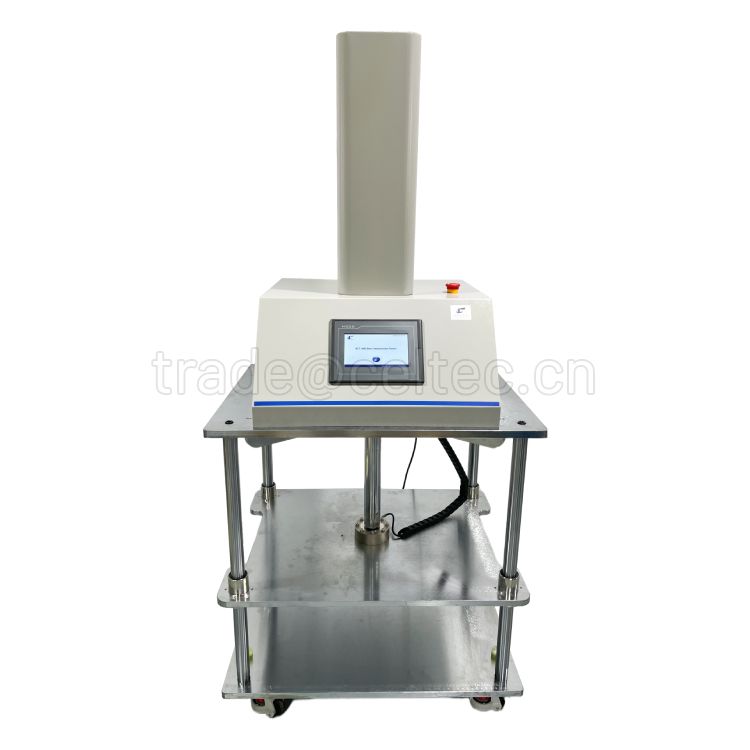
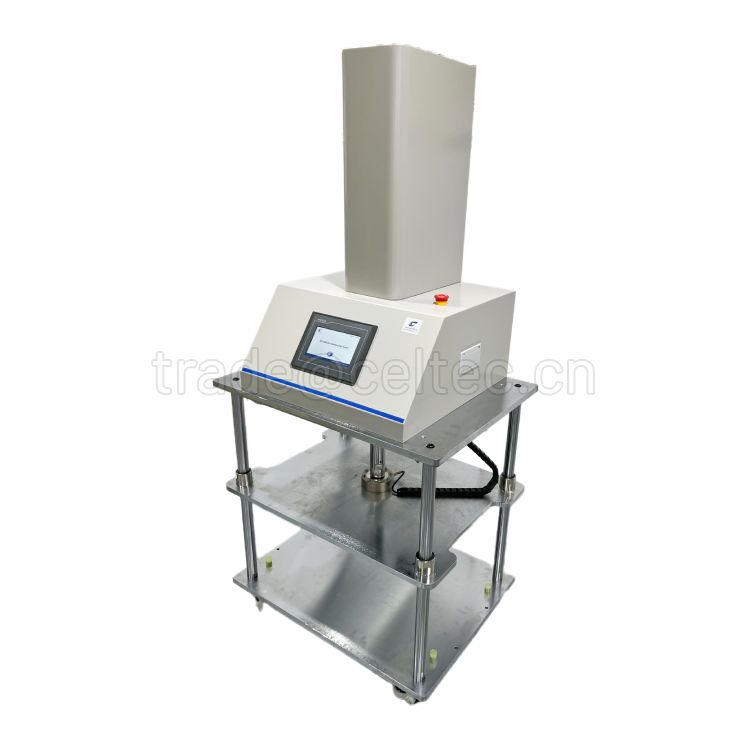
BCT-600 Box Compression Tester

The BCT-600 Box Compression Tester simulates real-world compressive forces, enabling manufacturers to validate packaging performance under stacking loads, transit stresses, and storage conditions. By quantifying compressive strength and deformation, this instrument safeguards against product damage and ensures compliance with global standards.

The Critical Role of Packaging Resilience

In logistics, warehousing, and e-commerce, packaging durability directly impacts product safety and cost efficiency. The BCT-600 Box Compression Tester simulates real-world compressive forces, enabling manufacturers to validate packaging performance under stacking loads, transit stresses, and storage conditions. By quantifying compressive strength and deformation, this instrument safeguards against product damage and ensures compliance with global standards.

Applications

A box compression tester evaluates the ability of packaging—metal, wood, cardboard, plastics—to resist compressive loads or stacking pressures.

Typical uses include:
Corrugated boxes & fiberboard (e-commerce, food packaging).
Plastic containers & drums (chemical, pharmaceutical).
Wooden crates & composite materials (heavy machinery, automotive).
Filled & Empty Containers: Test with or without product contents to simulate real‑world loads.
R&D & quality control (optimizing material thickness, design validation).
Trusted by packaging manufacturers, third-party labs, and logistics providers.

Test Modes:
1. Strength Test: Measures ultimate compressive force (N) and deformation (mm) until failure.

2. Fixed-Value Test: Validates packaging stability under preset pressure/deformation thresholds.

- Fixed‑Deformation for stiffness and behavior at key deformation stages.
- Fixed‑Load for long‑term deformation profiles.

3. Stacking Simulation Test: Replicates warehouse stacking conditions to predict real-world performance.

Features & Benefit

1. 7″ Touchscreen HMI Guided workflows, test‑program selection, live curves
2. Three Independent Test Modes Strength, Fixed‑Value, and Stacking—covering all compression scenarios
3. Servo Cylinder: Accurate, jerk‑free platen motion at variable speeds
4. Embedded Micro‑Printer Instant hard‑copy of results
5. Auto Data Capture & Analysis Real‑time display of force, deformation, and curve.
6. Safety Interlocks & Limits Protects sensors and operators with emergency stop and mechanical end‑stops
7. Triple‑Mode Testing: Strength, Fixed‑Value, and Stacking tests in one unit.
8. High‑Rigidity Frame: Four‑column guidance with low‑friction linear bearings for consistent platen alignment.
9. Precision Load Measurement: load‑cell sensor above the upper platen detect breakpoints accurately.
10.Optional PC‑software export reports instantly.

規格

ISO 2234, ISO 12048, ISO 2874, ISO 2872, ASTM D642, ASTM D4169, TAPPI T804, JIS Z0212,GB/T 4857.3, GB/T 4857.4, QB/T 1047

Specifications

Test Space (mm, LWH) 600*600*600 (customizable)
Test Range 0.25KN, 0.5KN, 1KN, 2KN, 5KN, 10KN, etc
Resolution 0.01N
Deformation error ≤1mm
Plate parallelism ≤1mm
Loadcell Error ±1%
Return Speed 100mm/min
CompressionSpeed 10±3mm/min
Stacking Speed 5±1mm/min
Units N/Lbf /kgf
Power AC 110~ 220V 50/60 Hz

Box Compression Test Type

Testing box compression through crush tests, stacking tests, fixed‑deformation tests, and fixed‑load (creep) tests is vital to ensure packaging integrity, protect contents, and optimize logistics. Below is a concise overview of ach test type, why it matters, and how they complement one another in a comprehensive packaging validation protocol.

1. Crush Test (Top‑Load/Compressive Strength)

A crush test—also called top‑load or compressive strength test—applies a steadily increasing force to a box until it fails or deforms significantly.

Purpose: Determines the maximum force (peak load) the box can withstand before collapse, reflecting its resistance during lifting or equipment loading.

Key Metric: Peak load (N) and deformation at peak.

Why It Matters:

Ensures boxes won’t buckle under forklifts, conveyors, or overhead lifting.
Provides baseline data for packaging design and material selection.

2. Stacking Test (Constant Load Over Time)

The stacking test maintains a specified compressive load on the box for a set duration to simulate warehouse stacking conditions.

Purpose: Measures box performance under prolonged pressure, assessing creep and gradual deformation.

Key Metric: Time to failure or deformation at set time.

Why It Matters:

Reflects real‑world storage scenarios where boxes support each other over days or weeks.
Identifies long‑term strength loss due to material creep.

3. Fixed‑Deformation Test

In a fixed‑deformation test, the box is compressed to a predetermined deformation (displacement) under controlled speed, and the force necessary to maintain that deformation is recorded.

Purpose: Evaluates box stiffness and residual load‑bearing capacity at specific deformation levels.

Key Metric: Compression force (N) required to achieve or sustain set deformation.

Why It Matters:

Enables assessment of how much load reduction is needed to prevent damage at critical deformation points.
Guides design thresholds for cushioning and reinforcement.

4. Fixed‑Load (Creep) Test

A fixed‑load or creep test applies a constant load (force) and records how the box deforms over time under that static weight.

Purpose: Quantifies deformation progression (creep) under realistic loading conditions.

Key Metric: Deformation vs. time curve and time to reach critical deformation.

Why It Matters:

Highlights long‑term durability under constant stacking pressures.
Ensures packaging maintains dimensions to protect contents in transit and storage.

Tag

ja日本語