
ISO 8295 is an international standard that specifies the method for determining the coefficients of friction of plastic film and sheeting. It evaluates both static friction et dynamic friction when plastic surfaces slide against themselves or other materials. For manufacturers of flexible packaging, films, and plastic products, ISO 8295 provides a reliable approach to understanding surface slip characteristics and maintaining consistent product quality.
In modern packaging production, controlling friction behavior is essential. The plastic coefficient of friction testing process helps engineers determine whether a film surface is suitable for high-speed packaging equipment, transportation, stacking, and storage applications. Incorrect friction properties can lead to film feeding problems, product instability, machine downtime, or inconsistent packaging performance.
By using standardized friction testing methods based on ISO 8295, laboratories can quantify material performance, compare different film formulations, and optimize production processes. A professional coefficient of friction meter provides accurate measurement of the force required to initiate and maintain sliding between two contacting surfaces.
What Is the Coefficient of Friction of Plastic Film?
The coefficient of friction (COF) describes the resistance generated when two surfaces in contact move relative to each other. It is calculated as the ratio between frictional force and normal force:
μ = F / N
Où ?
- μ = coefficient of friction
- F = frictional force required for sliding
- N = normal force applied by the sled weight
The coefficient is a unitless value. A lower COF indicates easier sliding behavior, while a higher COF represents greater resistance.
For plastic films, ISO 8295 identifies two important friction characteristics:
| Mesures | Definition | Industrial Importance |
|---|---|---|
| Static coefficient of friction (μs) | Force required to start sliding | Determines initial movement resistance |
| Dynamic coefficient of friction (μd) | Force required to maintain sliding | Determines continuous sliding performance |
These two values provide different information about film behavior. A packaging film may have a low dynamic COF but a high static COF, which could create starting resistance during automated processing.
Why ISO 8295 Plastic Film Coefficient of Friction Testing Matters
Supporting Packaging Machine Performance
Plastic films are widely used in automated packaging systems, including:
- Form-fill-seal machines
- Vertical packaging machines
- Horizontal flow wrappers
- Film winding equipment
During processing, films must move smoothly over rollers and contact surfaces. If friction is too high:
- Film feeding may become unstable
- Equipment energy consumption may increase
- Surface damage or tearing may occur
- Production efficiency may decrease
If friction is too low:
- Packages may slide during transportation
- Stacked products may become unstable
- Film control during processing may become difficult
ISO 8295 testing allows manufacturers to establish appropriate friction specifications before materials enter production.
Principle of ISO 8295 Friction Testing
The ISO 8295 method places two surfaces in controlled contact under a uniform normal force. The force required to move one surface relative to another is measured and used to calculate the coefficient of friction.
The basic test principle includes:
- A plastic film specimen is placed on a horizontal test surface.
- A second specimen is attached to a weighted sled.
- The sled is placed on the lower specimen.
- The test system creates relative movement between the surfaces.
- The friction force is recorded.
- Static and dynamic coefficients are calculated.
The testing principle can be applied to:
- Film against film testing
- Film against metal testing
- Film against other material surfaces
The measured friction value depends on factors such as:
- Film composition
- Surface roughness
- Slip additives
- Surface treatment
- Aging conditions
- Contact material
ISO 8295 Test Procedure for Plastic Films
Sample Preparation Requirements
ISO 8295 requires careful specimen preparation because contamination or surface changes can affect results.
Typical requirements include:
- Film specimens approximately 80 mm × 200 mm
- Multiple specimen pairs from different locations
- Clean test surfaces free from dust and fingerprints
- Controlled conditioning before testing
Plastic films are commonly conditioned under standard laboratory conditions before measurement to improve repeatability.
This is especially important for films containing slip additives because these additives may migrate to the surface over time and change friction characteristics.
Testing Process
A typical ISO 8295 procedure includes:
1. Mounting the Specimens
The first film sample is fixed on the test table. The second sample is attached to the sled surface.
2. Applying Normal Force
A standard sled applies a controlled pressure to ensure uniform contact between surfaces.
Typical sled parameters include:
- Sled mass: approximately 200 g
- Contact area: approximately 63.5 mm × 63.5 mm
3. Starting Sliding Motion
The instrument moves the sled or test table at a controlled speed.
ISO 8295 commonly specifies:
- Vitesse d'essai : 100 mm/min ±10 mm/min
4. Recording Friction Force
The instrument captures:
- Maximum initial force for static friction
- Average sliding force for dynamic friction
5. Calculating COF
The coefficient of friction is calculated from the measured friction force divided by the applied normal force.
Factors Affecting Plastic Film Coefficient of Friction Testing Results
Précision plastic coefficient of friction testing requires controlling several variables.
Film Surface Properties
Different polymers naturally have different friction characteristics.
Examples:
- PE films often require controlled slip performance.
- BOPP films commonly use additives to optimize machine running.
- PET films may have different friction behavior due to surface treatment.
Slip Additives
Many plastic films contain additives that migrate to the surface and reduce friction.
However:
- Additive compatibility varies.
- Surface concentration changes with storage time.
- Aging can influence COF results.
Therefore, test results should consider film production date and storage conditions.
Conditions environnementales
Temperature and humidity can influence:
- Polymer flexibility
- Surface energy
- Additive migration
- Static electricity effects
Laboratories should maintain consistent testing environments.
Applications of ISO 8295 Testing Across Industries
Flexible Packaging Industry
ISO 8295 is widely used for:
- Snack packaging films
- Food pouches
- Beverage packaging films
- Pharmaceutical sachets
Manufacturers use COF data to optimize packaging machine compatibility.
Emballage médical
Medical device packaging requires consistent material movement during:
- Sterile pouch production
- Packaging automation
- Inspection processes
Stable friction properties improve manufacturing reliability.
Plastic Film Manufacturing
Film producers use friction testing for:
- Raw material development
- Quality inspection
- Production batch comparison
- Customer specification verification
Research Laboratories
Universities and testing organizations use COF measurement to study:
- Polymer surface behavior
- Coating performance
- Composite material interaction
ISO 8295 Compared with Other Friction Testing Standards
| Standard | Main Application | Typical Materials |
|---|---|---|
| ISO 8295 | Plastic film and sheeting COF | PE, PP, PET, BOPP films |
| ASTM D1894 | Static and kinetic COF testing | Plastic films and sheets |
| TAPPI T816 | Static friction measurement | Corrugated and solid fiberboard |
| GB 10006 | Plastic packaging friction testing | Plastic films |
Although these standards share similar concepts, differences exist in:
- Vitesse d'essai
- Specimen preparation
- Equipment requirements
- Calculation methods
Laboratories should select the correct standard according to customer requirements and industry specifications.
Selecting a Coefficient of Friction Meter for ISO 8295 Testing
Une fiabilité coefficient of friction meter should provide:
- Accurate force measurement
- Stable movement control
- Repeatable results
- Standard-compliant testing parameters
- Easy data recording
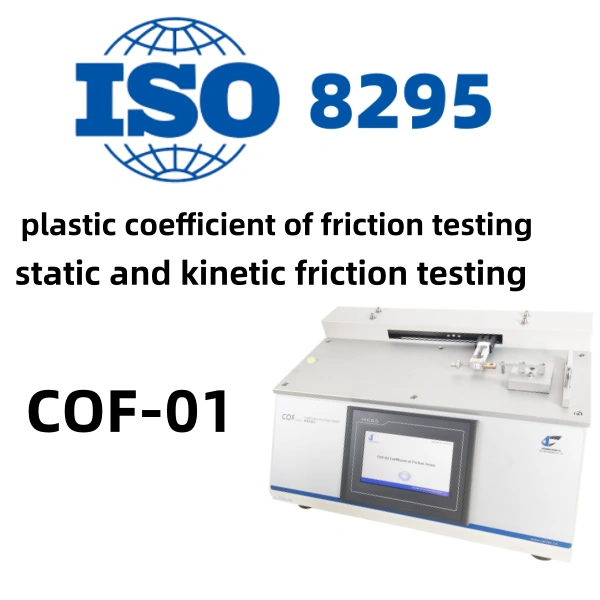
The Cell Instruments COF-01 Coefficient of Friction Tester is designed for ISO 8295 and related friction measurement applications.
The system supports:
- Static COF testing
- Dynamic COF testing
- Plastic film testing
- Paper and board friction testing
- Textile and composite material evaluation
Key technical advantages include:
| Fonctionnalité | Benefit |
|---|---|
| PLC-controlled operation | Stable and repeatable testing |
| Touchscreen interface | Easy parameter setup |
| Precision motion system | Smooth sled movement |
| Automatic data recording | Efficient quality control |
| Custom fixtures | Adaptation for special materials |
Main specifications:
| Paramètres | Spécifications |
|---|---|
| Load cell | 5 N or customized |
| Précision | 0,5% F.S. |
| Standard sled | 200 ± 1 g |
| Sled size | 63.5 mm × 63.5 mm |
| ISO test speed | 100 mm/min |
| Alimentation électrique | 110–220 V, 50/60 Hz |
Optional customized solutions include:
- Special sled designs
- Additional peel testing functions
- Peel cling force measurement
- PC software integration
- Localized user interface
Quality Control Benefits of ISO 8295 Testing
Implementing ISO 8295 testing helps manufacturers:
Improve material consistency
COF measurement identifies variations between production batches.
Reduce packaging failures
Controlled friction prevents feeding issues and transportation instability.
Optimize film formulations
Engineers can evaluate the effect of additives and surface treatments.
Support customer requirements
Standardized test data provides reliable quality documentation.
Improve production efficiency
Better friction control reduces machine adjustment and downtime.
Conclusion
ISO 8295 provides a practical and internationally recognized method for measuring the coefficient of friction of plastic films and sheets. Through controlled friction testing, manufacturers can understand material behavior, improve packaging performance, and maintain reliable production quality.
Précision plastic coefficient of friction testing requires suitable equipment, controlled test conditions, and correct interpretation of results. A professional coefficient of friction meter such as the COF-01 helps laboratories perform repeatable static and dynamic friction measurements according to ISO 8295 and related international standards.