
What Is ISO 1974?
ISO 1974 is an international standard that specifies the determination of paper tear resistance using the Elmendorf tear resistance test. The method measures the energy required to propagate an existing tear over a specified distance using a pendulum-type instrument.
Unlike tensile testing, which measures the force required to break an intact specimen, tear testing evaluates how easily an existing cut continues to propagate. This makes the standard especially valuable because many failures in real applications begin with small nicks, cuts, or defects.
The standard is widely adopted by:
- Paper manufacturers
- Packaging converters
- Printing companies
- Quality inspection laboratories
- Research institutes
- Packaging material suppliers
Why Is Paper Tear Resistance Important?
Paper products encounter repeated mechanical stresses throughout their lifecycle. Poor tear resistance can result in damaged packages, torn labels, production waste, and customer complaints.
Testing according to ISO 1974 hjälper tillverkare att:
- Improve product durability
- Optimize pulp fiber selection
- Compare different paper grades
- Evaluate coating and surface treatments
- Verify production consistency
- Reduce material waste
- Meet customer specifications
- Support quality certification programs
Typical applications include:
| Tillämpning | Importance of Tear Resistance |
|---|---|
| Packaging paper | Prevents package failure during transport |
| Shopping bags | Improves carrying durability |
| Printing paper | Resists damage during printing and handling |
| Labels | Prevents tearing during dispensing |
| Filter paper | Maintains structural integrity |
| Medical packaging | Ensures package protection |
| Specialty paper | Verifies mechanical performance |
Understanding the Elmendorf Method
Den Elmendorf method is named after Armin Elmendorf, who introduced the pendulum tear testing principle that remains an industry standard today.
The method measures the energy absorbed while a pendulum tears a specimen that already contains a standardized slit.
Instead of measuring maximum force, the instrument calculates tear resistance from the loss of potential energy of the swinging pendulum.
This approach provides:
- Utmärkt repeterbarhet
- Rapid testing
- Simple operation
- High laboratory efficiency
- Tillförlitlig jämförelse mellan olika material
Principle of the Elmendorf Tear Resistance Test
Under Elmendorf tear resistance test, a rectangular paper specimen is prepared with a standardized initial cut.
The specimen is clamped vertically between two jaws.
When released, the pendulum swings through the specimen, propagating the tear over a fixed distance.
The energy consumed during tearing is calculated from the reduction in pendulum height.
The measured energy is then converted into tear resistance, typically expressed in millinewtons (mN).
Because the test evaluates tear propagation rather than tear initiation, it closely represents actual material performance during handling and use.
ISO 1974 Test Procedure
Although laboratories should always consult the official standard for complete requirements, a typical paper tear test includes the following steps.
Förberedelse av prov
Representative specimens are cut from the paper.
Each specimen receives a standardized slit that terminates at the specified position.
Proper conditioning before testing is essential to minimize the effects of moisture and environmental variation.
Instrument Setup
Den Elmendorf-rivhållfasthetsprovare is equipped with an appropriate pendulum capacity based on expected tear strength.
The instrument is calibrated before testing.
Specimen Clamping
The specimen is securely clamped using fixed jaws that maintain alignment throughout the test.
Uniform clamping minimizes operator variability.
Pendulum Release
The pendulum is released automatically or manually depending on instrument design.
Gravity causes the pendulum to continue the tear through the remaining specimen.
Mätning
The instrument records energy loss and converts it into tear resistance.
Multiple specimens are tested, and average values are calculated for reporting.
Factors Affecting Tear Test Results
Several variables influence tear resistance.
These include:
- Fiber length
- Fiber orientation
- Paper basis weight
- Moisture content
- Surface coatings
- Internal bonding strength
- Paper formation
- Sample conditioning
- Cutting accuracy
- Instrument calibration
Careful laboratory control ensures consistent and reproducible data.
Applicable Materials
Although ISO 1974 primarily applies to paper, the test method is suitable for many paper-based products, including:
- Printing paper
- Writing paper
- Packaging paper
- Kraft paper
- Tissue base paper
- Papperskarta
- Coated paper
- Uncoated paper
- Corrugated linerboard
- Specialty paper
- Filter paper
- Label stock
Industries That Benefit from ISO 1974 Testing
The standard is widely used across numerous industries.
Examples include:
- Paper manufacturing
- Flexible packaging
- Food packaging
- Pharmaceutical packaging
- Medical packaging
- Consumer goods packaging
- Printing
- Publishing
- Label manufacturing
- Textile paper production
- Laboratory testing services
Choosing an Elmendorf Tear Tester
Selecting an appropriate Elmendorf-rivhållfasthetsprovare depends on testing volume, specimen types, reporting requirements, and compliance needs.
Important considerations include:
| Funktion | Benefit |
|---|---|
| Multiple pendulum capacities | Accommodates various paper grades |
| Automatic pendulum release | Improves repeatability |
| Pneumatic specimen clamping | Reduces operator influence |
| Touchscreen interface | Simplifies operation |
| Automatic statistics | Accelerates reporting |
| Verifiering av kalibrering | Maintains measurement accuracy |
| Data export | Supports laboratory traceability |
| Professional software | Enables advanced analysis |
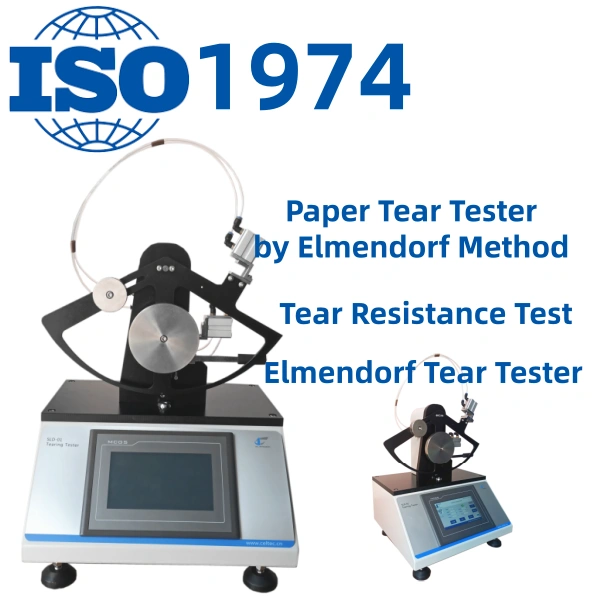
Cell Instruments SLD-01 Elmendorf Tear Tester for ISO 1974
For laboratories performing ISO 1974 testing, the SLD-01 Elmendorf Tårtestare from Cell Instruments provides a professional solution for measuring tear resistance using the pendulum principle.
Key features include:
- PLC-controlled operation with intuitive touchscreen interface
- Pneumatic specimen clamping for consistent positioning
- Automatic pendulum release to improve repeatability
- Multiple pendulum capacities:
- 200 gf
- 400 gf
- 800 gf
- 1600 gf
- 3200 gf
- 6400 gf
- Calibration weight for routine verification
- Automatic statistical calculation
- Optional RS-232 communication
- Mikroskrivare (tillval)
- Optional professional data management software
- Paper-specific reporting units including mN and tear index
The instrument supports efficient quality control laboratories requiring accurate and repeatable tear resistance measurements for paper, paperboard, flexible films, nonwoven materials, textiles, and composite materials.
Advantages of Using ISO 1974 in Quality Control
Routine implementation of ISO 1974 provides significant operational benefits.
These include:
- Early detection of production variations
- Improved supplier qualification
- Better product consistency
- Reduced customer complaints
- Lower material waste
- Support for product development
- Reliable comparison between formulations
- Compliance with international customer requirements
Because tear resistance is directly related to product durability, routine testing becomes an important part of modern quality management systems.
ISO 1974 Compared with Other Tear Testing Standards
| Standard | Material | Testmetod |
|---|---|---|
| ISO 1974 | Papper | Elmendorf pendulum tear method |
| ASTM D689 | Papper | Internal tearing resistance |
| ASTM D1922 | Plastic films | Elmendorf tear method |
| ISO 6383-1 | Plastic films | Elmendorf pendulum method |
| ASTM D1424 | Textiles | Elmendorf tear method |
Although these standards all employ the pendulum principle, specimen preparation, reporting units, and applicable materials differ according to product type.
Slutsats
ISO 1974 remains one of the most important international standards for evaluating paper tear resistance. Using the proven Elmendorf method, manufacturers and laboratories obtain reliable measurements of tear propagation that closely reflect real-world product performance.
Whether developing new paper grades, validating production consistency, or meeting customer quality specifications, the Elmendorf tear resistance test delivers valuable data for informed decision-making. Combined with a modern Elmendorf tear tester such as the Cell Instruments SLD-01, laboratories can achieve accurate, repeatable, and efficient testing that supports continuous quality improvement across the paper industry.