
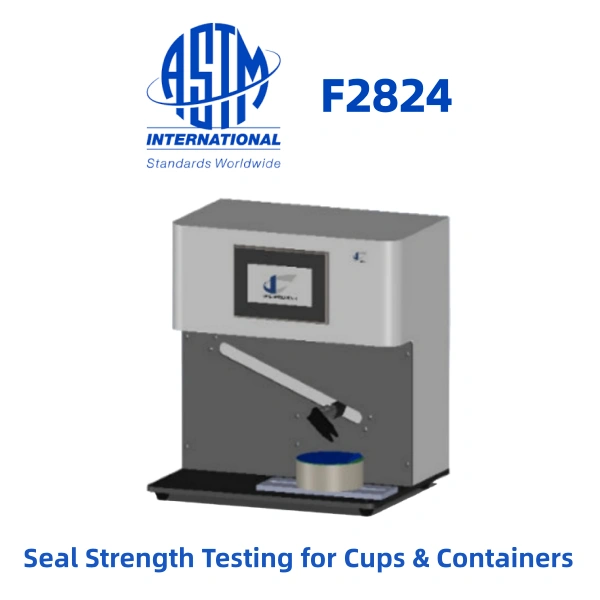
Förstå ASTM F2824 och dess roll för förpackningsintegritet
ASTM F2824 definierar en standardiserad metod för att utvärdera mekanisk tätningshållfasthet för runda behållare förseglade med flexibla, avskalningsbara lock. Till skillnad från partiella förseglingstester fokuserar denna metod på ta bort hela locket, vilket ger en holistisk bedömning av tätningens integritet.
Tillverkare inom livsmedels-, läkemedels- och förpackningsindustrin förlitar sig på ASTM F2824 för att säkerställa att förseglade behållare bibehåller produktsäkerheten under transport och lagring samtidigt som de tillåter kontrollerad öppning av slutanvändare.
Denna metod spelar en avgörande roll i kvalitetssäkringen eftersom den mäter både
- Maximal tätningsstyrka - den maximala kraften under skalning
- Genomsnittlig tätningsstyrka - tätningens konsistens över hela omkretsen
Dessa parametrar ger en komplett prestandaprofil, snarare än en lokal ögonblicksbild.
Test av behållares tätningsstyrka
Testning av behållares tätningsstyrka enligt ASTM F2824 innebär kontrollerad mekanisk peeling av ett lock från en styv eller halvstyv behållare.
Viktiga testprinciper
- Behållaren är säkert fastsatt i en testfixtur
- Lockfliken är fastspänd i ett kraftmätningssystem
- Locket är avskalat på en konstant hastighet på 300 mm/min
- Den önskad vinkel på skalet är 45°., säkerställa standardiserade resultat
- Kraftdata registreras kontinuerligt under hela testet
Detta tillvägagångssätt säkerställer att tätningsprestanda över hela tätningsområdet utvärderas, vilket gör den mycket relevant för verkliga förpackningsförhållanden.
Varför testning med fullt lock är viktigt
Traditionella metoder som partiell tätningsprovning utvärderar endast ett segment. I motsats till detta är ASTM F2824:
- Upptäcker svaga zoner över hela tätningen
- Reflekterar konsumenternas faktiska öppningsbeteende
- Ger mer tillförlitliga data för processoptimering
Förseglingsstyrka hos flexibla peel-lock
Förseglingsstyrkan hos flexibla lock med skal påverkar direkt både produktskydd och användarupplevelse.
Kritiska faktorer som påverkar tätningens hållfasthet
- Materialkompatibilitet (lockfilm vs behållarsubstrat)
- Parametrar för värmeförsegling (temperatur, tryck, uppehållstid)
- Tätningens geometri och yta
- Skalets vinkel och riktning
ASTM F2824 standardiserar dessa variabler, vilket säkerställer repeterbarhet och jämförbarhet mellan olika tester.
Viktiga mätutgångar
- Toppkraft (maximal tätningsstyrka)
- Genomsnittlig kraft över skalbanan
- Utfört arbete (energi som krävs för att öppna)
Införandet av arbete (ytan under kraft-förskjutningskurvan) ger djupare insikt i konsumentens öppningsinsats, vilket är särskilt värdefullt vid ergonomisk förpackningsdesign.
Test av skalstyrka för koppar
En tillförlitlig skalhållfasthetstestare för koppar är avgörande för att utföra ASTM F2824 exakt. Utrustningen måste säkerställa:
- Exakt kontroll av skalets hastighet och vinkel
- Stabil fastspänning av behållare
- Kraftmätning med hög upplösning
- Kurvanalys i realtid
Rekommenderad lösning: CCPT-01
Den Cell Instruments CCPT-01 Avskalningsprovare för koppar och behållare är speciellt utformad för denna applikation.
Varför det överensstämmer med kraven i ASTM F2824:
- Stöd för konsekventa avskalningshastigheter och justerbara hastigheter
- Tillhandahåller kraftkurvor i realtid och statistiska utdata
- Säkerställer stabil fixturdesign för runda behållare
- Aktiverar anpassade armaturer, inklusive vakuumklämning för koppar
Detta system gör det möjligt för kvalitetskontrollteam att replikera ASTM F2824-förhållanden exakt, vilket förbättrar testtillförlitligheten och den operativa effektiviteten.
Översikt över testprocedurer
Ett typiskt ASTM F2824-arbetsflöde inkluderar:
- Verifiering av kalibrering av kraftmätningssystemet
- Identifiering av avskalningslinje och startpunkt för avskalning
- Säker montering av behållaren i fixturen
- Fastspänning av lockfliken i det övre greppet
- Utförande av testet vid 300 mm/min och 45° vinkel
- Registrering och analys av kraftdata
Konsekvens i installationen är viktigt för att säkerställa Datavaliditet och repeterbarhet.
Få en professionell lösning
Se till att dina förpackningar uppfyller kraven i ASTM F2824 med exakt testning av förseglingens styrka på hela locket. Genom att kontrollera skalvinkel, hastighet och kraftmätning ger den här metoden tillförlitliga insikter om förseglingens integritet och öppningsprestanda. Implementera avancerade testlösningar som CCPT-01 för att förbättra kvalitetskontrollen, minska antalet förpackningsfel och öka kundnöjdheten. Kontakta oss idag för att optimera din process för testning av behållarförseglingar.
Vanliga frågor
1. Vad är den största skillnaden mellan ASTM F2824 och F88?
ASTM F2824 utvärderar hela tätningen, medan F88 fokuserar på en del av tätningen, vilket gör F2824 mer representativ för verklig användning.
2. Varför rekommenderas en 45° skalvinkel?
En 45° vinkel säkerställer konsekvent kraftfördelning och förbättrar jämförbarheten mellan testresultaten.
3. Kan ASTM F2824 användas för icke-runda behållare?
Även om de är utformade för runda behållare kan liknande metoder anpassas för andra former om de valideras på rätt sätt.
4. Vilka branscher gynnas mest av ASTM F2824?
Livsmedels-, läkemedels- och förpackningsindustrin gynnas mest på grund av sitt beroende av förseglade behållares integritet.
5. Hur säkerställer jag korrekta testresultat?
Använda kalibrerad utrustning, upprätthålla konsekventa testparametrar och följa standardiserade förfaranden strikt.