
Perpendicularity Tester Overview
In bottle manufacturing and packaging quality control, maintaining precise container alignment is essential for appearance, filling performance, sealing reliability, and automated production efficiency. The ISO 9008 Perpendicularity Tester provides a reliable solution for evaluating bottle vertical deviation and ensuring that containers maintain proper geometric alignment during production and inspection. This precision testing instrument is widely used as a tester de perpendicularitate a sticlei for glass bottles, plastic containers, pharmaceutical vials, and other cylindrical packaging products where vertical accuracy directly affects product quality.
Bottle deformation, uneven forming, neck offset, or poor dimensional consistency can cause problems such as unstable standing, inaccurate labeling, sealing difficulties, and failures during automated packaging operations. By applying a controlled rotation measurement principle, the ISO 9008 Perpendicularity Tester helps manufacturers identify deviations between the bottle axis and the reference vertical line, providing objective data for process improvement and quality verification.
For industries producing beverages, cosmetics, pharmaceuticals, and daily chemical packaging, accurate perpendicularity measurement is an important part of incoming inspection, production monitoring, and final quality evaluation.
What Is an ISO 9008 Perpendicularity Tester?
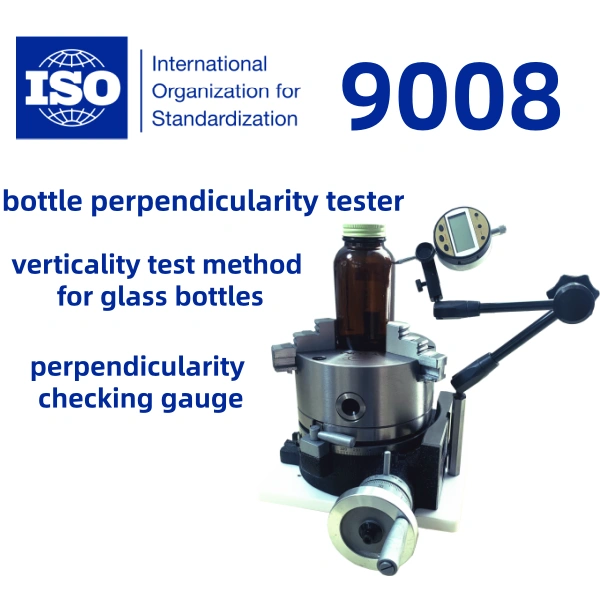
O ISO 9008 Perpendicularity Tester is a precision instrument designed to measure the vertical axis deviation or perpendicularity error of bottle containers. It evaluates whether a bottle remains properly aligned when positioned upright by measuring the displacement of the bottle mouth or reference point during a complete rotation.
The instrument is also commonly known by several industry names, including:
- Bottle deviation tester
- Bottle verticality tester
- Coaxiality tester
- Coaxial tester
- Circle runout tester for vials and cylindrical containers
- Perpendicularity checking gauge
Although different industries may use different names, these instruments share the same basic purpose: determining the relationship between the bottle center axis and the vertical reference axis.
A bottle with excessive perpendicularity deviation may lean visibly, create difficulties during high-speed filling lines, or cause inaccurate positioning during capping and labeling. Therefore, manufacturers use perpendicularity testing equipment to maintain consistent container dimensions and improve production reliability.
Why Bottle Perpendicularity Testing Is Important
Bottle perpendicularity is a critical dimensional characteristic for many packaging applications. Even small deviations can influence downstream processes, especially when containers operate in automated systems.
The main benefits of performing perpendicularity testing include:
1. Improving production consistency
Bottle forming processes such as injection molding, blow molding, and glass forming can introduce dimensional variations. Regular perpendicularity testing allows manufacturers to monitor process stability and identify abnormal production conditions.
2. Ensuring packaging line compatibility
Modern filling and packaging equipment requires containers with consistent geometry. Excessive vertical deviation may affect:
- Bottle positioning systems
- Filling nozzles
- Capping mechanisms
- Labeling accuracy
- Conveyor stability
3. Enhancing product appearance
Consumers often associate straight, uniform bottles with product quality. Perpendicularity inspection helps prevent visible defects caused by tilted or uneven containers.
4. Supporting quality documentation
Laboratories and quality departments require repeatable measurement data for supplier evaluation, process validation, and customer compliance. A calibrated ISO 9008 Perpendicularity Tester provides measurable results rather than relying on visual inspection.
Verticality Test Method for Glass Bottles and Other Containers
The verticality test method for glass bottles is based on measuring the change in position of a bottle reference point while the bottle rotates around its central axis.
The typical measurement principle includes the following steps:
- Sample installation
The bottle is placed securely on the rotating platform. Proper positioning ensures that the bottle base remains stable during measurement. - Probe positioning
A precision dial gauge or measuring probe contacts the bottle mouth or designated measurement point. - 360-degree rotation
The bottle is rotated one complete revolution while the probe continuously follows the surface movement. - Data recording
The maximum and minimum displacement values generated during rotation are recorded. - Deviation calculation
The vertical axis deviation is calculated according to the difference between the highest and lowest readings:
Vertical deviation = (Maximum reading – Minimum reading) / 2
This measurement method eliminates subjective judgment and provides a repeatable evaluation of bottle alignment.
Working Principle of the Bottle Perpendicularity Tester
The ISO 9008 Perpendicularity Tester uses a combination of rotational positioning and precision displacement measurement.
During testing, the bottle is mounted on a rotating plate. The bottle mouth contacts the measuring probe, and the operator rotates the sample through 360 degrees. Because any inclination or offset changes the probe position during rotation, the instrument detects the maximum radial movement of the bottle.
The instrument then calculates the deviation value based on the difference between the two extreme readings.
This method provides several advantages:
| Measurement Feature | Benefit |
|---|---|
| Full 360° sample rotation | Captures complete deviation behavior |
| Precision probe measurement | Provides accurate displacement readings |
| Stable rotating platform | Improves repeatability |
| Digital or dial indication | Simplifies result evaluation |
| Optional PC data export | Supports quality record management |
Main Applications of ISO 9008 Perpendicularity Testing Equipment
The ISO 9008 Perpendicularity Tester is suitable for many container inspection applications.
1. Beverage Bottle Inspection
Glass and PET beverage bottles require consistent vertical alignment to ensure stable filling, capping, and transportation. Perpendicularity measurement helps beverage manufacturers control bottle forming quality.
2. Pharmaceutical Packaging Quality Control
Pharmaceutical containers such as vials and bottles require strict dimensional control. Small geometric deviations can affect sealing systems, automated inspection, and drug packaging processes.
3. Cosmetic Container Testing
Luxury cosmetic packaging often requires high appearance standards. Perpendicularity testing helps ensure that bottles, jars, and containers maintain a professional appearance.
4. Food Packaging Inspection
Food containers must meet dimensional requirements for filling equipment compatibility and transportation stability. Vertical deviation testing supports reliable packaging production.
5. Bottle Manufacturing Process Verification
Bottle manufacturers use perpendicularity testing during:
- Raw material and supplier evaluation
- Mold adjustment verification
- Production line monitoring
- Finished product inspection
Technical Features of the ISO 9008 Perpendicularity Tester
The PER-01 Perpendicularity Tester is designed for accurate and efficient bottle alignment measurement.
1. Adjustable Measuring Probe
The measuring probe position can be finely adjusted according to different bottle designs, allowing flexible measurement of various container sizes.
2. High Measurement Resolution
The instrument provides measurement resolution options of 0.01 mm or 0.001 mm, allowing laboratories to detect very small dimensional variations.
3. Stable Sample Rotation System
A controlled rotating platform ensures smooth sample movement during the complete measurement cycle, improving repeatability and reducing operator influence.
4. Wide Sample Compatibility
The tester supports different bottle dimensions:
| Parametru | Specificații |
|---|---|
| Diametrul eșantionului | 5 mm–145 mm or customized |
| Intervalul de măsurare | 0–12.7 mm or customized |
| Valoarea diviziei | 0.01 mm / 0.001 mm optional |
| Înălțime măsurabilă | 15 mm–300 mm or customized |
5. Data Management Capability
Optional PC connection and Excel data export functions allow laboratories to store, analyze, and manage testing results efficiently.
How to Select the Right Perpendicularity Checking Gauge
When choosing a perpendicularity measurement instrument, manufacturers should consider several factors:
1. Container type
Different bottles, vials, and cylindrical containers may require different fixtures or probe configurations.
2. Precizia măsurării
High-precision applications, such as pharmaceutical packaging, may require instruments with micron-level resolution.
3. Sample size range
The equipment should accommodate the diameter and height range of the tested containers.
4. Data recording requirements
Quality laboratories may require digital recording, export functions, or integration with quality management systems.
5. Applicable standards
The selected instrument should support the required testing procedures and industry standards.
ISO 9008 Standard and Related Testing Requirements
The ISO 9008 standard provides guidance related to bottle verticality and perpendicularity evaluation. In addition to ISO 9008, different industries may reference additional national and industry standards depending on packaging type and application requirements.
Common related standards include:
| Standard | Application Area |
|---|---|
| ISO 9008 | Bottle perpendicularity measurement |
| GB 8452 | Glass bottle dimensional inspection |
| QB 2357 | Container quality requirements |
| QB/T 1868 | Packaging container testing |
| YBB 00192003 | Pharmaceutical packaging requirements |
Standards may define measurement methods, sample preparation requirements, or acceptance criteria. Manufacturers should select testing procedures according to their specific product requirements and regulatory environment.
Quality Control Benefits of Using a Perpendicularity Tester
Implementing an ISO 9008 Perpendicularity Tester in laboratory and production environments provides measurable advantages:
- Reduces packaging defects caused by bottle misalignment
- Improves production process monitoring
- Provides objective quality evaluation data
- Supports supplier qualification programs
- Enhances compatibility with automated packaging systems
- Helps maintain consistent product appearance
For companies producing millions of containers annually, even small improvements in dimensional control can significantly reduce waste, customer complaints, and production interruptions.
Conclusion: Reliable Bottle Alignment Testing for Packaging Quality
Accurate bottle verticality measurement plays an important role in modern packaging quality management. The ISO 9008 Perpendicularity Tester provides manufacturers, laboratories, and quality teams with a dependable method for evaluating container alignment through precise rotation measurement and deviation analysis.
Whether applied to glass bottles, PET containers, pharmaceutical vials, or cosmetic packaging, this testing solution helps ensure dimensional consistency, production efficiency, and compliance with industry requirements. By selecting a professional bottle perpendicularity tester, companies can strengthen quality control systems and improve confidence in their packaging performance.
Cell Instruments provides professional bottle perpendicularity testing solutions with precision measurement capability, customizable fixtures, and reliable performance for laboratory and industrial applications. Contact our technical team to learn more about suitable testing equipment and customized measurement solutions for your packaging requirements.