
Compreender a ASTM D6241 nos ensaios de geossintéticos
ASTM D6241 é uma norma amplamente reconhecida utilizada para avaliar a resistência à perfuração de geotêxteis e materiais relacionados com geossintéticos. O ensaio determina a força necessária para perfurar um provete utilizando um Sonda cilíndrica com 50 mm de diâmetro, fornecendo um valor de índice importante para avaliar a durabilidade mecânica destes materiais.
Em aplicações de engenharia civil, como revestimentos de aterros, construção de estradas e sistemas de drenagem, os geotêxteis têm de suportar tensões causadas por agregados, partículas de solo e cargas de instalação. O Método ASTM D6241, comummente designada por Ensaio de perfuração CBR, O sistema de controlo de segurança, que simula as forças concentradas que podem ocorrer durante a instalação ou o serviço.
Ao medir o força máxima necessária para romper o material, Os engenheiros e profissionais de controlo de qualidade podem avaliar se um produto geossintético oferece resistência adequada aos danos por perfuração.
Ensaio de resistência à perfuração estática de geossintéticos
O ensaio de resistência à perfuração estática de materiais geossintéticos fornece uma medição de índice que reflecte a resistência do material a cargas localizadas. O método aplica uma força vertical através de uma sonda de aço no centro de um espécime fixado até ocorrer a rutura.
Ao contrário do ensaio de tração, que avalia a resistência sob tensão uniforme, este ensaio cria tensão multidirecional em torno da ponta da sonda. Este padrão de tensão representa melhor as condições do mundo real em que pedras afiadas ou cargas mecânicas pressionam a superfície do geotêxtil.
As principais caraterísticas deste teste incluem:
- Diâmetro da sonda: Cilindro em aço polido de 50 ± 1 mm
- Raio da extremidade da sonda: 2,5 ± 0,5 mm
- Fixação de amostras: Anéis de aperto circulares que impedem o deslizamento
- Velocidades de teste: Comumente 30 mm/min, 50 mm/min ou 100 mm/min
- Resultado medido: Força máxima necessária para perfurar o provete
O carga máxima registada durante a penetração representa o resistência à perfuração estática do material.
Este valor fornece aos engenheiros um indicador fiável da resistência do material a deformação localizada e rutura.
Ensaio de resistência à perfuração para geotêxteis
O ensaio de resistência à perfuração para geotêxteis avalia a durabilidade mecânica dos tecidos utilizados nas camadas de filtração, de separação, de reforço e de proteção dos sistemas geotécnicos.
Nas aplicações práticas, os geotêxteis deparam-se frequentemente com agregados cortantes, cargas de construção e tensões concentradas. O método ASTM D6241 ajuda a determinar se o material pode suportar tais forças sem se rasgar ou romper.
Os materiais típicos avaliados incluem:
- Geotêxteis tecidos
- Geotêxteis não tecidos
- Compósitos geossintéticos
- Geocompósitos de drenagem
- Tecidos de reforço
Uma vez que muitos geossintéticos podem apresentar propriedades diferentes em cada lado devido aos processos de fabrico, Alguns materiais requerem ensaios em ambas as superfícies para obter dados completos de desempenho.
As equipas de garantia de qualidade dependem de Resultados dos ensaios ASTM D6241 ao selecionar geotêxteis para ambientes de construção exigentes.
Aparelho e equipamento de ensaio ASTM D6241
A norma especifica vários componentes essenciais necessários para efetuar o ensaio com precisão.
Máquina de ensaio
O teste utiliza um máquina de ensaio de velocidade constante de extensão ou de velocidade constante de deslocação capaz de aplicar uma deslocação controlada e registar a força.
O instrumento deve fornecer:
- Medição de carga estável
- Velocidade controlada da cruzeta
- Registo contínuo da força
Os modernos aparelhos de ensaio de tração também oferecem ecrãs de curvas digitais e registo automático de resultados.
Sonda de punção
A sonda desempenha um papel fundamental na consistência do teste. De acordo com ASTM D6241, A sonda deve cumprir requisitos dimensionais rigorosos:
- Diâmetro: 50 ± 1 mm
- Construção cilíndrica em aço
- Superfície polida
- Aresta radial arredondada
Estas especificações garantem distribuição de tensões repetível durante a punção.
Dispositivo de fixação
O provete é fixado entre placas de fixação circulares concêntricas.
As caraterísticas importantes da pinça incluem:
- Diâmetro interno aproximado 150 mm
- Superfícies antiderrapantes (serrilhas, serrilhados ou lixas)
- Sistema de aperto seguro dos parafusos
A fixação adequada evita o movimento do espécime que, de outra forma, poderia afetar a força de punção medida.
Visão geral do procedimento de teste ASTM D6241
O Procedimento ASTM D6241 segue uma sequência estruturada para garantir resultados repetíveis.
Preparação do espécime
Os espécimes de ensaio são cortados a partir de uma amostra de laboratório retirada da largura do rolo de geotêxtil. A norma recomenda que se evitem as zonas de extremidade e as secções danificadas.
Salvo indicação em contrário, dez exemplares são normalmente utilizados quando não estão disponíveis dados estatísticos de variação.
Configuração de teste
O operador fixa o provete entre placas circulares sem aplicar tensão. As bordas do espécime estendem-se para além do anel de fixação para garantir um suporte adequado.
A sonda é posicionada diretamente acima do centro da área de teste sem suporte.
Execução de testes
A máquina de testes move a sonda verticalmente em direção à amostra à velocidade especificada. À medida que a sonda penetra no material, a força aumenta até ocorrer a rutura.
O sistema regista:
- Força máxima de perfuração
- Deslocamento na rutura
- Qualquer deslizamento do provete durante o ensaio
Se o deslizamento for superior a 5 mm, o resultado deve ser rejeitado e a amostra novamente testada.
Cálculo do resultado
O resultado final é o resistência média à perfuração obtidos a partir de todos os espécimes válidos. Alguns clientes podem também solicitar a deslocamento médio no pico da força.
Estes valores fornecem dados úteis para comparar materiais ou verificar a conformidade com as especificações do projeto.
Equipamento recomendado para o ensaio ASTM D6241
Um ensaio fiável requer um controlo preciso da carga e uma medição exacta do deslocamento. A máquina universal de ensaio de tração equipado com um dispositivo de punção específico é normalmente utilizado.
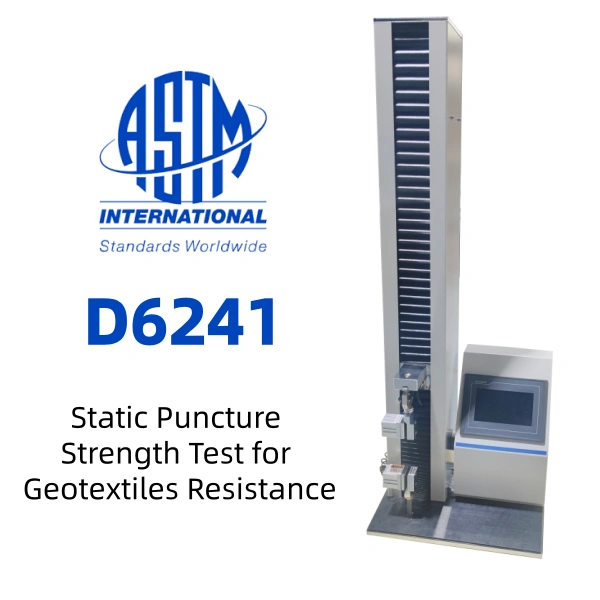
O Cell Instruments TST-01 Testador de tração fornece uma solução eficaz para laboratórios que efectuam Teste de resistência à perfuração ASTM D6241.
As principais vantagens incluem:
- Sistema de controlo baseado em PLC garantir uma execução estável dos ensaios
- Ampla gama de velocidades ajustáveis (1-500 mm/min) compatível com as velocidades de ensaio ASTM
- Controlo de deslocamento de alta precisão para uma medição exacta da deformação
- Compatibilidade com vários aparelhos de iluminação, permitindo que o mesmo sistema efectue ensaios de tração, descasque, rasgamento e perfuração
- Visualização de curvas em tempo real através de uma interface de ecrã tátil de 7 polegadas
Com uma construção mecânica robusta e uma configuração flexível, o TST-01 suporta a fiabilidade a longo prazo em laboratórios de ensaio de geossintéticos, institutos de investigação e instalações de controlo de qualidade.
Porque é que a ASTM D6241 é importante para a garantia de qualidade
Para materiais geossintéticos utilizados em projectos de infra-estruturas, a resistência à perfuração afecta diretamente o desempenho a longo prazo. Uma força de perfuração insuficiente pode levar a:
- Danos na membrana durante a instalação
- Redução do desempenho da filtração ou da separação
- Falha estrutural em camadas de proteção
Ao implementar ASTM D6241 teste, Os fabricantes e engenheiros podem:
- Comparar objetivamente o desempenho dos materiais
- Verificar a conformidade com as especificações do projeto
- Melhorar a conceção e a durabilidade dos produtos
- Garantir instalações geotécnicas mais seguras
À medida que os projectos de infra-estruturas continuam a expandir-se a nível mundial, são necessárias normas fiáveis de ensaio de geotêxteis, tais como ASTM D6241 desempenham um papel fundamental na manutenção da qualidade da engenharia.