
ASTM D1894 is a widely recognized test method for determining the static and kinetic coefficient of friction (COF) of plastic film and sheeting. In packaging production, understanding friction behavior is essential because the coefficient of friction of plastic film directly affects material handling, machine feeding, stacking stability, and packaging line efficiency.
Plastic films used in flexible packaging often move across rollers, forming collars, sealing jaws, and conveyor systems. If the surface friction is too high, films may experience feeding resistance, wrinkles, or processing interruptions. If the friction is too low, packages may slide excessively during transportation or fail to maintain stable stacking.
신뢰할 수 있는 static friction test 그리고 kinetic friction test provide quantitative information about surface interaction characteristics, allowing manufacturers to optimize material formulations, surface treatments, and production processes.
ASTM D1894 defines a controlled laboratory method to measure the force required for one material surface to begin sliding and continue sliding against another surface. These measurements help quality control teams verify consistency between production batches and ensure packaging materials perform reliably in real-world applications.
What Is the Coefficient of Friction of Plastic Film?
The coefficient of friction (COF) represents the resistance between two contacting surfaces when one surface moves relative to another. It is a dimensionless value calculated by:
μ = f / N
Where:
- μ = coefficient of friction
- f = frictional force required for movement
- N = normal force applied between surfaces
A lower COF indicates smoother sliding behavior, while a higher COF indicates greater resistance.
For plastic films, two friction values are typically evaluated:
| Friction Value | Definition | Typical Application |
|---|---|---|
| Static COF (μs) | Force required to initiate movement | Bag stacking, carton handling, package stability |
| Kinetic COF (μk) | Force required to maintain movement | Film unwinding, high-speed packaging equipment |
The relationship between static and kinetic friction provides valuable insight into how packaging materials behave during machine operation.
예를 들어
- A polyethylene film with excessive friction may cause feeding problems on automatic packaging machines.
- A low-friction BOPP film may improve high-speed wrapping performance.
- A paper-based package with optimized friction can improve stacking stability during logistics.
Why ASTM D1894 Testing Is Important for Packaging Quality Control
Preventing Packaging Line Problems
Modern packaging lines operate at high speeds, requiring predictable material movement. Variations in surface friction can cause:
- Film slipping or misalignment
- Product feeding errors
- Machine stoppages
- Seal position variations
- Increased material waste
By applying ASTM D1894 testing during material development and incoming inspection, manufacturers can identify friction-related risks before large-scale production.
Improving Material Selection and Process Optimization
Different packaging structures have different friction requirements. Multilayer films, coated papers, and laminated materials may exhibit significantly different surface characteristics.
COF testing helps engineers evaluate:
- Polymer formulation changes
- Additive concentration effects
- Corona treatment influence
- Coating performance
- Printing and lamination effects
- Aging and environmental effects
This data supports evidence-based material selection instead of relying only on production trials.
ASTM D1894 Static Friction Test and Kinetic Friction Test Principles
Static Friction Test Method
그리고 static friction test measures the initial force needed to start movement between two surfaces.
During testing:
- A test specimen is fixed on a horizontal test platform.
- A weighted sled is placed on the specimen surface.
- The sled is pulled at a controlled speed.
- The maximum force required to initiate sliding is recorded.
- The static COF is calculated from the measured force.
Static COF is especially important for applications where materials must remain stable before movement begins.
Examples include:
- Stacked plastic bags
- Pharmaceutical packaging bundles
- Corrugated carton handling
- Palletized products
Kinetic Friction Test Method
그리고 kinetic friction test evaluates the force required to maintain continuous sliding after movement starts.
The testing process includes:
- Continuous sled movement across the sample surface.
- Recording the average friction force during sliding.
- Calculating kinetic COF values.
Kinetic friction data is critical for:
- Automatic filling machines
- Form-fill-seal packaging systems
- Film unwinding processes
- High-speed wrapping equipment
ASTM D1894 Test Procedure Overview
A typical ASTM D1894 test involves several controlled conditions:
| 매개변수 | Typical Requirement |
|---|---|
| Test specimen | Plastic film or sheeting |
| Contact surface | Film-to-film or film-to-standard surface |
| Sled weight | 200 ± 1 g (commonly used) |
| 테스트 속도 | 150 mm/min according to ASTM D1894 |
| 측정 | Static and kinetic friction force |
| Result | Unitless COF value |
Before testing, laboratories should control:
- Temperature and humidity conditions
- Sample conditioning time
- Surface cleanliness
- Specimen preparation
Proper sample preparation is essential because contamination, dust, moisture, and surface damage can significantly influence friction results.
Materials Suitable for ASTM D1894 COF Testing
ASTM D1894 is mainly applied to plastic films and sheets, but friction measurement technology is also widely used for many other materials.
Common tested materials include:
Flexible Packaging Films
- PE polyethylene film
- PP polypropylene film
- BOPP biaxially oriented polypropylene film
- PET polyester film
- CPP cast polypropylene film
- PVC film
Paper and Fiber-Based Materials
- 판지
- Corrugated board
- Coated paper
- Packaging cartons
Other Industrial Materials
- Textile fabrics
- Nonwoven materials
- 복합 필름
- Plastic sheets
- Coated surfaces
ASTM D1894 Compared with Other COF Standards
Different industries use different friction testing standards depending on material type and application.
| 표준 | 애플리케이션 |
|---|---|
| ASTM D1894 | Static and kinetic COF of plastic film and sheeting |
| ISO 8295 | COF testing for plastic films and sheets |
| TAPPI T816 | Static friction testing of fiberboard materials |
| GB 10006 | COF testing requirements for plastic packaging materials |
Although these standards share similar principles, differences may exist in:
- 테스트 속도
- Specimen preparation
- Sled requirements
- Reporting methods
Laboratories should select the appropriate method based on customer specifications, industry requirements, and regulatory expectations.
Selecting a Friction Testing Machine for ASTM D1894 Testing
A professional friction testing machine should provide accurate force measurement, stable movement control, and repeatable test results.
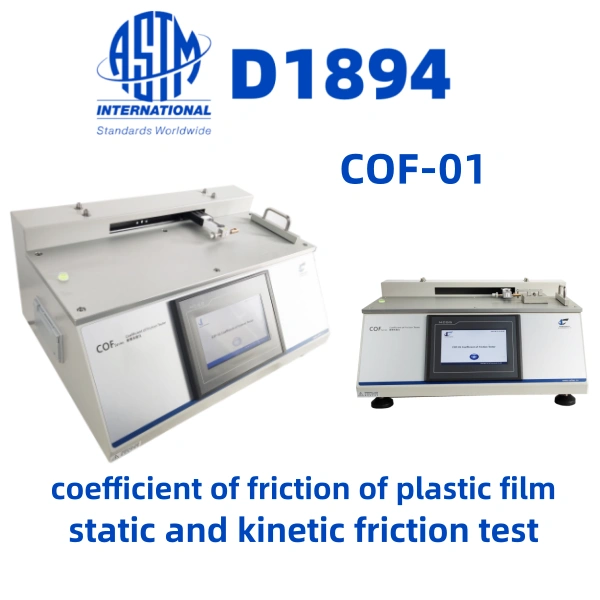
The Cell Instruments COF-01 Coefficient of Friction Tester is designed for evaluating static and kinetic COF according to standards such as ASTM D1894 and ISO 8295.
The system supports laboratory testing of:
- Plastic films
- Flexible packaging materials
- 종이 제품
- Textiles
- Composite materials
Key technical features include:
- Dual-mode testing: Static and kinetic COF measurement programs
- Precision motion control: Stepper motor and ball lead screw system for smooth sled movement
- Automated data recording: Maximum, minimum, and average friction values
- Programmable testing parameters: Suitable for different standards and materials
- Custom fixtures: Adaptable sleds and special testing configurations
Typical specifications:
| 매개변수 | 사양 |
|---|---|
| Load cell | 5 N or customized |
| 정확성 | 0.5% F.S. |
| Standard sled | 200 ± 1 g |
| Sled size | 63.5 mm × 63.5 mm |
| ASTM test speed | 150 mm/min |
| ISO test speed | 100mm/min |
For laboratories requiring additional functions, customized solutions may include:
- Special sled designs
- Peel force measurement
- Peel cling force testing
- PC software integration
- Localized interface languages
Applications of ASTM D1894 Testing in Different Industries
Food Packaging Industry
Food manufacturers use COF testing to ensure packaging films run smoothly on filling and sealing equipment while maintaining package stability.
Applications include:
- Snack packaging films
- Frozen food bags
- Beverage packaging films
- Retort packaging materials
Pharmaceutical Packaging
Stable friction properties are important for:
- Sachets
- Medical pouches
- Protective packaging films
Consistent COF helps improve automated packaging reliability.
Medical Device Packaging
Medical packaging requires predictable material handling during:
- Pouch manufacturing
- Sterile barrier packaging production
- Automated inspection processes
Flexible Packaging Manufacturing
Film producers use ASTM D1894 data for:
- Product development
- Quality inspection
- Batch comparison
- Customer certification
Benefits of ASTM D1894 Testing for Quality Control
Implementing COF measurement provides several advantages:
- Improved production stability by controlling material movement characteristics
- Reduced packaging defects caused by friction variation
- Better supplier quality management through measurable acceptance criteria
- Optimized material formulations using objective performance data
- Compliance support with international testing requirements
A reliable COF testing program allows manufacturers to move from reactive troubleshooting to preventive quality management.
결론
ASTM D1894 provides a standardized approach for measuring the static and kinetic coefficient of friction of plastic films and sheets. Accurate COF data helps packaging manufacturers understand material behavior, improve production efficiency, and maintain consistent product quality.
Whether evaluating flexible packaging films, laminated structures, or specialty materials, selecting an appropriate friction testing machine is essential for obtaining reliable results. Advanced systems such as the COF-01 Coefficient of Friction Tester provide laboratories with accurate, repeatable measurements for ASTM D1894 and related friction testing requirements.