
Tear resistance is a critical mechanical property used to evaluate whether materials can withstand damage propagation after an initial cut or defect. ASTM D1424 is a widely recognized standard for determining the tearing strength of fabrics and textile materials using the Elmendorf pendulum method. This fabric tear strength test provides valuable information about material durability, helping manufacturers select appropriate materials, optimize production processes, and ensure product reliability.
について ASTM D1424 Elmendorf method measures the force required to continue tearing a prepared specimen after an initial slit has been introduced. By analyzing tear strength performance, industries can evaluate the suitability of fabrics, nonwoven materials, and textile composites used in apparel, protective products, medical applications, and industrial materials.
For laboratories and quality control departments, accurate tear testing requires not only compliance with ASTM D1424 but also reliable testing equipment capable of delivering repeatable and traceable results. Instruments such as the エルメンドルフ・ティア・テスター provide automated operation, controlled tearing conditions, and precise measurement of tear resistance.
What Is ASTM D1424 Tear Testing?
ASTM D1424 is a standard test method developed for determining the tearing strength of woven and nonwoven textile fabrics using a falling pendulum apparatus. The method is commonly known as the Elmendorf tear test because it is based on the principle originally developed by Armin Elmendorf in the early 20th century.
Unlike tensile testing, which measures the force required to break a specimen by pulling it apart, tear testing evaluates the ability of a material to resist the propagation of an existing tear. This makes ASTM D1424 especially important for applications where fabrics may experience accidental cuts, punctures, or localized damage during use.
Typical applications include:
- Clothing and protective garments
- Industrial textiles
- Geotextiles
- Medical textiles
- Packaging fabrics
- Nonwoven filtration materials
- Composite textile structures
The resulting tear strength value helps engineers compare materials, verify manufacturing consistency, and predict product performance under real-world conditions.
Principle of the ASTM D1424 Elmendorf Method
について Elmendorf method is based on measuring the energy absorbed when a pendulum tears a specimen through a defined distance.
The basic testing principle includes:
- A rectangular specimen is prepared with a precisely positioned initial slit.
- The specimen is clamped securely between two jaws of the tear tester.
- A pendulum with a known potential energy is released from a fixed position.
- The pendulum propagates the existing tear through the specimen.
- The energy loss during tearing is converted into tear resistance.
The tear force is calculated based on the difference between the initial and final pendulum positions. The result is generally reported as:
- Newtons (N)
- Millinewtons (mN)
- Gram-force (gf)
Higher tear strength values indicate better resistance against tear propagation.
The Elmendorf principle provides advantages because it simulates practical failure conditions where materials already contain small defects rather than breaking from a completely intact condition.
Why ASTM D1424 Fabric Tear Strength Testing Is Important
Textile materials are often subjected to mechanical stresses during manufacturing, transportation, and final use. A fabric with insufficient tear resistance may fail prematurely even if its tensile strength is acceptable.
について fabric tear strength test helps manufacturers:
Improve Material Selection
Different textile structures show significant differences in tear performance. Woven fabrics, knitted fabrics, and nonwoven materials may require different reinforcement methods depending on their end applications.
Ensure Product Durability
Products such as outdoor clothing, military textiles, and protective equipment must withstand tearing forces during service. ASTM D1424 testing provides objective durability data.
Control Manufacturing Quality
Variations in:
- Fiber type
- Yarn structure
- Weaving density
- Coating process
- Lamination quality
can influence tear resistance. Routine testing helps identify production inconsistencies.
Reduce Product Failure Risks
Early detection of weak materials prevents failures in finished products and reduces costs associated with recalls, warranty claims, and material waste.
ASTM D1424 Test Procedure Overview
The ASTM D1424 testing process generally includes the following steps:
1.試料の準備
Fabric samples are cut according to specified dimensions. The specimen is positioned so that the tear direction matches the required testing orientation.
Common considerations include:
- Warp direction testing
- Weft direction testing
- Machine direction testing
- Cross direction testing
A starter cut is created in the specimen to establish the tear initiation point.
2. Specimen Mounting
The prepared specimen is installed between the clamps of the Elmendorf tear tester.
Proper clamping is essential because:
- Excessive pressure may damage the specimen
- Insufficient pressure may cause slipping
- Uneven gripping can affect test accuracy
3. Pendulum Release
The pendulum is released automatically or manually depending on the instrument design.
テスト中
- The pendulum tears the specimen
- The energy consumed during tearing is measured
- The remaining pendulum movement is recorded
4.結果計算
The tester calculates tear resistance based on pendulum energy loss.
Modern electronic elmendorf tear testers can automatically:
- Record test results
- Calculate averages
- Store testing data
- Generate reports
This improves laboratory efficiency and reduces operator influence.
Factors Affecting ASTM D1424 Tear Strength Results
Accurate tear testing depends on controlling multiple factors.
| Factor | Influence on Results |
|---|---|
| Fabric structure | Weave and fiber arrangement affect tear propagation |
| Fiber properties | Stronger fibers generally improve tear resistance |
| Sample thickness | Thicker materials may require higher tearing energy |
| Cutting accuracy | Incorrect starter cuts can cause inconsistent results |
| Clamping pressure | Improper gripping may create measurement errors |
| Environmental conditions | Temperature and humidity may affect textile behavior |
Laboratories should maintain consistent conditioning and testing procedures to achieve reliable comparison between materials.
Applicable Materials for ASTM D1424 Testing
ASTM D1424 is primarily applied to textile fabrics, including:
Woven Fabrics
Examples:
- Cotton fabrics
- Polyester fabrics
- Nylon fabrics
- Industrial woven textiles
Applications include:
- Apparel
- Outdoor products
- Workwear
- Technical textiles
Nonwoven Materials
Nonwoven fabrics are widely used in:
- Medical products
- Hygiene materials
- Filtration systems
- Protective equipment
Tear resistance is especially important because many nonwoven structures rely on fiber bonding rather than traditional weaving.
Coated and Laminated Textiles
Coated fabrics used for:
- Tarpaulins
- Protective covers
- Industrial membranes
Require sufficient tear resistance to prevent damage from spreading after puncture.
ASTM D1424 Compared with Other Tear Testing Standards
Different industries use different tear resistance standards depending on material type and application.
| スタンダード | 申し込み | 試験方法 |
|---|---|---|
| ASTM D1424 | Textile fabrics | Elmendorf pendulum tear test |
| ASTM D1922 | Plastic films and thin sheets | Elmendorf tear propagation test |
| ISO 6383-1 | Plastic films | Trouser tear method |
| ASTM D689 | Paper materials | Internal tear resistance testing |
While these standards share the Elmendorf principle, specimen dimensions, calculation methods, and reporting requirements vary.
Selecting the correct standard ensures that test results accurately represent the intended product application.
ASTM D1424 Testing Equipment: Elmendorf Tear Tester Selection
信頼できる エルメンドルフ・ティア・テスター should provide:
- Stable pendulum movement
- Accurate energy measurement
- Repeatable specimen clamping
- Automatic result calculation
- Easy calibration verification
- Data recording capability
For modern quality laboratories, automated testing systems reduce manual operation errors and improve testing efficiency.
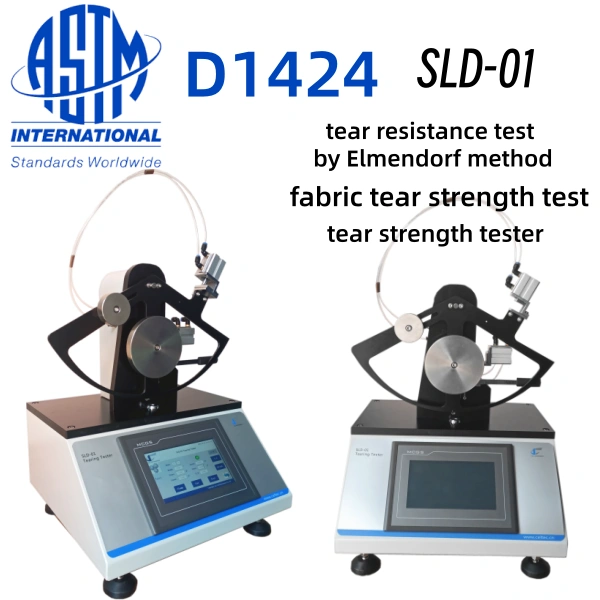
について SLD-01 Tear Tester from Cell Instruments is designed for standardized tear resistance evaluation based on pendulum tearing principles. It supports testing applications involving textiles, films, paper, nonwoven materials, and composite structures.
Key features include:
- PLC control and touchscreen operation for simple parameter setup
- Pneumatic specimen clamping to maintain consistent holding force
- Automatic pendulum release to reduce operator variation
- Calibration weights for accuracy verification
- Automatic statistical analysis for efficient quality control
- Optional software for advanced data management and reporting
The SLD-01 provides a practical solution for laboratories requiring repeatable tear resistance measurements across different material categories.
Industrial Applications of ASTM D1424 Tear Testing
Textile Manufacturing
Fabric producers use ASTM D1424 testing to evaluate:
- Raw material quality
- Fabric construction performance
- Finishing process effects
Medical and Hygiene Products
Medical textiles require reliable tear resistance to maintain product integrity during handling and use.
Examples include:
- Surgical gowns
- Protective clothing
- Medical nonwovens
保護具
Protective garments must resist tearing when exposed to mechanical stress.
Applications include:
- Safety clothing
- Industrial uniforms
- Outdoor equipment
Research and Quality Laboratories
Testing laboratories use ASTM D1424 for:
- Material comparison
- Product development
- サプライヤー資格
- Failure analysis
Benefits of Implementing ASTM D1424 Tear Testing in Quality Control
A structured tear testing program provides manufacturers with:
Better Material Decisions
Reliable tear data supports engineering choices during product development.
Improved Production Control
Regular testing identifies process variations before they become quality problems.
Enhanced Customer Confidence
Verified tear performance demonstrates product reliability.
Reduced Development Costs
Material evaluation helps avoid selecting unsuitable fabrics for demanding applications.
結論
ASTM D1424 remains an important method for evaluating textile tear resistance through the proven Elmendorf method. By measuring the energy required to propagate an existing tear, manufacturers gain valuable insight into fabric durability and performance.
A properly controlled fabric tear strength test helps industries optimize material selection, improve quality control, and reduce product failures. With reliable testing equipment such as the SLD-01 Elmendorf tear tester, laboratories can achieve accurate, repeatable tear measurements for textiles, nonwovens, and other flexible materials.