
Understanding ISO 21182 and Why It Matters
ISO 21182 is the international standard for determining the static and dynamic coefficient of friction of light conveyor belts. In modern manufacturing, logistics, food processing, packaging, and material handling systems, conveyor belt surface friction directly influences product transport stability, positioning accuracy, throughput efficiency, and operational safety.
Akurat coefficient of friction measurement helps manufacturers evaluate how conveyor belts interact with products, guide surfaces, and machine components. Whether designing a new conveyor system or validating belt performance during quality control, ISO 21182 provides a standardized and repeatable method for light conveyor belt friction testing.
Because conveyor belt surfaces are engineered with different materials, textures, and patterns to achieve specific conveying functions, friction characteristics can vary significantly. ISO 21182 establishes a consistent testing methodology that allows manufacturers, belt suppliers, and laboratories to compare performance objectively.
What Does ISO 21182 Measure?
ISO 21182 specifies methods for measuring two important friction characteristics:
| Parameter | Deskripsi | Importance |
|---|---|---|
| Static Coefficient of Friction (μS) | Resistance to movement when motion begins | Product start-up stability |
| Dynamic Coefficient of Friction (μD) | Resistance during continuous sliding | Ongoing conveying performance |
The standard applies to light conveyor belts as defined in ISO 21183-1 and evaluates friction between the conveyor belt surface and a standardized metallic test panel under controlled conditions.
Static Friction (μS)
Static friction represents the force required to initiate movement between the belt surface and the test panel.
A higher static coefficient may help prevent products from slipping during startup, acceleration, or incline conveying.
Dynamic Friction (μD)
Dynamic friction represents the resistance encountered once sliding motion has already begun.
This value is particularly important for:
- Product transfer operations
- Conveyor speed optimization
- Automated sorting systems
- Packaging and assembly lines
- Material handling equipment design
Testing Principle of ISO 21182
The test method uses a metallic sled (test panel) placed on the conveyor belt specimen under a specified normal load.
Dynamic Coefficient of Friction Test
For dynamic testing:
- A conveyor belt specimen is clamped securely to the testing platform.
- A metallic test panel with a specified mass is placed on the specimen.
- The panel is pulled at a controlled speed.
- Friction force is continuously recorded.
- The dynamic coefficient is calculated using the measured friction force and normal force.
The dynamic coefficient is determined by:
\mu_D=\frac{F_D}{F_N}
Dimana:
- μD = dynamic coefficient of friction
- FD = median dynamic friction force
- FN = normal force
Static Coefficient of Friction Test
For static testing:
- The metallic test panel is positioned on the specimen.
- A pulling force is applied gradually.
- The force required to initiate movement is recorded.
- The first peak force (break-away force) is used for calculation.
The static coefficient is determined by:
\mu_S=\frac{F_S}{F_N}
Dimana:
- μS = static coefficient of friction
- FS = static friction force
- FN = normal force
Typical Test Procedure
Persiapan Sampel
Test specimens are cut from the conveyor belt in either the longitudinal or transverse direction while maintaining full belt thickness.
Pengaturan Peralatan
The test table must be leveled in both directions. The metallic test panel is inspected to ensure the surface remains clean and free from corrosion.
Eksekusi Tes
The operator:
- Fixes the specimen securely
- Places the weighted metallic sled on the surface
- Connects the pulling mechanism
- Selects either static or dynamic test mode
- Runs the test at the specified speed
Analisis Data
For dynamic testing:
- Data from the final 200 mm of travel are evaluated.
- The median friction force is used to calculate μD.
For static testing:
- The first force peak or the point where the force curve deviates from linear behavior is identified.
- This force value becomes FS for calculation.
COF Testing Machine Requirements for ISO 21182
A suitable COF testing machine should provide:
- Accurate force measurement
- Stable pulling speed
- Consistent sled loading
- Real-time force curve recording
- Static and dynamic friction analysis
- Repeatable motion control
Because ISO 21182 requires both static and dynamic friction evaluation, the instrument must be capable of recording break-away forces as well as continuous sliding friction.
Cell Instruments Solutions for ISO 21182 Testing
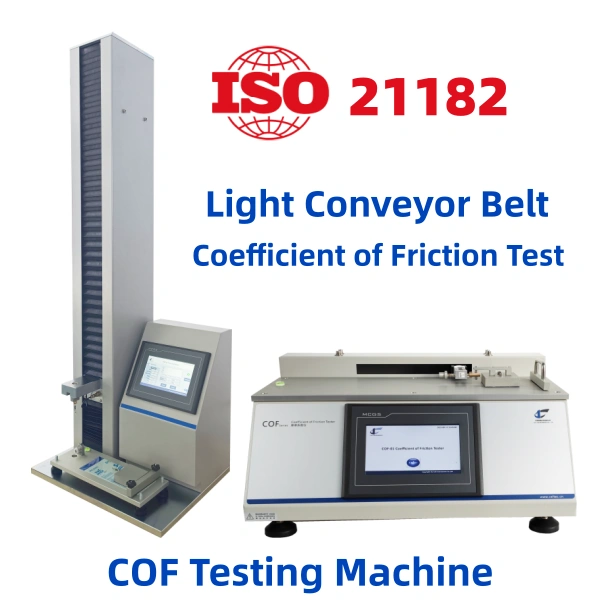
COF-01 Penguji Koefisien Gesekan
The COF-01 is designed for laboratory-based friction testing and supports static and kinetic coefficient of friction measurements.
Key capabilities include:
- PLC-controlled operation
- Touchscreen HMI interface
- Real-time friction curve display
- Static and dynamic COF testing modes
- Precision stepper motor drive
- Ball screw motion system
- Automated data processing
- Optional printer and RS-232 communication
Typical specifications include:
| Parameter | Spesifikasi |
| Sel Beban | 5 N (customizable) |
| Akurasi | 0,5% FS. |
| Berat Kereta Luncur | 200 ± 1 g |
| Uji Kecepatan | 100 mm/min (ISO), 150 mm/min (ASTM) |
| Daya | 110–220 V, 50/60 Hz |
For customized conveyor belt friction applications, sled dimensions and loading conditions can be adapted to project requirements.
TST-01 Universal Testing System
For laboratories seeking greater flexibility, the TST-01 universal testing platform can be configured for friction testing using dedicated fixtures.
Manfaatnya meliputi:
- Adjustable speed from 1–500 mm/min
- Kontrol perpindahan presisi tinggi
- Multi-function testing capability
- Custom fixture integration
- Data export and reporting functions
The system is particularly suitable for research laboratories, conveyor belt manufacturers, and testing centers requiring customized friction evaluation methods.
Why Coefficient of Friction Measurement Is Important
Reliable coefficient of friction measurement provides several operational advantages:
Improved Product Handling
Proper friction levels minimize:
- Product slipping
- Misalignment
- Transport interruptions
- Production downtime
Better Conveyor Belt Selection
Engineers can compare different belt surface materials and patterns objectively.
Quality Control Consistency
Manufacturers can establish acceptance criteria and verify lot-to-lot consistency.
Product Development Support
Friction testing helps optimize:
- Surface coatings
- Textures
- Belt materials
- Conveyor system design
ISO 21182 Compared with Other Friction Standards
| Standar | Aplikasi |
| ISO 21182 | Light conveyor belts |
| ASTM D1894 | Plastic films and sheets |
| ISO 8295 | Plastic film friction testing |
| TAPPI T549 | Paper and paperboard friction |
| ASTM D4918 | Paper and paperboard friction |
While these standards all involve friction testing, ISO 21182 is specifically developed for conveyor belt applications and uses a dedicated metallic test panel configuration designed to provide consistent and reproducible results.
ISO 21182 provides a standardized approach to light conveyor belt friction testing, enabling manufacturers and laboratories to determine both static and dynamic friction performance under controlled conditions. Accurate coefficient of friction measurement supports conveyor belt selection, product development, process optimization, and quality assurance across numerous industries.
By utilizing a reliable COF testing machine and following ISO 21182 procedures, organizations can generate repeatable friction data that improve conveyor system performance and reduce operational risks throughout the production and material handling process.