
Introduction aux essais d'étanchéité par chute de pression
Le contrôle d'étanchéité par chute de pression est l'une des méthodes les plus couramment utilisées dans les chaînes de production industrielles. Cette méthode est simple, économique par rapport au contrôle à l'hélium et facile à automatiser, ce qui en fait un choix privilégié dans divers secteurs industriels.
Comment fonctionne le test d'étanchéité par chute de pression ?
La méthode de chute de pression consiste à remplir un composant testé d'air sous pression. Une fois la pression souhaitée atteinte, le composant est isolé de l'alimentation en air et on le laisse se stabiliser. Un capteur mesure ensuite la chute de pression sur une durée définie.
Principe fondamental : Une baisse de pression indique la présence d'une fuite. L'ampleur de la chute de pression détermine la gravité de la fuite. Si aucune variation de pression n'est constatée, le composant est considéré comme étanche.
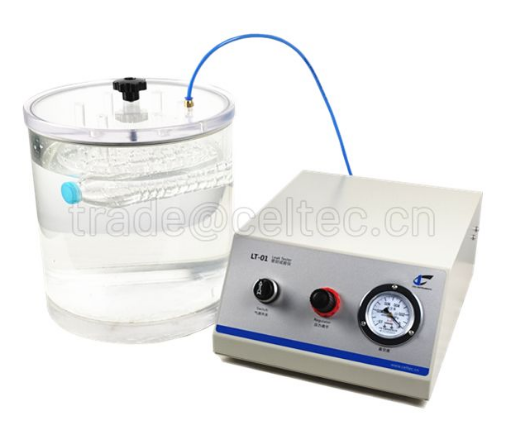
Avantages des essais de chute de pression
Très précise : Détecte même les fuites les plus infimes.
Rentable : Utilise de l'air à la place de gaz coûteux comme l'hélium.
Polyvalent : Convient aussi bien aux essais sous pression positive que sous pression négative.
Large éventail d'applications industrielles : Utilisé dans les secteurs de l'automobile, du médical, de l'emballage et de la fabrication industrielle.
Essais de chute de pression : applications et secteurs d'activité
Les essais d'étanchéité par chute de pression sont utilisés dans divers secteurs, notamment :
Automobile – Composants du système d'alimentation en carburant, radiateurs et systèmes d'airbags.
Médical – Tubulures médicales, seringues et récipients hermétiques.
Emballage – Récipients hermétiques pour aliments et boissons.
Fabrication industrielle – Composants hydrauliques et pneumatiques.
Procédure d'essai de perte de pression : étape par étape
1. Installation et mise en service de la cartouche
Assurez-vous que tous les composants sont disponibles.
Installez la cartouche dans le boîtier en veillant à bien serrer tous les raccords.
Si vous utilisez une cartouche pré-humidifiée, passez directement au test.
Pour humidifier la cartouche, ouvrez les vannes afin de permettre l'écoulement du fluide et d'éliminer les bulles d'air.
2. Réalisation de l'essai de chute de pression
Assurez-vous que toutes les vannes sont initialement fermées.
Raccordez une source d'air ou d'azote régulée.
Augmentez progressivement la pression jusqu'à la valeur d'essai spécifiée.
Fermez la vanne et laissez le système se stabiliser.
Mesurer la perte de charge sur une durée donnée (généralement 10 minutes).
Si la perte de charge est inférieure au seuil, le composant est jugé conforme.
Formule pour l'essai de chute de pression
Le taux de chute de pression peut être calculé à l'aide de la formule suivante :
DP = D * T * Pa / V
Où ?
DP = Perte de charge maximale admissible.
D = Limite du taux de diffusion.
T = Durée du test en minutes.
Pa = Pression atmosphérique (14,7 psi).
V = Volume de l'appareil d'essai.
Problèmes courants et dépannage
1. Fuites d'air dans la plomberie
Assurez-vous que tous les raccords sont étanches. Effectuez régulièrement des contrôles d'étanchéité du système.
2. Échecs de justesse
Réhumidifiez la cartouche et refaites le test si nécessaire.
3. Mauvaise installation de la cartouche
Vérifiez que les joints toriques ne sont pas endommagés et qu’ils sont correctement en place.
Conclusion
Le contrôle d'étanchéité par chute de pression est une méthode fiable, économique et largement répandue pour détecter les fuites dans les applications industrielles et de fabrication. En respectant les procédures appropriées et en résolvant les problèmes potentiels, les fabricants peuvent garantir l'intégrité et la sécurité de leurs produits.
Nos installations parfaitement équipées et notre excellent contrôle qualité à toutes les étapes de la fabrication nous permettent de garantir la satisfaction totale des acheteurs de Testeur de thermoscellage,Fabricant de matériel d'essai d'étanchéité,Testeur d'étanchéité et de résistance des joints,Équipements d'essai en Chine,Équipement d'essai des matériaux,Équipement d'essai sur mesure,Testeur de traction,Testeur de fuite à vide,Essais sur les textiles,Testeur de coefficient de frottement,Test électronique
Si vous souhaitez obtenir plus d'informations sur ce produit, n'hésitez pas à nous contacter. Nous vous recommandons d'autres produits populaires : Équipement d'essai d'étanchéité brute, Testeur de fuites brutes Équipement d'essai, Testeur de fuites brutes Équipement d'essai, fabricant de testeurs de flexion gelbo, Fabricant de testeurs Gelbo Flex, Fournisseur de Gelbo Flex Tester, Testeur Gelbo Flex Chine, Services du testeur Gelbo Flex, Testeur de résistance aux fuites et aux joints d'étanchéité Chine, Solution de test d'étanchéité et de résistance des joints, Solution Gelbo Flex Tester, Fournisseur de Cof Tester