
Übersicht
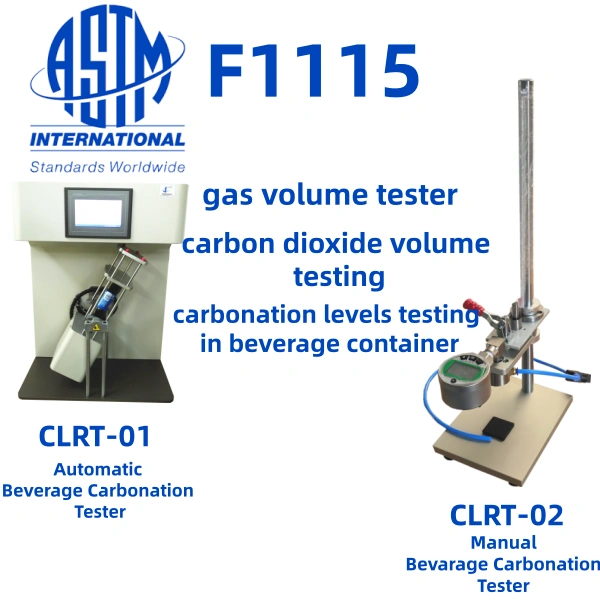
Carbonation quality plays a critical role in beverage taste, texture, shelf stability, and consumer experience. To maintain consistent carbonation performance, beverage manufacturers rely on accurate carbon dioxide measurement methods. ASTM F1115 carbonation tester solutions provide a reliable approach for determining CO₂ loss and evaluating carbonation levels in beverage containers. Cell Instruments offers professional carbonation testing solutions, including the automated CLRT-01 Karbonisierungstester and the manual CLRT-02 Carbonation Tester, designed for precise carbon dioxide volume testing in bottles and cans.
These testing instruments help beverage producers, quality control laboratories, and R&D teams measure dissolved CO₂ content through pressure and temperature analysis. By providing accurate carbonation data, ASTM F1115 compliant testing equipment supports production consistency, product development, and quality assurance across carbonated beverages, beer, sparkling water, and other gas-containing drinks.
What Is ASTM F1115 Carbonation Testing?
ASTM F1115 is a standard test method used for determining the CO₂ loss of beverage containers. Carbonated beverages contain dissolved carbon dioxide that directly affects product characteristics. During storage, transportation, or packaging failures, CO₂ may escape from the container, resulting in reduced carbonation and changes in product quality.
Eine ASTM F1115 carbonation tester measures the internal pressure of a beverage container after controlled agitation and stabilization. Combined with temperature measurement, the test result can be converted into dissolved CO₂ volume using established carbonation tables.
The test provides important information about:
- Carbon dioxide retention performance
- Beverage carbonation consistency
- Packaging sealing effectiveness
- Product quality during shelf life
- Production process stability
For beverage manufacturers, carbon dioxide volume testing is not only a quality inspection procedure but also an important tool for maintaining brand consistency.
Why Carbonation Levels Testing in Beverage Containers Is Important
Carbonation levels directly influence the sensory characteristics of beverages. Incorrect CO₂ concentration can affect taste, mouthfeel, and consumer acceptance.
A professional carbonation testing process helps manufacturers:
Maintain Product Consistency
Every production batch should deliver the same carbonation experience. Regular testing ensures that CO₂ levels remain within product specifications.
Improve Quality Control
Carbonation measurement helps identify problems related to filling processes, sealing performance, storage conditions, and transportation.
Support New Product Development
During beverage formulation, R&D engineers use carbonation testing equipment to optimize CO₂ content for different products.
Reduce Product Loss
Early detection of CO₂ loss helps prevent quality issues before products reach the market.
Industries commonly applying carbonation testing include:
| Industry | Testing Purpose |
|---|---|
| Carbonated soft drinks | Verify carbonation concentration and batch consistency |
| Beer production | Monitor dissolved CO₂ levels |
| Sparkling water | Control carbonation performance |
| Energy drinks | Maintain product characteristics |
| Fermented beverages | Evaluate CO₂ retention |
How Does an ASTM F1115 Carbonation Tester Work?
The working principle of an ASTM F1115 carbonation tester is based on the relationship between pressure, temperature, and dissolved CO₂ content.
When a sealed beverage container is tested, the instrument measures internal pressure after CO₂ reaches equilibrium. Because carbonation behavior changes with temperature, the tester also records sample temperature. The pressure and temperature values are then used to determine the CO₂ volume.
The general testing process includes:
- Sample Preparation: A sealed beverage bottle or can is placed into the carbonation tester.
- Container Piercing: The piercing mechanism creates a connection with the container headspace while minimizing CO₂ loss.
- Pressure Stabilization: Excess gas is released through the vent valve to establish a stable measurement condition.
- Agitation: The sample is shaken to distribute dissolved CO₂ evenly between the liquid and gas phases.
- Measurement: The instrument records pressure and temperature values.
- CO₂ Volume Calculation: The measured data is converted into carbonation volume results.
This method provides repeatable carbon dioxide volume testing for beverage quality control laboratories.
Automatic ASTM F1115 Carbonation Tester: CLRT-01
Die CLRT-01 Karbonisierungstester is an automated testing solution designed for laboratories and production environments requiring efficient and repeatable carbonation measurement.
Unlike traditional manual methods, CLRT-01 integrates automatic piercing, controlled agitation, and real-time data acquisition into one testing workflow.
Automated Carbonation Testing Workflow
The CLRT-01 improves testing efficiency through:
Automatic Cap Piercing
The precision-controlled piercing system penetrates the container cap at a stable speed, reducing operator influence and improving repeatability.
Pressure Stabilization Control
The integrated vent valve helps remove excess pressure and establishes a reliable measurement condition.
Servo-Controlled Agitation
A servo motor provides consistent shaking conditions. The standard agitation time is 40 seconds, while parameters can be customized according to testing requirements.
Real-Time Data Collection
High-resolution sensors continuously monitor:
- Pressure (MPa)
- Temperature (℃)
The system automatically calculates CO₂ volume using carbonation tables and displays the final result.
Technical Advantages of CLRT-01
- Industrial PLC and touchscreen HMI control
- Automatic testing process
- Adjustable piercing speed and shaking parameters
- High repeatability between operators and batches
- Leak-resistant testing structure
- Compatible with bottles, cans, and customized containers
The CLRT-01 is suitable for beverage companies requiring high-frequency quality inspection and automated laboratory workflows.
Manual ASTM F1115 Carbonation Tester: CLRT-02
Die CLRT-02 Manueller Karbonisierungstester provides a practical and economical solution for laboratories that require reliable carbonation measurement without automated operation.
It applies the same fundamental ASTM F1115 testing principle while using a manual workflow.
Manual Carbonation Testing Procedure
The CLRT-02 operation includes:
- Manually pierce the container using the hardened piercing head.
- Open the vent valve to release excess gas.
- Stabilize the internal pressure.
- Shake the sample manually for CO₂ distribution.
- Record pressure and temperature values.
- Determine CO₂ volume through carbonation tables.
Technical Advantages of CLRT-02
- Durable quenching piercing head
- High-precision pressure gauge
- Pressure range up to 1 MPa
- Resolution of 0.0001 MPa
- Leak-resistant valve structure
- Adjustable sample height for different containers
The CLRT-02 is ideal for:
- Beverage R&D laboratories
- Small-scale manufacturers
- Quality inspection facilities
- Educational and research laboratories
CLRT-01 vs CLRT-02 Carbonation Tester Comparison
| Merkmal | CLRT-01 Automatic Carbonation Tester | CLRT-02 Manueller Karbonisierungstester |
|---|---|---|
| Operation method | Automatic | Handbuch |
| Piercing process | Motor controlled | Manual operation |
| Agitation | Servo-driven shaking | Manual shaking |
| Data recording | Automatic acquisition | Manual reading |
| Testing efficiency | High throughput | Standard laboratory testing |
| Anmeldung | Production QA and advanced laboratories | R&D and routine testing |
| Cost efficiency | Automation-focused | Budget-friendly solution |
Both models provide reliable solutions for ASTM F1115 carbonation testing. Users can select the appropriate equipment based on testing frequency, automation requirements, and laboratory workflow.
Applications of Carbon Dioxide Volume Testing Equipment
A professional gas volume tester supports beverage manufacturers throughout product development and production.
Typical applications include:
Soft Drink Quality Control
Manufacturers use carbonation testers to verify CO₂ concentration after filling and packaging.
Beer and Fermented Beverage Testing
Breweries evaluate carbonation levels to maintain product characteristics and packaging performance.
Sparkling Water Production
Carbon dioxide measurement ensures consistent carbonation intensity.
Packaging Development
Packaging engineers use carbonation testing data to evaluate container performance and CO₂ retention capability.
Related Standards for Carbonation Testing
| Standard | Beschreibung |
|---|---|
| ASTM F1115 | Standard Test Method for Determining the CO₂ Loss of Beverage Containers |
| GB/T 10792 | Chinese standard related to carbonated beverages |
ASTM F1115 provides the testing foundation for evaluating CO₂ loss behavior, while suitable carbonation testing equipment helps laboratories achieve accurate and repeatable measurements.
How to Select the Right ASTM F1115 Carbonation Tester?
Selecting the correct carbonation tester depends on testing objectives and laboratory requirements.
Choose CLRT-01 Automatic Carbonation Tester when:
- High testing frequency is required
- Multiple operators need consistent results
- Automated data collection is preferred
- Production quality control is the primary application
Choose CLRT-02 Manueller Karbonisierungstester when:
- Testing volume is moderate
- Budget efficiency is important
- Manual laboratory operation is acceptable
- Basic CO₂ volume measurement is required
Both instruments provide dependable solutions for carbon dioxide volume testing in beverage containers.
Technische Daten
CLRT-01 Karbonisierungstester
| Parameter | Spezifikation |
|---|---|
| Testbereich | 0–1 MPa |
| Pressure Resolution | 0.01 kPa |
| Auflösung der Temperatur | 0.1℃ |
| Durchdringende Geschwindigkeit | 5 mm/s (customizable) |
| Shaking Time | 40 s (customizable) |
| Probe Höhe | ≤350 mm |
| Operation | Automatic |
CLRT-02 Manueller Karbonisierungstester
| Parameter | Spezifikation |
|---|---|
| Testbereich | 0–1 MPa |
| Pressure Resolution | 0.0001 MPa |
| Operation | Manual piercing and shaking |
| Probe Höhe | ≤350 mm |
| Einheiten | MPa, psi, bar |
| Stromversorgung | AC 110–220V 50/60Hz |
Summary of Key Points
Reliable carbonation measurement helps beverage manufacturers maintain consistent product quality, improve packaging performance, and control production processes. Cell Instruments provides ASTM F1115 carbonation tester solutions with automated and manual configurations to meet different testing environments. Whether you need high-efficiency quality control equipment or a practical laboratory carbonation tester, our technical team can provide suitable solutions, customized fixtures, and professional support for your beverage testing applications.