
Understanding ISO 9187 and Its Importance
ISO 9187 defines the technical requirements and test methods for glass ampoules used in pharmaceutical injections. These ampoules must ensure safe drug containment, easy opening, and chemical stability. Quality control teams rely on ISO 9187 to evaluate whether ampoules meet strict performance benchmarks.
The standard focuses on three critical aspects:
- Hydrolytic resistance of the glass inner surface
- Annealing quality to minimize residual stress
- Breaking force to ensure controlled and safe opening
These parameters directly impact patient safety and product integrity, making ISO 9187 compliance essential for manufacturers and testing laboratories.
ISO 9187-1: Requirements for Glass Ampoules
ISO 9187-1 applies to ampoules for injectable preparations and establishes baseline performance criteria.
Key Technical Requirements
- Hydrolytic Resistance
Ampoules must meet HC 1 classification per ISO 4802 standards, ensuring minimal alkali release into drug solutions. - Annealing Quality
Residual stress must remain below 50 nm/mm optical retardation, preventing spontaneous cracking. - Breaking Force
Ampoules with a predefined breaking point must meet specified force values to ensure consistent opening behavior.
Testing Principle
The breaking force test determines the force required to separate the ampoule head from the body, while also evaluating whether the fracture is clean and safe.
ISO 9187-2: Requirements for OPC Ampoules
ISO 9187-2 extends the standard to one-point-cut (OPC) ampoules, which feature a marked breaking point.
Additional Requirements
- Breaking Point Positioning
The marking must remain centered within ±1 mm to ensure accurate force application. - Thermal Stability
The breaking point must withstand 120°C heating followed by cooling, simulating sterilization processes. - Odolnost
It must tolerate routine cleaning and sterilization without degradation.
These requirements ensure that OPC ampoules maintain consistent performance under real-world pharmaceutical conditions.
Glass Ampoule Break Force Test
Na stránkách glass ampoule break force test plays a central role in ISO 9187 compliance.
Testovací podmínky
- Testovací rychlost: 10 mm/min
- Force range: up to 200 N
- Sample conditioning: 20 ± 5°C
- Force applied at 90° to ampoule axis
Proč na tom záleží
- Ensures user safety during manual opening
- Prevents glass fragmentation contamination
- Guarantees consistent usability across batches
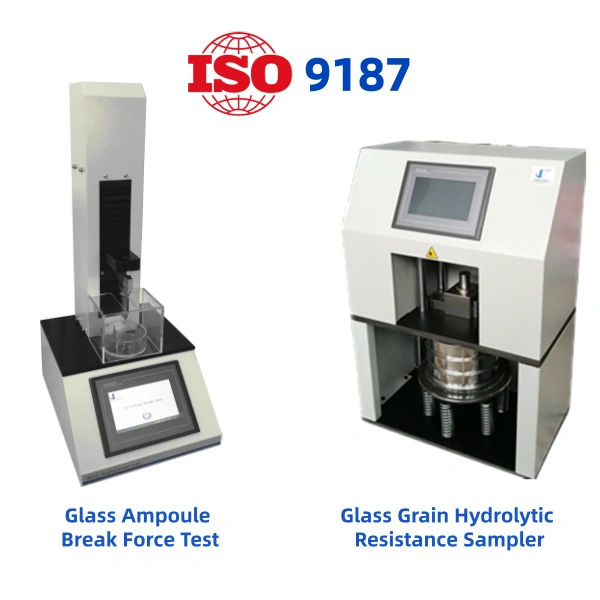
For precise and repeatable results, laboratories often adopt automated solutions such as the BST-01 Tester pro porušení ampulí, which integrates controlled speed, high-resolution force measurement, and safety protection systems.
3 Point Bending Strength in Ampoule Evaluation
Although not explicitly defined in ISO 9187, 3 point bending strength analysis complements breaking force testing.
Aplikace
- Evaluates mechanical robustness of ampoule necks
- Identifies structural weaknesses during production
- Supports R&D optimization for glass formulation
This method provides additional insight into ampoule durability, especially during transport and handling.
Glass Ampoule Hydrolytic Resistance Test
Na stránkách glass ampoule hydrolytic resistance test determines the chemical durability of the glass surface.
Princip testu
- Glass is crushed into controlled particle sizes
- Extracted with water under defined conditions
- Released alkali content is measured
Automated preparation systems like the GHR-01A Tester hydrolytické odolnosti skleněných zrn improve sample consistency, operator safety, and repeatability, ensuring compliance with ISO 4802 requirements.
Význam
- Prevents drug contamination
- Ensures long-term stability
- Splňuje požadavky pharmaceutical regulatory standards
Practical Testing Workflow for ISO 9187
A typical ISO 9187 testing process includes:
- Sample selection based on ISO 2859-1
- Conditioning at controlled temperature
- Breaking force testing using calibrated equipment
- Hydrolytic resistance evaluation
- Data recording and compliance verification
Modern laboratories increasingly adopt automated and integrated systems to reduce human error and improve throughput.
Why Choose Cell Instruments for ISO 9187 Testing
Cell Instruments provides specialized solutions for ampoule testing, combining precision engineering with compliance-focused design.
Mezi hlavní výhody patří:
- High accuracy force measurement systems
- Automated workflows for repeatability
- Safety-focused design for glass handling
- Customization for different ampoule sizes and materials
Ensure your ampoules meet ISO 9187 requirements with precise breaking force and hydrolytic resistance testing. By combining standardized methods with automated instruments, laboratories can achieve reliable, repeatable results while improving efficiency. Advanced testing solutions support accurate force measurement, controlled sample preparation, and compliance with global standards, helping manufacturers enhance product quality and safety.
Často kladené otázky
1. What is ISO 9187 mainly used for?
ISO 9187 defines quality and testing standards for glass ampoules used in pharmaceutical injections.
2. Why is breaking force critical in ampoule testing?
It ensures safe opening without excessive force or glass fragmentation, protecting users and drug integrity.
3. How is hydrolytic resistance evaluated?
By measuring alkali release from glass after controlled extraction, following ISO 4802 methods.
4. What is the difference between ISO 9187-1 a ISO 9187-2?
Part 1 covers general ampoules, while Part 2 focuses on OPC ampoules with specific breaking point requirements.
5. Can automated testers improve ISO 9187 compliance?
Yes, automated systems increase repeatability, reduce human error, and ensure consistent test conditions.