
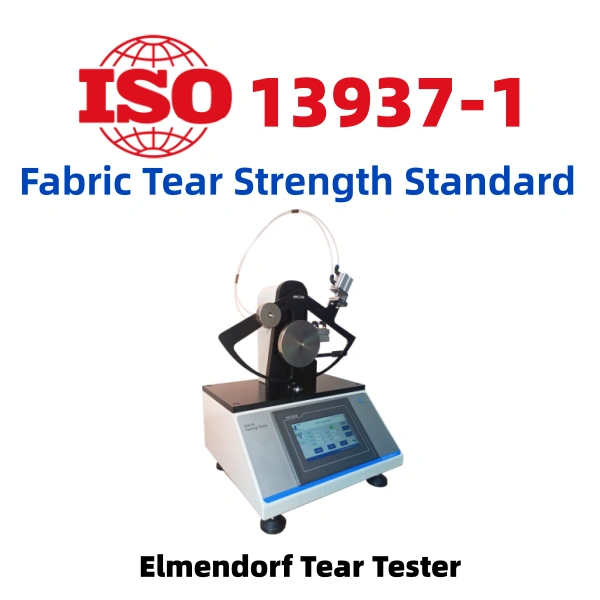
Why ISO 13937-1 Matters in Textile Testing
ISO 13937-1 is one of the most widely recognized standards for evaluating the tear resistance of textile fabrics. In textile manufacturing, product development, and quality assurance, understanding how a fabric behaves after it has been cut, punctured, or damaged is critical. While tensile strength measures a fabric’s resistance to breaking under direct pulling forces, tear strength evaluates its ability to resist the propagation of an existing cut or slit.
Cái ISO 13937-1 fabric tear strength standard utilizes the ballistic pendulum method, commonly known as the Elmendorf tear test of fabric, to determine the force required to continue a tear through a defined distance. The method provides valuable information for manufacturers of apparel, industrial textiles, protective clothing, medical fabrics, packaging materials, and technical textiles.
By measuring tear resistance, manufacturers can improve product durability, reduce material failures, and ensure compliance with customer specifications and industry requirements.
Understanding the Tear Test of Fabric
A fabric may experience localized damage during manufacturing, transportation, or end use. Once a cut or puncture occurs, the ability of the material to resist further tearing becomes critical.
Cái tear test of fabric evaluates:
- Resistance to tear propagation
- Structural integrity after damage
- Durability during service
- Product safety and performance
Principle of ISO 13937-1 Elmendorf Tear Testing
Cái ISO 13937-1 method measures the work required to propagate a pre-cut tear through a specified distance.
The test utilizes a pendulum mechanism with two clamps:
- One clamp remains fixed.
- The second clamp is attached to a pendulum.
- A specimen is secured between the clamps.
- A predefined slit is introduced.
- The pendulum is released.
- The pendulum’s kinetic energy tears the specimen.
- The energy loss during tearing is converted into tear force.
Because the test measures energy rather than direct force, it effectively captures the dynamic tearing behavior of textile materials.
ISO 13937-1 Test Specimen Preparation
Proper specimen preparation is essential for obtaining reliable results.
Specimen Requirements
According to ISO 13937-1:
- The specimen is mounted between two jaws.
- A slit of 20 mm ± 0.5 mm is cut.
- A remaining tear length of 43 mm ± 0.5 mm is maintained.
- Specimens are tested in both warp and weft directions when applicable.
Number of Tests
The standard requires:
- At least five valid specimens per fabric direction.
- Additional specimens if excessive invalid results occur.
ISO 13937-1 Test Procedure
Cái tear test of fabric follows a straightforward but highly controlled procedure.
Step 1: Pendulum Selection
Select a pendulum capacity that produces readings between:
15% and 85% of the instrument scale range
This ensures optimal measurement accuracy.
Step 2: Instrument Verification
- Confirm zero calibration.
- Raise the pendulum to its starting position.
Step 3: Mount the Specimen
- Position the specimen centrally.
- Align the long side parallel to the jaw edge.
- Secure the specimen firmly.
Step 4: Introduce the Slit
Using the integrated knife:
- Cut a 20 mm slit.
- Verify the remaining tear length.
Step 5: Release the Pendulum
- Release the pendulum.
- Allow complete tearing of the specimen.
Step 6: Record Results
- Read tear force directly from the display.
- Apply correction factors if required by the instrument design.
- Record results in Newtons.
Step 7: Validate the Test
Observe:
- Whether the tear follows the intended direction.
- Whether yarn slippage occurs.
Tests exhibiting thread slippage rather than tearing must be discarded.
If three or more specimens are invalid, the standard considers the method unsuitable for that material.
Fabric Tear Strength Standard Compared with Other Tear Test Methods
Cái fabric tear strength standard landscape includes several test methods.
| Tiêu chuẩn | Method | Primary Application |
|---|---|---|
| ISO 13937-1 | Elmendorf Pendulum | Woven fabrics |
| ISO 13937-2 | Trouser Tear Method | Various textiles |
| ISO 13937-3 | Wing Tear Method | Textile fabrics |
| ASTM D1424 | Elmendorf Tear Method | Textiles |
| ASTM D2261 | Tongue Tear Method | Textile materials |
Among these methods, ISO 13937-1 remains one of the most efficient and widely adopted procedures for routine textile quality control.
Elmendorf Tear Tester Components
An Elmendorf tear tester designed for ISO 13937-1 testing typically includes:
- Ballistic pendulum assembly
- Fixed and movable specimen clamps
- Precision cutting knife
- Tear force measurement system
- Calibration mechanism
- Digital display or touchscreen interface
The instrument must provide sufficient accuracy to ensure results remain within the standard’s specified measurement range.
Choosing an Elmendorf Tear Tester for ISO 13937-1 Compliance
Laboratories performing routine tear test of fabric evaluations require an instrument that delivers repeatability, ease of use, and traceable results.
Cell Instruments SLD-01 Elmendorf Tear Tester
Cái SLD-01 Elmendorf Tear Tester is designed to support testing according to ISO 13937-1 and related tear resistance standards.
Key features include:
- PLC control with HMI touchscreen for intuitive operation
- Pneumatic specimen clamping for consistent gripping force
- Automatic pendulum release to reduce operator influence
- Integrated calibration weights for range verification
- Automatic statistical analysis of test results
- Optional software package for advanced reporting
- Optional micro-printer and RS-232 communication
- Multiple pendulum capacities:
- 200 gf
- 400 gf
- 800 gf
- 1600 gf
- 3200 gf
- 6400 gf
Technical Specifications
| Parameter | Specification |
|---|---|
| Pendulum Capacity | 200–6400 gf |
| Tearing Arm Length | 104 ± 1 mm |
| Initial Tearing Angle | 27.5° ± 0.5° |
| Gas Supply | 0.6 MPa |
| Nguồn điện | AC 110–220 V, 50/60 Hz |
These features help laboratories maintain compliance with the requirements of the ISO 13937-1 fabric tear strength standard while improving testing efficiency and data reliability.
Cái ISO 13937-1 standard provides a reliable and internationally recognized method for determining the tear resistance of textile fabrics using the Elmendorf tear tester. By measuring the force required to propagate a pre-existing tear, the method offers valuable insights into fabric durability, structural integrity, and product performance.
Whether used for apparel development, technical textile qualification, medical fabric verification, or routine quality control, the tear test of fabric remains an essential tool for ensuring consistent material performance and compliance with modern industry requirements.