
TAPPI T826 is a widely used test method for evaluating the short span compressive strength of paper and board materials, especially those used in container and box manufacturing. This short span compressive strength testing method provides reliable data about the compression resistance of containerboard by measuring the maximum force a small test specimen can withstand before compressive failure. For packaging engineers and quality laboratories, TAPPI T826 offers an effective approach to assessing material strength, optimizing board performance, and maintaining consistent packaging quality.
Unlike conventional compression tests that evaluate larger structures, short span compression testing focuses on the inherent compressive strength of the paper or board fibers within a short unsupported length. This helps manufacturers understand the material’s contribution to box compression performance and identify whether raw materials meet production requirements.
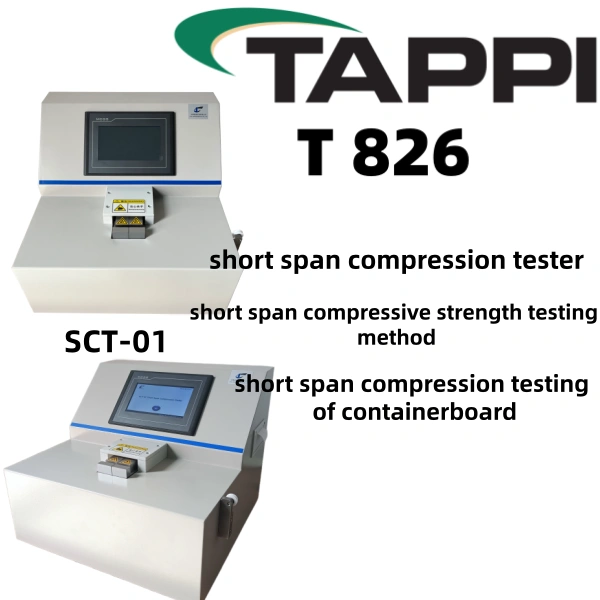
The SCT-01 Short Span Compression Tester from Cell Instruments is designed specifically for performing this type of evaluation, providing accurate measurement of paper and board compression strength in both machine direction (MD) and cross direction (CD).
What Is TAPPI T826 Short Span Compression Testing?
TAPPI T826 is a testing method used to determine the compressive strength of paper and board by applying a compressive force over a short test span. The method is particularly suitable for containerboard materials with grammage ranging from approximately 100 g/m² to 400 g/m².
During the test, a narrow specimen is clamped between two precision jaws. The clamps move toward each other, creating compression over a controlled short distance until the sample fails. The highest compression force recorded before failure represents the material’s short span compression strength.
The measured value helps engineers evaluate the ability of paper and board fibers to resist crushing forces. Since containerboard performance depends heavily on fiber strength and structural integrity, this information is valuable for:
- Selecting appropriate paper grades
- Optimizing corrugated board designs
- Improving packaging durability
- Controlling incoming raw material quality
- Comparing supplier materials
- Supporting research and development activities
It is important to note that TAPPI T826 is designed for compression strength evaluation and is not intended for determining strain at break.
Why Is Short Span Compression Strength Testing of Containerboard Important?
Containerboard must withstand various mechanical stresses throughout its lifecycle. During manufacturing, transportation, stacking, and storage, packaging materials experience compression forces that can lead to deformation or collapse.
Traditional box compression performance depends on multiple factors, including board structure, flute design, adhesive quality, and paper strength. Among these factors, the intrinsic compression resistance of the paper components plays a critical role.
Spletna stran short span compression strength testing of containerboard provides direct information about fiber-level compression performance. This makes it an important quality control method for paper mills, corrugated board manufacturers, and packaging companies.
Key benefits include:
Evaluate Material Strength Before Production
Paper and board suppliers can use short span compression data to verify whether materials meet internal specifications before converting them into packaging products.
Improve Packaging Design
Packaging engineers can compare different paper grades and select materials that provide sufficient compression resistance while reducing unnecessary material usage.
Monitor Manufacturing Consistency
Changes in raw materials, fiber composition, moisture content, or production conditions can affect compression performance. Regular testing helps identify variations early.
Support Supplier Qualification
Purchasing teams can use objective compression strength data when evaluating and comparing different containerboard suppliers.
Testing Principle of TAPPI T826 Short Span Compression Method
The principle behind TAPPI T826 is based on measuring the maximum compressive force required to cause failure in a short paper or board specimen.
The SCT-01 Short Span Compression Tester follows this testing principle:
- A rectangular test specimen is prepared with a width of 15 mm and a length of 75 mm.
- The specimen is securely positioned between two compression jaws.
- The clamping system applies a controlled force to hold the sample firmly.
- The compression jaws move together at a controlled speed.
- The instrument records the maximum force generated before compressive failure.
- The measured force represents the short span compression strength of the material.
The short test span minimizes buckling effects and allows the instrument to evaluate the actual compression resistance of the paper structure.
How Is Short Span Compression Testing Performed?
Zanesljiv short span compression testing process requires accurate sample preparation, stable clamping, and precise force measurement.
Priprava vzorca
The test sample is typically prepared according to the required dimensions:
| Parameter | Vrednost |
|---|---|
| Sample width | 15 mm |
| Sample length | 75 mm |
| Test direction | Machine direction (MD) and cross direction (CD) |
| Recommended material range | Paper and board materials |
The sample must be clean, flat, and free from damage before testing.
Clamping Process
The SCT-01 uses two high-friction clamps to hold the specimen securely. Each clamp contains stationary and movable jaws with a gripping surface length of 30 mm.
The clamping system applies a consistent force of:
2300 ± 500 N
This controlled clamping force prevents sample slipping during compression and improves test repeatability.
Compression Process
The jaws are positioned with a controlled gap and move toward each other at:
3 ± 0,1 mm/min
As compression continues, the instrument detects the highest force value before the specimen fails.
Result Recording
The maximum compression force is displayed through the instrument control system. Results can be displayed in multiple units, including:
- Newton (N)
- Kilogram-force (kgf)
- Pound-force (lbf)
The data can also be printed immediately through the integrated micro printer or transferred through optional RS-232 communication.
SCT-01 Short Span Compression Tester for TAPPI T826 Testing
The SCT-01 Short Span Compression Tester is designed to provide accurate and repeatable compression testing for paper and board materials used in packaging applications.
Its engineering features support laboratory testing requirements where precision, repeatability, and operational efficiency are essential.
Key Features
PLC Controlled and HMI Operation
The advanced control system simplifies operation while maintaining accurate test control.
Pneumatic Sample Clamping
The pneumatic clamping system provides adjustable and stable gripping force, reducing operator influence and improving repeatability.
Adjustable Test Speed
The instrument allows controlled testing conditions for different paper and board materials.
High Precision Force Measurement
With a resolution of 0.01 N, the tester captures small changes in compression performance.
Safety Protection System
The emergency stop function and over-range protection improve operator safety during testing.
Flexible Data Management
The instrument supports multiple force units and optional computer connectivity for laboratory data management.
Technical Specifications of SCT-01
| Specifikacija | Vrednost |
|---|---|
| Preskusno območje | 1~500 N (or customized) |
| Compression Distance | 0.3~2 mm |
| Clamping Length | 30 ± 0.5 mm |
| Hitrost testiranja | 3 ± 0,1 mm/min |
| Resolucija | 0.01 N |
| Velikost vzorca | 15 × 75 mm (W × L) |
| Tlak plina | 0.4~0.7 MPa |
| Velikost plinskih vrat | Φ6 mm |
| Napajanje | AC 110~220 V, 50/60 Hz |
Applications of Short Span Compression Testing
Spletna stran short span compression strength testing of containerboard is widely used across industries where paper-based packaging performance is critical.
Corrugated Packaging Manufacturing
Corrugated box manufacturers use compression data to evaluate linerboard and medium materials before production.
Applications include:
- Raw material inspection
- Board performance verification
- Packaging optimization
Paper Mills
Paper manufacturers use TAPPI T826 testing to monitor production consistency and evaluate the effect of fiber composition and processing conditions.
Packaging Research and Development
R&D engineers use compression test results when developing lightweight packaging solutions with improved strength-to-weight ratios.
Quality Control Laboratories
Independent testing laboratories and corporate quality departments use short span compression testing for material verification and supplier evaluation.
Materials Suitable for TAPPI T826 Testing
The SCT-01 Short Span Compression Tester is suitable for testing:
- Containerboard
- Corrugated paper materials
- Karton
- Packaging paper
- Fiber-based packaging materials
The method is especially valuable for materials where compression resistance directly affects final packaging performance.
Related Standards for Short Span Compression Testing
TAPPI T826 is associated with several international and regional methods for evaluating paper and board compression performance.
| Standard | Opis |
|---|---|
| TAPPI T826 | Short span compression strength testing of paper and board |
| ISO 9895 | Compression strength testing method for paper and board materials |
| DIN 54518 | Short span compression testing method |
| BS 7325 | Paper and board compression testing method |
| GB/T 2679.10 | Paper and board compression performance testing |
| QB/T 2386 | Paper product compression-related testing requirements |
These standards provide guidance for evaluating compression resistance and maintaining consistent testing procedures across different regions.
How to Select the Right Short Span Compression Tester?
When choosing equipment for short span compression testing, laboratories should consider several factors:
Natančnost testiranja
The instrument should provide precise force measurement to identify small differences between materials.
Clamping Reliability
A stable clamping system prevents sample movement and improves repeatability.
Testing Flexibility
The equipment should support different material types and testing directions.
Data Management Capability
Modern laboratories often require digital records, printing functions, and software integration.
Application Requirements
Manufacturers should select equipment according to their material types, production processes, and quality control objectives.
The SCT-01 combines precision measurement, stable clamping, and practical laboratory operation, making it suitable for packaging material manufacturers, research facilities, and quality inspection laboratories.
Zaključek
Accurate short span compression testing helps packaging manufacturers understand material strength, improve product reliability, and maintain consistent quality standards. Cell Instruments provides professional testing solutions including the SCT-01 Tester za kompresijo s kratkim razponom, customized fixtures, and application-focused technical support. Whether you need routine quality control, material comparison, or advanced packaging research, our testing systems can help you obtain reliable compression data and improve your testing efficiency. Contact us to learn more about suitable testing solutions for your application.