
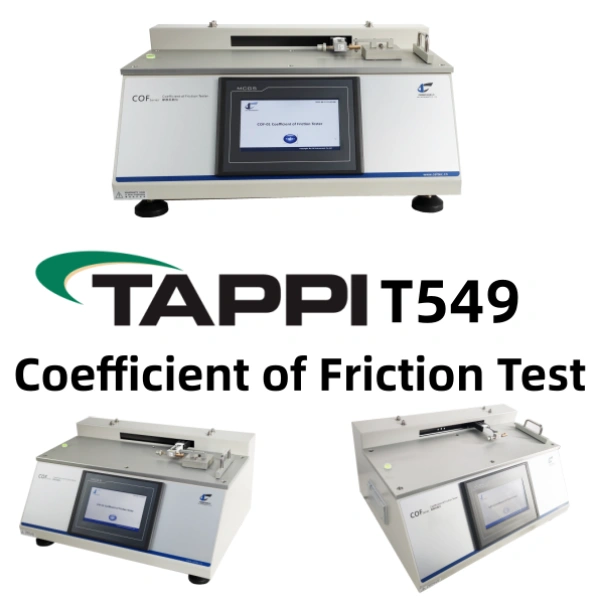
Spletna stran TAPPI T549 standard is the primary method for evaluating the preskus koeficienta trenja of uncoated writing and printing paper using the horizontal plane method. For paper manufacturers, printers, copier paper producers, and quality control laboratories, TAPPI T549 provides a reliable approach for measuring coefficient of friction to ensure smooth sheet feeding, minimize double-feeding, and improve equipment efficiency.
Unlike friction tests developed for packaging materials, TAPPI T549 focuses specifically on paper sliding against itself under controlled laboratory conditions. The test measures both static and kinetic coefficients of friction, providing valuable information for paper production, converting, printing, and end-use performance.
Why TAPPI T549 Matters
Paper handling depends heavily on surface friction. During printing, copying, collating, or automated document handling, every sheet must separate properly from the stack while maintaining stable transport through rollers and guides.
If the friction is too low:
- Multiple sheets may feed simultaneously.
- Printing accuracy decreases.
- Equipment jams become more frequent.
If the friction is too high:
- Feeding resistance increases.
- Paper transport slows down.
- Wear on transport systems may increase.
A properly controlled preskus koeficienta trenja allows manufacturers to optimize these properties before products reach customers.
What Does TAPPI T549 Measure?
TAPPI T549 determines two important friction characteristics.
| Property | Definition | Importance |
|---|---|---|
| Static COF | Force required to initiate movement | Sheet separation, feed reliability |
| Kinetic COF | Force required to maintain continuous movement | Smooth transport through equipment |
The coefficient of friction is calculated as:
μ = F / N
Kje:
- μ = coefficient of friction
- F = friction force
- N = normal force (sled weight)
Since both values use the same units, the result is dimensionless.
Principle of the TAPPI T549 Test
The standard uses the horizontal plane method.
One paper specimen is fixed to a horizontal platform.
Another specimen is attached beneath a standardized sled weighing approximately 200 g.
A motor pulls the sled across the lower specimen at a constant speed while a load cell continuously records the pulling force.
Sistem zabeleži:
- Peak force before movement (Static COF)
- Average force during sliding (Kinetic COF)
This direct force measurement provides highly repeatable results for cof testing of paper.
Standard Test Equipment
A typical coefficient of friction machine used for TAPPI T549 includes:
| Component | Function |
|---|---|
| Horizontal test platform | Holds lower specimen |
| 200 g sled | Applies standard normal load |
| Precision load cell | Measures friction force |
| Constant-speed drive system | Maintains uniform motion |
| Touchscreen controller | Test setup and data display |
| Data acquisition software | Calculates static and kinetic COF |
Modern systems automatically calculate friction coefficients and generate complete laboratory reports.
Test Conditions Specified by TAPPI T549
Several parameters are standardized to ensure repeatable results.
| Parameter | Typical Requirement |
|---|---|
| Test method | Horizontal plane |
| Sled weight | 200 ± 5 g |
| Travel speed | 150 ± 30 mm/min |
| Sliding distance | Approximately 130 mm |
| Test surfaces | Paper against itself |
| Measurements | Static and kinetic COF |
Environmental conditioning according to TAPPI atmospheric standards is recommended before testing.
Priprava vzorca
Natančno measuring coefficient of friction begins with proper specimen preparation.
Important practices include:
- Sample paper from representative production lots.
- Condition specimens before testing.
- Cut specimens carefully without damaged edges.
- Maintain machine direction identification.
- Test consecutive sheet pairs as specified by the standard.
- Avoid touching the test surfaces unnecessarily.
Good specimen preparation significantly improves test repeatability.
TAPPI T549 Test Procedure
The general workflow includes:
- Condition paper specimens.
- Level the testing instrument.
- Secure the lower specimen on the horizontal platform.
- Position the upper specimen beneath the sled.
- Connect the sled to the force measuring system.
- Start the constant-speed drive.
- Record the maximum starting force.
- Continue sliding and record average force.
- Calculate static and kinetic COF.
- Repeat for all specimen pairs.
The first movement is especially important because TAPPI T549 records friction during the initial slide rather than repeated sliding cycles.
Interpretacija rezultatov
Both measured values provide useful production information.
Static COF
Higher static friction generally improves stack stability but may increase sheet feeding resistance.
Lower static friction helps sheet separation but may increase the risk of double-feeding.
Kinetic COF
Kinetic friction affects continuous movement inside:
- Printing presses
- Digital copiers
- Laser printers
- Sheet feeders
- Automated document handling systems
Manufacturers often establish acceptable COF ranges based on equipment performance rather than a universal target value.
Applications of COF Testing of Paper
Although TAPPI T549 focuses on uncoated writing and printing paper, the testing principle supports numerous quality control activities.
Typical applications include:
- Office copy paper
- Inkjet paper
- Laser printing paper
- Notebook paper
- Book paper
- Publishing grades
- Security paper
- Specialty papers
- Paper converting
- Printing quality assurance
Regular cof testing of paper helps identify coating changes, calendering variations, fiber composition differences, and production inconsistencies.
Common Factors Affecting Friction
Several manufacturing variables influence paper friction.
Surface finish
Smoother surfaces generally produce different friction characteristics than rougher sheets.
Coatings
Surface treatments and coating formulations may significantly change friction behavior.
Moisture
Paper moisture content directly affects surface interaction.
Fiber orientation
Machine direction and cross direction often produce different friction values.
Calendering pressure
Surface densification alters contact characteristics.
Environmental humidity
Humidity influences both paper flexibility and surface adhesion.
Understanding these variables helps manufacturers maintain consistent production quality.
TAPPI T549 Compared with Related Standards
| Standard | Primary Application | Preskusna metoda |
|---|---|---|
| TAPPI T549 | Writing and printing paper | Horizontal plane |
| ASTM D1894 | Plastic film and sheeting | Horizontal plane |
| ISO 8295 | Plastic films | Horizontal plane |
| TAPPI T816 | Corrugated board and fiberboard | Horizontal plane |
| TAPPI T815 | Packaging materials | Inclined plane |
While these standards all involve friction measurement, specimen preparation, testing objectives, and result interpretation differ according to material type.
Selecting a Suitable Coefficient of Friction Machine
Sodoben coefficient of friction machine should provide:
- High-precision load cell
- Stable constant-speed motion
- Programmable test parameters
- Automatic static and kinetic COF calculation
- Real-time force curve display
- Data export capability
- Compliance with multiple international standards
- Easy fixture replacement for different materials
Laboratories that test multiple substrates often benefit from instruments supporting ASTM, ISO, GB, and TAPPI methods within one platform.
COF-01 Coefficient of Friction Machine from Cell Instruments
For laboratories performing TAPPI T549 and other international friction standards, the COF-01 Coefficient of Friction Machine from Cell Instruments provides a versatile testing solution.
Key technical features include:
- 5 N precision load cell with high measurement accuracy
- 200 ± 1 g standard sled, with custom weights available
- Test speeds supporting both 150 mm/min (ASTM/TAPPI) in . 100 mm/min (ISO)
- PLC-controlled operation with an intuitive touchscreen interface
- Stepper motor and precision ball screw drive for stable sled movement
- Automatic calculation of static and kinetic COF values
- Real-time test curves and statistical analysis
- Optional PC software, multilingual interface, microprinter, and RS-232 communication
- Custom sleds, peel testing, and peel cling force functions for specialized applications
Beyond paper testing, the COF-01 is suitable for films, paperboard, corrugated materials, textiles, composites, rubber, and other engineered materials, making it a practical solution for laboratories serving multiple industries.
Why Regular Friction Testing Improves Quality
Routine measuring coefficient of friction offers significant manufacturing benefits:
- Improves sheet feeding reliability
- Reduces printing and copier jams
- Maintains production consistency
- Supports customer quality requirements
- Verifies process adjustments
- Identifies coating or surface changes early
- Provides documented quality records
- Reduces waste and production downtime
For both paper manufacturers and commercial printers, implementing TAPPI T549 as part of routine quality assurance helps ensure consistent product performance across production batches.
Pogosto zastavljena vprašanja
What is TAPPI T549?
TAPPI T549 is a standardized horizontal plane method for determining the static and kinetic coefficient of friction of uncoated writing and printing paper as it slides against itself.
Why are both static and kinetic COF measured?
Static COF evaluates the force required to initiate movement, while kinetic COF measures the force needed to maintain continuous sliding. Together they provide a complete understanding of paper handling behavior.
Is TAPPI T549 suitable for plastic films?
No. Plastic films are generally tested using ASTM D1894 or ISO 8295. TAPPI T549 is specifically designed for writing and printing papers.
What industries commonly perform this test?
Paper manufacturing, printing, publishing, office paper production, copier paper manufacturing, quality inspection laboratories, and research institutions routinely use this method.
Accurate friction measurement is essential for producing paper that performs reliably in modern printing and document handling equipment. Whether your laboratory conducts routine quality control or develops new paper grades, selecting a precise testing solution is critical. Cell Instruments offers the COF-01 Coefficient of Friction Machine, designed to support TAPPI T549 along with ASTM, ISO, and other international standards. With configurable fixtures, automated data collection, and customizable testing solutions, it provides dependable performance for a wide range of friction testing applications.