
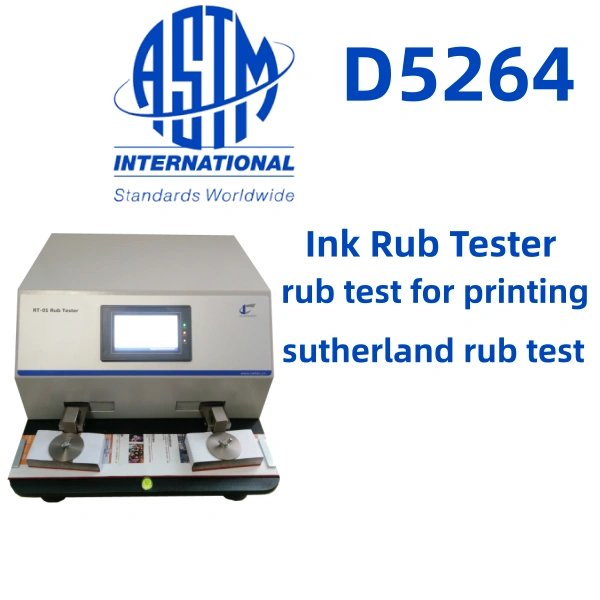
Printed information on packaging, labels, cartons, and promotional materials must remain clear and readable throughout production, transportation, storage, and consumer use. Friction during handling can cause ink smearing, color transfer, fading, or coating damage, affecting product appearance and brand reliability. The ASTM D5264 Rub Tester provides a standardized method to evaluate printed surface durability by simulating rubbing actions under controlled laboratory conditions.
Сайт ASTM D5264 Rub Tester, also known as a Sutherland rub tester, is designed to measure the abrasion resistance of printed inks, coatings, and surface finishes. By applying controlled pressure, speed, and reciprocating motion, the tester helps laboratories determine whether printed materials can withstand repeated contact and mechanical wear. This testing method is widely used by packaging manufacturers, printing companies, ink suppliers, and quality control laboratories to verify print performance before products reach the market.
Cell Instruments’ RT-01 Rub Tester provides a professional solution for rub test for printing applications, supporting dry rub, wet rub, heated rub, wet bleed, wet smear, and customized functional rubbing evaluations. The instrument helps engineers establish consistent quality standards and reduce risks associated with poor ink adhesion, weak coatings, and insufficient abrasion resistance.
What Is ASTM D5264 Rub Testing?
ASTM D5264 is a standard test method used to evaluate the resistance of printed materials to abrasion caused by rubbing. The method simulates the mechanical friction that printed surfaces experience during handling, stacking, packaging operations, and transportation.
The test typically involves rubbing a printed specimen against a receptor material using a specified load and controlled stroke motion. After a defined number of rubbing cycles, the specimen is evaluated for:
- Ink removal or fading
- Color transfer to the receptor
- Smearing or bleeding
- Surface coating damage
- Print durability under repeated friction
Unlike simple visual inspection, ASTM D5264 provides a repeatable and measurable approach for comparing different inks, coatings, substrates, and printing processes.
A professional Тестер устойчивости к истиранию чернил based on ASTM D5264 helps manufacturers identify weak points in printing systems and optimize ink formulation, curing conditions, coating selection, and substrate compatibility.
Why Ink Abrasion Resistance Testing Matters
Printed packaging serves both functional and marketing purposes. Barcodes, regulatory information, product descriptions, and brand graphics must remain intact throughout the product lifecycle.
Poor abrasion resistance may lead to:
- Unreadable labels and barcodes
- Customer complaints caused by damaged appearance
- Reduced brand image
- Product rejection during quality inspection
- Increased waste from packaging failures
Сайт ASTM D5264 Rub Tester helps companies prevent these issues by providing quantitative information about print durability.
Key Benefits of Rub Testing
| Testing Benefit | Quality Control Value |
|---|---|
| Ink durability evaluation | Confirms whether printed ink withstands mechanical friction |
| Coating performance verification | Determines resistance of varnishes and protective layers |
| Printing process optimization | Helps compare inks, substrates, and curing conditions |
| Supplier quality control | Provides objective acceptance criteria for printed materials |
| Failure prevention | Reduces packaging returns and production waste |
For industries producing high-volume printed packaging, abrasion testing is an essential part of incoming inspection, production monitoring, and product validation.
How ASTM D5264 Rub Testing Works
The ASTM D5264 test principle is based on controlled friction between two surfaces. A printed specimen is fixed onto the test platform, while a weighted receptor moves repeatedly across the printed area.
The rubbing process creates a controlled simulation of real-world wear conditions.
Basic ASTM D5264 Testing Procedure
1. Подготовка образцов
A printed sample is prepared according to the required testing conditions. The specimen should represent the actual printing structure, including:
- Printing ink layer
- Coating or varnish layer
- Paper, film, board, or other substrate
Proper sample preparation ensures accurate and repeatable results.
2. Specimen Mounting
The printed material is securely installed on the test platform. A receptor material is positioned against the printed surface to evaluate ink transfer or abrasion behavior.
3. Load Selection
The RT-01 Rub Tester supports different testing loads:
| Вес | Force |
|---|---|
| 908 g | 2 lb / 8.9 N |
| 1816 g | 4 lb / 17.8 N |
The selected load determines the rubbing intensity applied during testing.
4. Rubbing Motion
The instrument performs a controlled reciprocating arc-stroke movement.
Typical parameters include:
- Speed: 20–120 cycles per minute
- Arc length: 57 mm ± 1 mm
- Rotation radius: 185 mm
The operator can define the number of rubbing cycles according to the test requirement.
5. Result Evaluation
After testing, the receptor and printed sample are examined for:
- Amount of transferred ink
- Degree of fading
- Smearing level
- Coating damage
Results can be evaluated visually or through additional color measurement equipment when quantitative analysis is required.
Applications of ASTM D5264 Rub Tester
The ASTM D5264 Rub Tester supports multiple abrasion evaluation methods for different industry requirements.
Dry Rub Testing
Dry rub testing evaluates printed surface resistance under normal handling conditions.
Typical applications include:
- Folding cartons
- Paper labels
- Printed films
- Instruction manuals
- Promotional materials
It helps determine whether ink remains stable during transportation and daily handling.
Wet Rub Testing
Moisture can significantly affect ink durability. Wet rub testing evaluates print resistance when surfaces contact water or humidity.
Applications include:
- Beverage labels
- Food packaging
- Pharmaceutical packaging
- Household product labels
This test helps identify inks that may dissolve, transfer, or smear when exposed to moisture.
Heated Rub Testing
Some printed materials experience elevated temperatures during storage, filling, sterilization, or transportation.
A heated rub test evaluates:
- Thermal resistance of inks
- Coating stability
- Adhesion performance at higher temperatures
The RT-01 can support heated testing configurations through customization.
Wet Bleed and Wet Smear Testing
These methods evaluate the tendency of printed materials to release or spread ink under wet friction.
They are especially useful for:
- Water-sensitive labels
- Outdoor printed products
- Functional packaging materials
Materials Suitable for Rub Testing
The ASTM D5264 Rub Tester can evaluate a wide range of printed materials.
| Material Type | Типовые применения |
|---|---|
| Бумага | Labels, manuals, brochures, printed documents |
| Картон | Folding cartons and pharmaceutical boxes |
| Corrugated board | Shipping packaging |
| Plastic films | Flexible packaging and labels |
| Coated materials | Varnished and laminated surfaces |
| Printed composites | Multi-layer packaging structures |
Material selection, ink chemistry, coating formulation, and printing technology all influence abrasion resistance performance.
Industries Using ASTM D5264 Rub Test Equipment
Упаковочная промышленность
Packaging manufacturers rely on abrasion testing to ensure graphics, instructions, and identification information remain readable.
Common applications include:
- Food packaging
- Beverage labels
- Cosmetic cartons
- Consumer goods packaging
Printing Industry
Printing companies use rub testing to verify:
- Ink formulation
- Printing machine settings
- Drying and curing performance
- Customer specification compliance
Фармацевтическая упаковка
Pharmaceutical packaging requires excellent print durability because labels and instructions must remain clear throughout storage and distribution.
Applications include:
- Medicine cartons
- Blister packaging labels
- Regulatory information printing
Quality Inspection Laboratories
Independent laboratories use ASTM D5264 testing to provide standardized evaluation services for manufacturers and suppliers.
ASTM D5264 Rub Tester Technical Features
Cell Instruments RT-01 Rub Tester is designed for professional laboratory testing with accurate motion control and flexible testing functions.
Main Features
- Supports ASTM D5264 and related rub testing standards
- Adjustable rubbing speed from 20–120 cpm
- Two standard test weights available
- HMI touchscreen operation
- Real-time display of stroke count and speed
- Supports dry, wet, and customized testing methods
- Compact laboratory design
- Suitable for quality control and R&D applications
Технические характеристики
| Параметр | Технические характеристики |
|---|---|
| Модель | RT-01 Rub Tester |
| Weight Options | 908 g (2 lb), 1816 g (4 lb) |
| Диапазон скоростей | 20–120 cpm |
| Specimen Quantity | 1–2 specimens |
| Длина дуги | 57 мм ± 1 мм |
| Радиус вращения | 185 мм |
| Размеры | 390 × 480 × 220 mm |
| Источник питания | 110–220 V, 50/60 Hz |
ASTM D5264 and Related Rub Testing Standards
ASTM D5264 is one of the commonly referenced standards for printed material abrasion evaluation. Depending on the material type and application, laboratories may also consider additional standards.
| Стандарт | Приложение |
|---|---|
| ASTM D5264 | Abrasion resistance of printed materials using a rub tester |
| TAPPI T830 | Rub resistance testing for printed packaging materials |
| ASTM F1571 | Printing performance evaluation for packaging applications |
| ASTM F2497 | Printing and labeling durability-related evaluation |
Selecting the correct standard depends on the substrate, printing process, industry requirements, and customer specifications.
How to Select an Ink Abrasion Resistance Tester
When selecting equipment for ASTM D5264 testing, laboratories should consider:
Test Standard Compatibility
The instrument should support required standards and allow accurate control of test parameters.
Load Accuracy
Consistent pressure application is critical because different loads can produce significantly different abrasion results.
Motion Control
Stable rubbing speed and stroke movement improve repeatability between operators and laboratories.
Testing Flexibility
Modern testing requirements often include dry, wet, heated, and customized tests. A flexible platform provides better long-term value.
Управление данными
Digital control systems simplify operation, improve traceability, and support quality documentation.
Improve Printing Quality Control with ASTM D5264 Testing
Reliable print durability testing allows manufacturers to move from subjective inspection toward measurable quality control. The ASTM D5264 Rub Tester provides engineers with practical data to compare inks, coatings, and substrates before large-scale production.
For packaging and printing companies, implementing a standardized sutherland rub test helps reduce production risks, improve supplier evaluation, and ensure finished products maintain their appearance throughout the supply chain.
Cell Instruments provides professional testing solutions, including standard rub testers, customized fixtures, and application-specific testing systems designed for packaging, printing, medical, pharmaceutical, and industrial material evaluation.
Заключение
Сайт RT-01 Rub Tester is a professional instrument designed to evaluate the abrasion resistance and durability of printed inks, coatings, and surface finishes. It performs controlled rubbing tests under adjustable pressure, speed, and cycle conditions to simulate real handling and transportation wear. Supporting ASTM D5264 and related standards, the tester is suitable for dry rub, wet rub, smear, bleed, and customized abrasion evaluations. It helps packaging manufacturers, printers, and laboratories verify print quality, improve coating performance, and ensure consistent product appearance.