
Introduction to ASTM D6636
ASTM D6636 defines a standardized procedure to evaluate the ply adhesion strength of reinforced geomembranes using a 180° peel configuration. Engineers and quality control professionals rely on this method to assess bonding integrity between layers in multilayer geomembrane structures.
Reinforced geomembranes are widely used in containment systems such as landfills, mining ponds, and water reservoirs. Their performance depends heavily on interlayer adhesion. ASTM D6636 provides a quantifiable and repeatable index test to ensure consistent product quality.
Geomembrane 180 Peel Test
The geomembrane 180 peel test measures the force required to separate bonded plies at a constant angle and speed. The test simulates real-world stresses where delamination may occur.
Key Concept:
- A specimen is partially separated manually (25–50 mm)
- Both ends are clamped into a tensile testing machine
- The plies are pulled apart at 180°
- Force vs. displacement is continuously recorded
Why 180°?
This configuration ensures uniform stress distribution across the bond interface, making results more reliable for comparison.
Ply Adhesion Strength of Geomembranes
The ply adhesion strength of geomembranes directly impacts:
- Long-term durability
- Resistance to delamination
- Structural integrity under stress
- Environmental protection performance
ASTM D6636 emphasizes that acceptable adhesion values vary by product type. Therefore, manufacturers and clients must define minimum acceptable thresholds based on application requirements.
Important Insight: If tearing occurs instead of separation, adhesion strength exceeds the material’s tear strength—an indicator of strong bonding.
ASTM D6636 Test Procedure Overview
Pregătirea specimenului
- Pre-peel plies manually (25–50 mm)
- Ensure clean, undamaged edges
- Maintain consistent specimen width
Test Conditions
- Temperature: 21 ± 2°C
- Humidity: 50–70% RH
- Viteza: 50 mm/min (constant)
Execution Steps
- Clamp both peeled ends securely
- Align specimen to avoid twisting
- Mențineți 180° separation angle
- Start test and record force over at least 100 mm separation distance
Special Case Handling
- If tearing occurs:
- Cut the tearing ply and continue
- Record the maximum force
- Report as tear-limited result
Calculation of Ply Adhesion Strength
The adhesion strength is calculated as:
SPA = F / W
Unde:
- SPA = Ply adhesion strength (N/m)
- F = Force applied (N)
- W = Specimen width (m)
Results are typically reported as an average of multiple specimens to ensure statistical reliability.
Geomembrane Peel Strength Tester: Equipment Selection
Un produs de încredere geomembrane peel strength tester is essential for accurate ASTM D6636 results. The testing system must deliver:
- Precise speed control (50 mm/min)
- Stable force measurement
- Consistent displacement accuracy
- Smooth motion without vibration
Soluție recomandată: Tester de tracțiune Cell Instruments
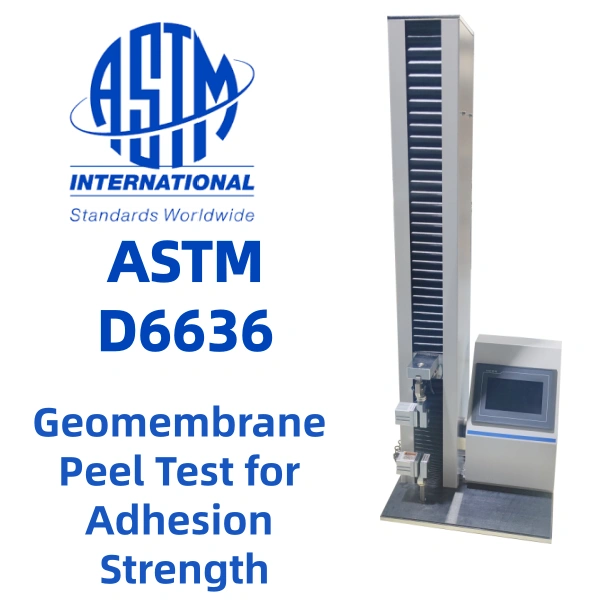
The TST-01 Tester de tracțiune is well-suited for ASTM D6636 applications due to:
- High-precision ball screw system ensuring smooth peel motion
- Gamă largă de viteze (1-500 mm/min) for flexible testing
- PLC-controlled system with real-time curve display
- Compatibilitate cu mai multe corpuri de iluminat for peel and tensile tests
- Accurate force measurement (±0.5% FS)
Its modular fixture design allows seamless adaptation to 180° peel configurations, making it ideal for geomembrane testing laboratories.
Ensure reliable geomembrane performance with ASTM D6636 testing. This method accurately measures ply adhesion strength using a controlled 180° peel test, helping you verify bonding integrity and meet project standards. With advanced tensile testing solutions from Cell Instruments, you can achieve precise, repeatable results and improve quality control efficiency. Upgrade your testing capabilities today to ensure consistent product performance in demanding environmental applications.
Interpretation of Test Results
Understanding ASTM D6636 results requires attention to failure modes:
Adhesive Failure
- Clean separation between plies
- Indicates true adhesion strength
Cohesive/Tear Failure
- Material tears before separation
- Suggests adhesion exceeds material strength
Variability Considerations
- Adhesion may vary:
- Between plies
- Along the same specimen
- Always test multiple samples for accuracy
Întrebări frecvente
1. What does ASTM D6636 measure?
It measures the force required to peel apart bonded layers in reinforced geomembranes under a 180° configuration.
2. What is the standard test speed in ASTM D6636?
The test runs at a constant speed of 50 mm/min to ensure consistency.
3. What happens if the specimen tears during testing?
Tearing indicates that adhesion strength exceeds tear strength, and the result should be reported accordingly.
4. Why is a 180° peel angle used?
A 180° angle provides uniform stress distribution, improving result reliability and repeatability.
5. How many samples should be tested?
Multiple specimens should be tested, and results reported as an average value to ensure accuracy.