
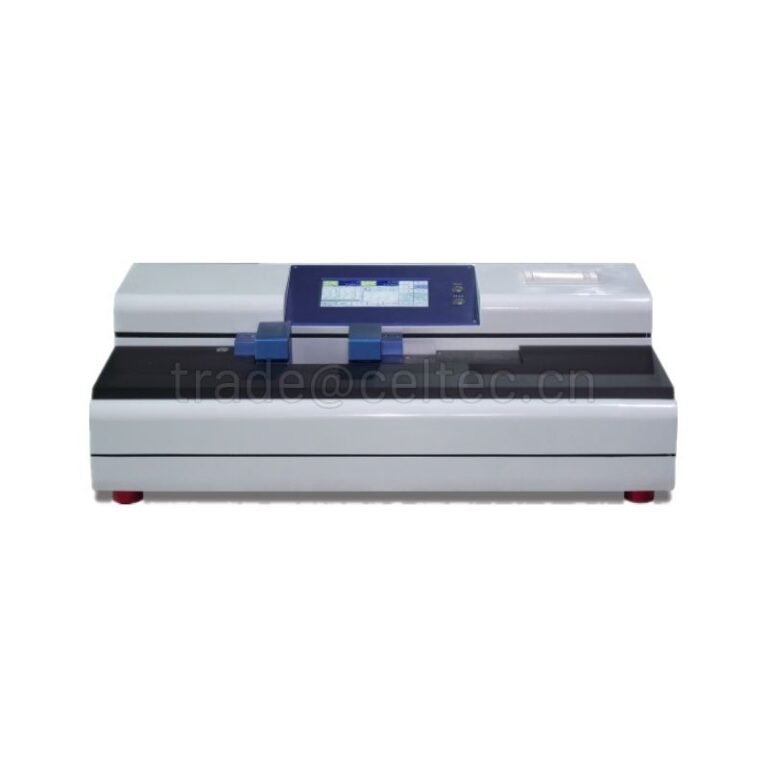
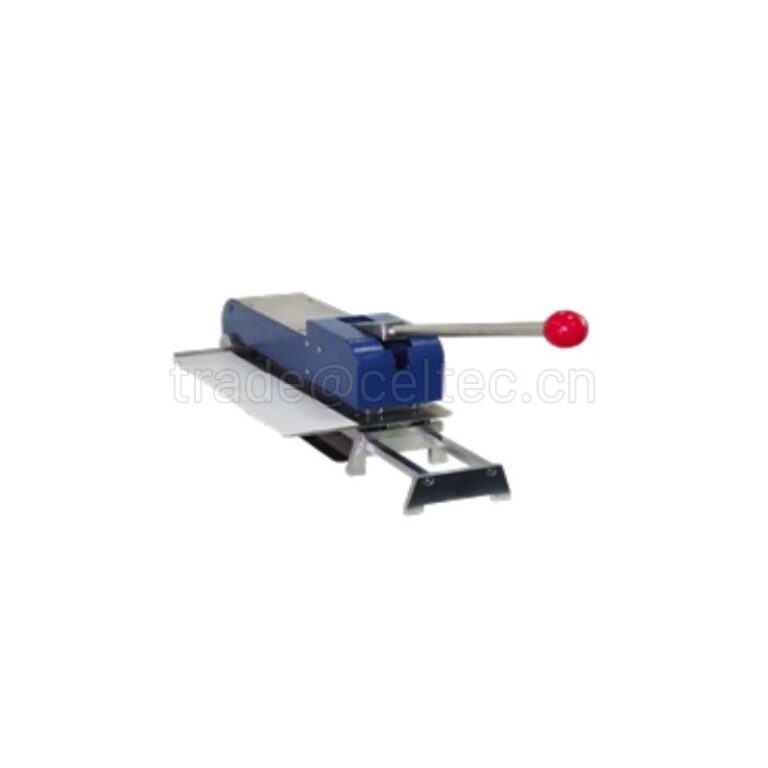
1. Introduction of TST-H Horizontal Tensile Tester
TST-H Horizontal Tensile Tester is a constant-rate-of-elongation equipment which is used for the determination of the tensile strength, stretch at maximum force and tensile energy absorption, tensile stiffness of paper,paperboard, tissue paper and tissue products. It also calculating the tensile index and the tensile energy absorption index.
Terms
Tensile strength:
Maximum tensile force per unit width that a test piece will withstand before breaking.
Tensile index:
Tensile strength divided by grammage.
Stretch at maximum force:
Ratio of the elongation of a test piece, over its initial length, at the moment when the maximum tensile force is reached during a tensile test. Stretch at maximum force is expressed as a percentage of the initial test span length.
Tensile energy absorption TEA:
Amount of energy absorbed per unit surface area of a test piece while being stretched under application of tensile force, until the onset of break (the moment of maximum tensile force)
Tensile energy absorption index:
Tensile energy absorption divided by grammage

Main Functions of Horizontal Tensile Tester
Tensile Strength Measurement: It measures the maximum stress that a material can withstand while being stretched or pulled before breaking.
Elongation at Break: The tester can determine how much a material can stretch before it breaks, which is crucial for understanding material elasticity.
Yield Strength: It can identify the point at which a material begins to deform permanently under tension.
Modulus of Elasticity: The tester helps calculate the ratio of stress to strain in the elastic limit of a material, indicating its stiffness.
Main Purposes of Horizontal Tensile Tester
Quality Control: To ensure that materials meet specific standards and specifications, especially in manufacturing processes.
Material Research: For developing new materials or improving existing ones by understanding their mechanical properties.
Product Development: To test the durability and performance of products made from various materials, aiding in the design process.
Failure Analysis: To investigate why a material failed under certain conditions, helping to prevent future failures.
2. Benefits of Horizontal Tensile Tester
Single-column structure precision ball screw for stable transmission and higher testing accuracy.
7-inch touchscreen operation, User-friendly
Wet tensile strength water tank meets the requirements of wet testing (Optional)
Computer Connectivity for control and data storage (optional)
Modular thermal printer enables instant printing of test reports
3. Test Principle of Horizontal Tensile Tester
A test piece of given dimensions, is stretched to break at a constant rate of elongation using TST-H Horizontal Tensile Tester that measures and records the tensile force as a function of the elongation of the test piece.
From the recorded data, the tensile strength, the corresponding stretch at maximum force and the tensile energy absorption can be calculated.
4. Specifications of Horizontal Tensile Tester
| TST-H | |
| Measurement range | 30N, 500N or as required |
| Elongation measurement range | 45-260mm |
| Stretching speed: | (1~500) mm/min |
| Return speed | 100mm/min |
| Clamp spacing | 1~250mm |
| Test speed accuracy | (1~10) mm/min: ±0.1mm/min |
| sampling frequency | 400 Times/S |
| Accuracy | ≤±0.5% |
| Force accuracy | ±0.1% (20~100%FS) |
| Deformation resolution | ≤0.1mm |
| Sample Clamping | pneumatic |
| Clamping pressure | 0.2-0.7Mpa (adjustable) |
| Sample size | 1-25mm |
| Human-machine interface | 7 in touch screen |
| Printout | embedded thermal printer. |
| Power | AC 220V 50Hz |
| Dimension | 650*500*400mm |
5. Standards of Horizontal Tensile Tester
GB/T12914, GB/T 24328.3, GB/T 24328.4, GB/T 24328.5, QB/T5560, ISO 1924-1, ISO 1924-2, ISO 1924-3, ISO 12625-4, ISO 12625-5, TAPPI T494
6. FAQs of Horizontal Tensile Tester
What is Tensile strength?
The maximum tensile force developed in a test specimen before rupture on a tensile test carried to rupture under prescribed conditions. Tensile strength (as used here) is the force per unit width of test specimen.
What is Stretch?
The maximum tensile strain developed in the test specimen before rupture in a tensile test carried to rupture under prescribed conditions. The stretch (or percentage elongation) is expressed as a percentage, i.e., one hundred times the ratio of the increase in length of the test specimen to the original test span.
What is Tensile energy absorption (TEA)?
The work done when a specimen is stressed to rupture in tension under prescribed conditions as measured by the integral of the tensile strength over the range of tensile strain from zero to maximum strain. The TEA is expressed as energy per unit area (test span width) of test specimen.
What is Tensile stiffness?
The ratio of tensile force per unit width to tensile strain within the elastic region of the tensile-strain relationship. The elastic region of the tensile-strain relationship is the linear portion of the load-elongation relationship up to the elastic limit. The elastic limit is the maximum tensile force above which the load-elongation relationship departs from linearity. (Tensile stiffness is numerically equivalent to E·t, where E is the modulus of elasticity and t is sample thickness.)
What is Breaking length?
The calculated limiting length of a strip of uniform width, beyond which, if such a strip were suspended by one end, it would break of its own weight.
What is Tensile index?
The tensile strength in N/m divided by grammage.
If you have purchase needs, please contact us oraz Cell Instruments will give you satisfactory products.

 Polski
  English
  العربية
  Български
  Čeština
  Dansk
Dansk  Deutsch
  Ελληνικά
  Español
  Eesti
Eesti  Suomi
Suomi  Français
  Magyar
  Bahasa Indonesia
  Italiano
  日本語
日本語  한국어
한국어  Lietuvių kalba
  Latviešu valoda
  Norsk bokmål
  Nederlands
  Português
  Română
  Русский
  Slovenčina
  Slovenščina
  Svenska
  Türkçe
  Українська