
Paper products used in packaging, printing, labeling, and industrial applications must withstand mechanical stresses during converting, transportation, and end use. ASTM D689 provides a standardized approach for evaluating the tear resistance test of paper by measuring the force required to continue a tear after it has been initiated. Using the well-established Elmendorf method, the standard enables laboratories and manufacturers to compare materials objectively, optimize product performance, and maintain consistent production quality. Whether evaluating lightweight tissue, printing paper, packaging paper, or specialty grades, ASTM D689 supplies repeatable testing procedures that support material development and quality assurance.
What Is ASTM D689?
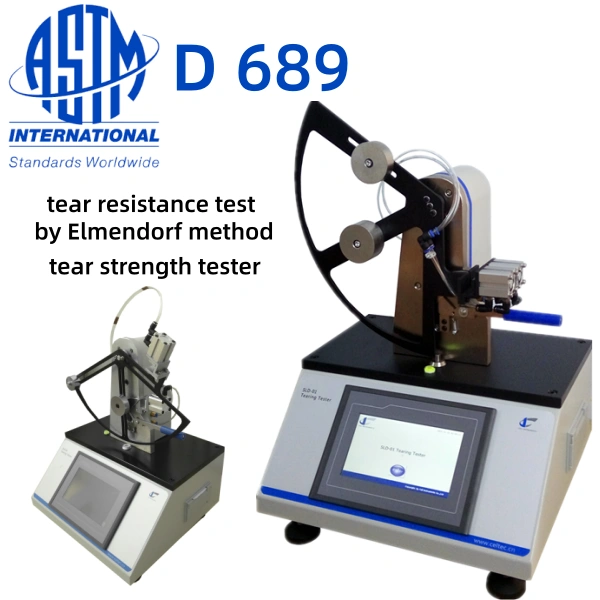
ASTM D689 is a standardized test method for determining the tearing resistance of paper using the Elmendorf method. Instead of measuring the force required to create the initial tear, the test quantifies the energy needed to propagate an existing cut through a specified distance.
The method has become one of the most widely accepted laboratory procedures because it provides:
- Excellent repeatability
- Fast testing
- Standardized specimen preparation
- Reliable comparison between paper grades
- Practical data for production quality control
The standard is extensively used by:
- Paper manufacturers
- Packaging converters
- Printing companies
- Quality inspection laboratories
- Mokslinių tyrimų ir plėtros centrai
- Universities and testing institutes
Why Perform a Tear Resistance Test of Paper?
Paper products experience tearing forces throughout their service life.
Typical situations include:
- Opening paper packaging
- Folding cartons
- Label application
- Printing operations
- High-speed converting
- Transport handling
- Consumer use
A tear resistance test of paper helps determine whether a material can resist accidental tear propagation while maintaining usability.
Typical quality objectives include:
| Quality Objective | Benefit |
|---|---|
| Evaluate material durability | Reduce product failure |
| Compare paper grades | Support material selection |
| Verify production consistency | Improve process stability |
| Optimize fiber formulation | Balance strength and cost |
| Support product development | Enhance end-use performance |
Understanding the Elmendorf Method
Svetainė Elmendorf method was originally developed by Armin Elmendorf and remains the industry standard for measuring tear propagation.
Unlike tensile testing, which stretches an entire specimen, the Elmendorf test measures the energy absorbed as a pendulum continues tearing a pre-cut sample.
The basic principle includes:
- A standardized specimen is prepared with a precise slit.
- The specimen is clamped securely.
- A pendulum is released from a known height.
- The pendulum tears the specimen.
- Energy loss is converted into tear resistance.
Because the pendulum supplies a fixed amount of energy, the amount remaining after tearing directly represents the energy consumed by the material.
This simple but highly repeatable principle makes the Elmendorf method especially suitable for routine laboratory testing.
Test Principle According to ASTM D689
The tearing resistance measured under ASTM D689 represents the average force required to continue an existing tear.
The procedure generally consists of:
- Preparing conditioned specimens
- Cutting a precise starter slit
- Clamping the specimen
- Selecting an appropriate pendulum capacity
- Releasing the pendulum
- Recording tear energy
- Calculating average tearing resistance
Unlike burst or tensile testing, the tear progresses rapidly, allowing the material’s resistance to crack propagation to be evaluated.
Bandymo procedūra
A typical ASTM D689 test includes the following steps.
Sample Conditioning
Paper specimens are conditioned under controlled laboratory temperature and humidity to minimize environmental effects.
Bandinių paruošimas
Samples are cut to standard dimensions, and a precise starter slit is introduced using a dedicated cutting knife.
Proper specimen preparation is critical because inaccurate cuts directly influence tear propagation.
Instrument Setup
Svetainė Elmendorf tear strength tester is configured with:
- Appropriate pendulum capacity
- Zero calibration
- Specimen clamps
- Test parameters
Testo atlikimas
The operator:
- Mounts the specimen
- Closes the clamps
- Releases the pendulum
- Allows the tear to propagate automatically
The instrument measures energy loss during the tearing event.
Data Processing
Modern instruments automatically calculate:
- Individual tear values
- Average tear resistance
- Statistical analysis
- Standartinis nuokrypis
- Optional tear index
Factors Affecting Tear Resistance
Several material characteristics influence test results.
Fiber Properties
Longer fibers generally produce higher tear resistance because they require greater energy to separate.
Fiber Orientation
Machine direction and cross direction often produce different tear values.
Paper Basis Weight
Heavier papers may exhibit greater tearing resistance, although fiber bonding also plays an important role.
Moisture Content
Paper properties are highly dependent on conditioning humidity.
Coatings and Surface Treatments
Coatings may either increase or decrease tear propagation depending on formulation.
Taikymas įvairiose pramonės šakose
Svetainė tear resistance test of paper supports quality assurance in numerous industries.
Pakuotė
- Shopping bags
- Folding cartons
- Wrapping papers
- Kraft paper
- Industrial packaging
Printing
- Book paper
- Copy paper
- Magazine paper
- Label stock
Maisto produktų pakuotės
- Baking papers
- Greaseproof paper
- Flexible paper packaging
Medicininė pakuotė
- Sterilization paper
- Medical wrapping paper
- Barrier paper materials
Specialty Paper
- Filter paper
- Decorative paper
- Electrical insulation paper
ASTM D689 vs Other Tear Test Standards
Different materials require different tear testing methods.
| Standartinis | Typical Material | Bandymo metodas |
|---|---|---|
| ASTM D689 | Paper | Elmendorf tear test |
| ASTM D1922 | Plastic film | Elmendorf tear test |
| ISO 6383-1 | Plastic films | Pendulum tear method |
| TAPPI T414 | Paper | Internal tearing resistance |
| ISO 1974 | Paper | Elmendorf tear method |
Although the testing principles are similar, specimen dimensions, reporting methods, and applicable materials differ between standards.
Choosing an Elmendorf Tear Strength Tester
Selecting an appropriate Elmendorf tear strength tester requires consideration of several factors.
Important features include:
- Multiple pendulum capacities
- Automatic pendulum release
- Pneumatic specimen clamping
- Accurate calibration
- PLC valdymas
- Touchscreen interface
- Automatic statistical calculations
- Data export capability
- Compliance with ASTM and ISO standards
For laboratories handling diverse materials, interchangeable pendulum capacities provide greater flexibility while maintaining measurement accuracy.
Cell Instruments SLD-01 Tear Tester
For laboratories performing testing in accordance with ASTM D689, , SLD-01 Tear Tester from Cell Instruments offers a practical solution for standardized tear resistance measurement.
Key features include:
- PLC-controlled operation with an intuitive touchscreen interface
- Pneumatic specimen clamping for consistent gripping force
- Automatic pendulum release to minimize operator variability
- Multiple pendulum capacities ranging from 200 gf to 6400 gf
- Calibration weights for routine verification
- Automatic statistical analysis of test data
- Optional professional software for advanced reporting
- Optional RS-232 communication and micro-printer
- Optional paper-specific reporting units, including mN and tear index
The system is suitable for routine quality control, research laboratories, production monitoring, and product development involving paper, paperboard, flexible films, textiles, nonwovens, and composite materials.
Benefits of ASTM D689 Testing in Quality Control
Įgyvendinti ASTM D689 testing provides measurable benefits throughout manufacturing.
These include:
- Early detection of raw material variation
- Improved production consistency
- Better product reliability
- Faster supplier qualification
- Reduced customer complaints
- Support for product development
- Objective acceptance criteria
- Standardized laboratory reporting
Routine tear testing also assists manufacturers in balancing strength, weight, and production cost while ensuring products meet application requirements.
Išvada
ASTM D689 remains one of the most important standards for evaluating the tear resistance test of paper using the proven Elmendorf method. By measuring the energy required to propagate an existing tear, the method delivers reliable, repeatable data that supports product development, process optimization, and quality assurance. When paired with a modern Elmendorf tear strength tester such as the Cell Instruments SLD-01 Tear Tester, laboratories can achieve accurate measurements, streamlined workflows, and consistent compliance with international testing practices.