
What Is ASTM D1709?
ASTM D1709, Standard Test Methods for Impact Resistance of Plastic Film by the Free-Falling Dart Method, specifies procedures for determining the impact resistance of plastic films and sheets.
The test measures the energy required to cause failure of a specimen when struck by a hemispherical dart dropped from a specified height. Results are typically reported as the dart mass or impact energy corresponding to a statistically determined 50% failure rate.
Svetainė dart impact test standard is commonly applied to:
- Polyethylene (PE) films
- Linear low-density polyethylene (LLDPE) films
- Low-density polyethylene (LDPE) films
- High-density polyethylene (HDPE) films
- Multilayer barrier films
- Stretch films
- Shrink films
- Agricultural films
- Medical packaging films
- Pharmaceutical packaging materials
- Industrial protective films
Understanding the ASTM D1709 Test Methods
The standard includes two primary testing methods.
Test Method A
Method A uses:
| Parameter | Requirement |
|---|---|
| Dart Head Diameter | 38.1 mm |
| Drop Height | 660 mm |
| Typical Test Range | Approximately 50 g to 6 kg |
Method A is commonly used for thinner and lower-impact-resistance films.
Test Method B
| Parameter | Requirement |
| Dart Head Diameter | 50.8 mm |
| Drop Height | 1520 mm |
| Typical Test Range | Approximately 300 g to 6 kg |
Method B is generally selected for stronger films requiring higher impact energies.
Results obtained from Method A and Method B should not be directly compared because the test conditions differ significantly.
How Does the Dart Drop Test Method Work?
Svetainė dart drop test method evaluates the ability of a plastic film specimen to resist failure from a controlled impact.
The basic principle involves:
- Clamping a specimen securely in a circular fixture.
- Selecting an appropriate dart weight.
- Positioning the dart at the specified height.
- Releasing the dart vertically.
- Observing whether the specimen fails.
- Adjusting dart weight according to the testing procedure.
- Determining the impact failure weight corresponding to a 50% failure probability.
The test simulates real-world impact conditions encountered by packaging materials during handling and distribution.
Staircase Testing Technique
The staircase method is the primary procedure specified in ASTM D1709.
In this approach:
- One specimen is tested at a time.
- The dart weight is increased after a non-failure result.
- The dart weight is decreased after a failure result.
- A constant weight increment is used throughout testing.
This method efficiently identifies the impact level at which approximately half of the specimens fail.
Typical Staircase Sequence
| Test Number | Dart Weight | Result |
| 1 | 300 g | Pass |
| 2 | 330 g | Pass |
| 3 | 360 g | Fail |
| 4 | 330 g | Pass |
| 5 | 360 g | Fail |
The sequence continues until the required number of failures and non-failures is achieved.
Alternative Group Testing Technique
The alternative procedure tests specimens in groups of ten.
For each group:
- One dart weight is selected.
- The percentage of failures is recorded.
- Dart weight is adjusted between groups.
Testing continues until sufficient data points are generated to establish the 50% failure level.
This method is often used in research and material characterization programs.
Equipment Required for ASTM D1709 Testing
A compliant dart drop impact tester should include:
Dart Assembly
- Hemispherical dart heads
- Precision weight system
- Incremental mass adjustments
- Standard-compliant dimensions
Dart Release Mechanism
- Electromagnetic or pneumatic release
- Precise vertical alignment
- Repeatable drop conditions
Measurement System
- Impact result calculations
- Data recording
- Statistical analysis capability
Specimen Clamping System
- Annular clamp structure
- Uniform clamping pressure
- Slip-resistant design
- Consistent specimen positioning
Saugos funkcijos
- Protective shielding
- Dart recovery protection
- Operator safety mechanisms
ASTM D1709 Dart Drop Impact Tester from Cell Instruments
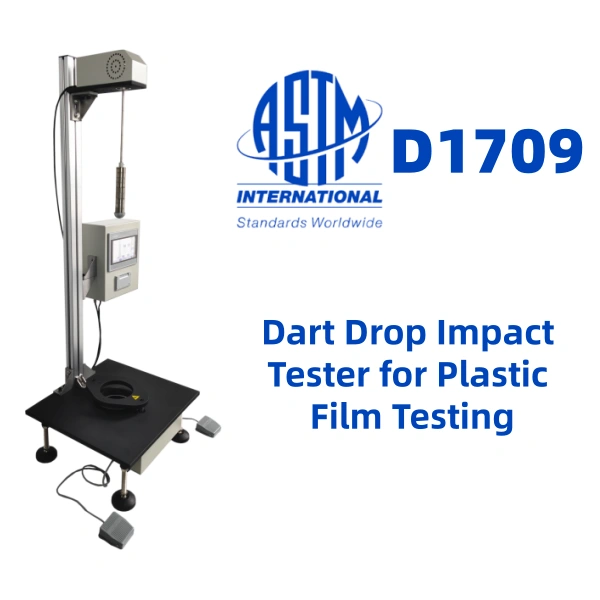
Cell Instruments offers a professional dart drop impact tester designed for ASTM D1709 dart impact test for plastic film applications.
Key Features
Smart Control System
- PLC-based industrial control
- 7-inch touchscreen interface
- Intuitive operation
- Stable performance
High-Precision Dart Release
- Electromagnetic suspension system
- Consistent dart release
- Excellent repeatability
Enhanced Operator Safety
- Foot-switch operation
- Dedicated test button
- Integrated observation light
Pneumatic Clamping
- Secure specimen fixation
- Reduced specimen distortion
- Improved test consistency
Data Management Options
- Optional micro-printer
- Optional software package
- Report generation and export capabilities
Automatic Result Processing
- Automatic calculation of impact results
- Elimination of manual calculations
- Improved testing efficiency
- Reduced operator error
Techninės specifikacijos
| Prekė | Specifikacija |
| Bandymo metodas | ASTM D1709 Method A / Method B (Optional) |
| Bandymų diapazonas | Method A: 50–2000 g |
| Method B: 300–2000 g | |
| Strėlės skersmuo | Method A: 38 ± 1 mm |
| Method B: 50 ± 1 mm | |
| Poveikio aukštis | 660 mm / 1500 mm |
| Tikslumas | 0.1 g (0.1 J) |
| Clamp Type | Pneumatinis spaustukas |
| Dujų tiekimas | 0,6 MPa |
| Pavyzdžio dydis | >150 mm × 150 mm |
| Maitinimo šaltinis | AC 110–220 V, 50 Hz |
Related Impact Testing Standards
Organizations often use ASTM D1709 alongside other packaging and film testing standards.
| Standartinis | Aprašymas |
| ASTM D3420 | Pendulum impact resistance of plastic film |
| ASTM D882 | Tensile properties of thin plastic sheeting |
| ASTM D1922 | Elmendorf tear resistance |
| ISO 7765-1 | Free-falling dart impact test, staircase method |
Choosing the Right Dart Impact Testing Solution
When selecting equipment for ASTM D1709 compliance, laboratories should evaluate:
- Method A and Method B capability
- Automation level
- Result calculation functions
- Data management requirements
- Repeatability and accuracy
- Safety design
- Future testing needs
A properly designed dart drop impact tester enables reliable impact resistance evaluation, supports quality assurance programs, and helps manufacturers develop stronger, more durable plastic film products.