
ASTM D2659 Overview
Packaging containers must maintain structural stability throughout filling, transportation, stacking, and storage. ASTM D2659 provides a standardized method for evaluating the column crush properties of blown thermoplastic containers, helping manufacturers understand how containers respond to vertical compression forces. A reliable top load tester for PET bottles enables engineers to measure container strength, identify deformation risks, and optimize packaging designs before products reach the market.
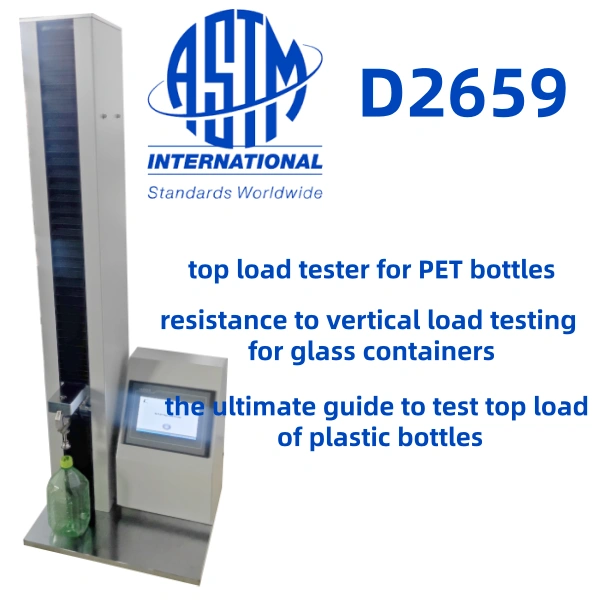
The TLT-01 Top Load Tester from Cell Instruments is designed for accurate vertical compression testing of plastic bottles, glass containers, drums, cartons, trays, and other packaging products. By applying controlled top-down force and recording load-displacement behavior, the system helps manufacturers verify packaging performance, improve material efficiency, and ensure compliance with international testing requirements, including ASTM D2659, ASTM D642, ASTM D4577, ASTM D4169, and ISO 8113.
What Is ASTM D2659 Top Load Testing?
ASTM D2659 is a standard test method used to determine the column crush properties of blown thermoplastic containers. The test evaluates the ability of hollow plastic containers, such as PET bottles and HDPE containers, to withstand vertical compressive loads without excessive deformation or structural failure.
During transportation and warehouse storage, containers often experience downward forces caused by:
- Stacking multiple layers of products
- External compression during logistics handling
- Temperature-related material changes
- Internal pressure variations
- Packaging weight accumulation
A container with insufficient vertical strength may collapse, buckle, or deform, causing product leakage, reduced shelf appearance, and increased transportation losses.
ASTM D2659 top load testing provides quantitative data about:
- Maximum compression force before failure
- Container deformation behavior
- Load-bearing capacity
- Structural stability under vertical pressure
This information allows packaging engineers to improve bottle geometry, material thickness, resin selection, and manufacturing processes.
Why Is Top Load Testing Important for Plastic Containers?
Plastic packaging design requires a balance between strength and material efficiency. Increasing wall thickness may improve compression resistance, but it also increases production costs and material consumption. Top load testing helps engineers find the optimal design point.
Protect Product Safety During Transportation
PET bottles, plastic containers, and glass packages experience significant mechanical stress during distribution. A weak container may collapse when stacked, especially in high-density storage environments.
By performing compression testing according to ASTM D2659, manufacturers can confirm that containers maintain sufficient strength under expected loading conditions.
Optimize Lightweight Packaging Design
Many industries are reducing packaging weight to lower costs and environmental impact. However, lightweight designs require careful mechanical validation.
Top load testing helps engineers determine whether thinner containers can still meet performance requirements by analyzing:
- Peak compression strength
- Deformation characteristics
- Failure points
- Structural recovery behavior
Improve Quality Control and Production Consistency
Bottle manufacturing processes can produce variations caused by:
- Material distribution differences
- Molding conditions
- Temperature fluctuations
- Equipment adjustments
Routine ASTM D2659 testing allows manufacturers to monitor production stability and quickly identify quality issues.
Reduce Product Damage and Return Costs
Packaging failure can result in:
- Damaged products
- Customer complaints
- Transportation losses
- Brand reputation problems
Reliable compression testing provides confidence that packaging can withstand real-world handling conditions.
The Ultimate Guide to Test Top Load of Plastic Bottles
The ultimate guide to test top load of plastic bottles begins with understanding the relationship between applied force and container deformation. A professional top load test system applies a controlled vertical load while continuously measuring compression force and displacement.
Testing Principle
The principle of top load testing is straightforward:
- The container is positioned vertically between compression platens.
- The upper platen moves downward at a controlled speed.
- Vertical force is gradually applied to the container.
- The instrument records force and deformation data.
- The maximum load or specified deformation point is analyzed.
The resulting data shows how the container performs under vertical compression.
The basic test evaluation includes:
| Test Parameter | Kuvaus |
|---|---|
| Suurin sallittu kuorma | Highest compression force the container withstands |
| Muodonmuutos | Change in container height during loading |
| Collapse Point | Force level where structural failure occurs |
| Load Stability | Ability to maintain strength under compression |
How Is ASTM D2659 Testing Performed?
A typical ASTM D2659 top load test procedure includes the following steps:
Näytteen valmistelu
Before testing, samples should be prepared according to the required test conditions.
Engineers typically consider:
- Container type and size
- Material type
- Manufacturing batch
- Storage condition
- Conditioning environment
For PET bottle testing, samples should represent normal production conditions.
Sample Positioning
The container is placed vertically between two parallel compression plates.
Proper alignment is essential because uneven loading may create inaccurate results.
Compression Loading
The top platen moves downward at a controlled speed while the system measures force and displacement.
The TLT-01 Top Load Tester supports adjustable testing programs, allowing users to select different testing modes depending on application requirements:
- Peak Load Test – Measures the maximum compression force before failure.
- Fixed Deformation Test – Determines the load at a specified deformation value.
- Fixed Load Test – Evaluates deformation behavior under a defined force.
- Single Compression Test – Performs one complete compression cycle.
- Cyclic Compression Test – Evaluates repeated loading performance.
Tietojen analysointi
After testing, engineers analyze:
- Maximum compression strength
- Deformation curve
- Container stability
- Batch-to-batch variation
These results support packaging optimization and quality control decisions.
Top Load Tester for PET Bottles and Glass Container Testing
Different packaging materials require different approaches to compression evaluation. A versatile compression testing system can support various container applications.
Top Load Tester for PET Bottles
PET bottles are widely used in:
- Beverage packaging
- Carbonated drinks
- Water bottles
- Household products
- Personal care products
PET containers must maintain vertical strength while minimizing material usage.
A top load tester for PET bottles helps evaluate:
- Bottle shoulder strength
- Neck stability
- Base design performance
- Lightweight bottle durability
For manufacturers producing high-volume PET packaging, compression testing is an essential part of product development and production quality management.
Resistance to Vertical Load Testing for Glass Containers
Glass packaging requires careful evaluation because vertical loads may create stress concentrations that lead to cracking or breakage.
The resistance to vertical load testing for glass containers evaluates how glass bottles and jars withstand compression forces applied along their vertical axis.
Applications include:
- Pharmaceutical glass bottles
- Food jars
- Beverage containers
- Cosmetic packaging
Testing helps manufacturers verify container safety during:
- Filling operations
- Capping processes
- Transportation
- Warehouse stacking
TLT-01 Top Load Tester Technical Features
The TLT-01 Top Load Tester provides a professional solution for packaging compression evaluation.
| Technical Parameter | Tekniset tiedot |
|---|---|
| Testialue | 0–1000 N (customizable) |
| Maximum Sample Height | 700 mm |
| Maximum Sample Diameter | 120 mm |
| Testinopeus | 1–500 mm/min |
| Siirtymän tarkkuus | 0,01 mm |
| Voiman tarkkuus | ±0.5% Full Scale |
| Ohjausjärjestelmä | PLC + 7″ HMI Touchscreen |
| Tietojen lähtö | Screen, Microprinter (optional), RS232 (optional) |
| Virtalähde | 110–220 V, 50/60 Hz |
PLC and HMI Control System
The integrated PLC control system provides stable operation and repeatable testing performance. The touchscreen interface allows operators to easily configure test parameters, monitor results, and manage testing programs.
Precision Mechanical Structure
The precision ball-lead screw mechanism ensures smooth movement and accurate force application during compression testing.
This design improves:
- Measurement reliability
- Toistettavuus
- Long-term stability
Flexible Testing Programs
Different packaging applications require different evaluation methods. The TLT-01 supports multiple testing modes to meet research, quality control, and production requirements.
Related Standards for Top Load and Compression Testing
ASTM D2659 is one of several standards related to packaging compression performance.
| Standardi | Hakemus |
|---|---|
| ASTM D2659 | Column crush properties of blown thermoplastic containers |
| ASTM D4577 | Compression resistance of containers under constant load |
| ASTM D642 | Compressive resistance of shipping containers and unit loads |
| ASTM D4169 | Performance testing of shipping containers and systems |
| ISO 8113 | Resistance to vertical load testing for glass containers |
These standards address different packaging situations, from individual container strength to complete transportation systems.
Industrial Applications of Top Load Testing
Top load testing supports quality assurance across multiple industries.
Beverage Industry
PET bottles for water, carbonated drinks, and juices require excellent vertical compression resistance to survive filling, transportation, and stacking.
Elintarvikepakkaukset
Plastic jars, containers, and bottles must maintain shape and strength throughout distribution.
Farmaseuttiset pakkaukset
Medical and pharmaceutical containers require reliable mechanical performance to protect sensitive products.
Household and Chemical Packaging
Detergent bottles, cosmetic containers, and chemical packaging need sufficient top load strength to prevent deformation.
Packaging Manufacturing
Packaging producers use compression testing for:
- New product development
- Material optimization
- Production inspection
- Customer quality verification
How Top Load Testing Improves Packaging Development
A professional top load testing system provides valuable engineering data throughout the packaging lifecycle.
During Design
Engineers can compare different:
- Bottle shapes
- Wall thicknesses
- Materials
- Manufacturing parameters
During Production
Quality teams can monitor:
- Production consistency
- Material performance
- Process stability
During Validation
Regulatory and packaging teams can verify that containers meet required mechanical performance criteria.
Choosing the Right Top Load Tester
When selecting compression testing equipment, laboratories should consider:
- Required test standards
- Sample dimensions
- Force range requirements
- Testing frequency
- Data management needs
- Automation requirements
The TLT-01 Top Load Tester combines accurate measurement, flexible programming, and robust mechanical design, making it suitable for laboratories, manufacturers, and quality inspection organizations.
Summary of ASTM D2659 Top Load Testing
ASTM D2659 top load testing provides essential information about the compression strength and structural stability of blown thermoplastic containers. By measuring how containers respond to vertical forces, manufacturers can improve packaging reliability, optimize material usage, and reduce transportation risks.
The TLT-01 Top Load Tester offers a complete solution for evaluating PET bottles, plastic containers, glass packaging, and other products requiring vertical compression testing. With precise force measurement, programmable testing modes, and compliance with international standards, it supports engineers in developing safer, stronger, and more efficient packaging solutions.
Cell Instruments provides professional testing equipment and technical support. Explore advanced top load testing solutions to improve packaging safety, efficiency, and reliability.