
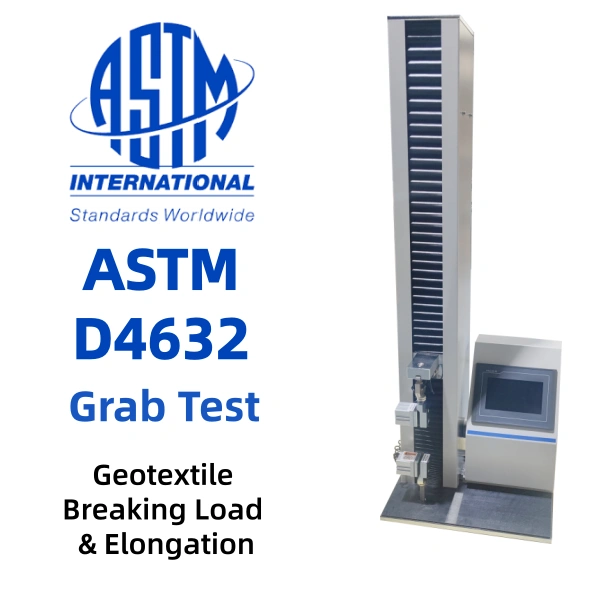
ASTM D4632 määritellään standardoitu menetelmä, jolla arvioidaan breaking load and elongation of geotextiles using the grab method. This approach measures the effective strength of a fabric by gripping only a portion of the specimen width, simulating real-world stress conditions.
Unlike strip testing, ASTM D4632 reflects the contribution of adjacent fibers, making it highly relevant for quality control and acceptance testing. However, results apply mainly to materials with similar structures, as fabric construction significantly influences performance.
Key takeaway:
ASTM D4632 provides a reliable index test for comparing geotextile strength under controlled tensile loading conditions.
Grab Strength Test: Principle and Key Parameters
The grab strength test involves applying a continuously increasing tensile force until the specimen ruptures. The method captures two critical parameters:
- Breaking Load (Grab Strength): Maximum force sustained before failure
- Murtovenymä: Deformation corresponding to peak load
Core Testing Conditions
- Gauge length: 75 ± 1 mm
- Test speed: 300 mm/min
- वातावरण: 21 ± 2°C, 65 ± 5% RH
- Specimen alignment: Centered in clamps
The test runs in both machine direction (MD) ja cross-machine direction (CD) to capture anisotropic behavior.
Tärkeää:
Improper clamping, slippage, or edge failure invalidates results and requires retesting.
Geotextile Grab Test Procedure and Data Interpretation
The geotextile grab test follows a structured sequence to ensure repeatability:
Step-by-Step Overview
- Condition specimens under standard atmospheric conditions
- Mount sample centrally in clamps
- Apply tensile load at controlled speed
- Record load-extension curve
- Identify peak load and elongation
- Repeat for multiple specimens
Data Reporting
Results must include:
- Average breaking load (MD & CD)
- Average elongation at break
- Standard deviation
Interpretation Insight:
Higher grab strength indicates better resistance to localized stress, while elongation reflects flexibility and deformation capacity.
CRT-vetotestauskone ASTM D4632:lle
A CRT-vetotestauskone on ratkaiseva tekijä tarkkojen ja toistettavien ASTM D4632 -tulosten varmistamisessa. Tarkkuus nopeuden säätö, siirtymän ja voiman mittaus vaikuttaa suoraan testin validiteettiin.
Miksi laitteilla on merkitystä
Jotta testausjärjestelmä olisi ASTM D4632:n mukainen, sen on tarjottava seuraavat ominaisuudet:
- Vakaa kuorman käyttö
- Tarkka venymän mittaus
- Johdonmukainen nopeuden säätö
- Luotettava tiedonkeruu
Suositeltu ratkaisu: Cell Instruments TST-01
The Cell Instruments TST-01 vetotesteri on suunniteltu täyttämään nämä vaatimukset:
- PLC-ohjattu järjestelmä, jossa on HMI reaaliaikaista käyrän visualisointia varten
- Korkean tarkkuuden palloruuvi vakaaseen siirtymän hallintaan
- Laaja nopeusalue (1-500 mm/min) ASTM-vaatimusten mukaisuutta varten
- Monen valaisimen mukautuvuus veto-, kuoriutumis- ja puhkaisukokeissa.
- Vankka rakenne pitkäaikaisen luotettavuuden varmistaminen
Tämä tekee siitä ihanteellisen CRT-vetotestauskone geotekstiilien testausta ja laajempaa materiaalien arviointia käsitteleville laboratorioille.
ASTM D4632:n merkitys laadunvalvonnassa
ASTM D4632 on edelleen välttämätön:
- Saapuvan materiaalin tarkastus
- Toimittajan pätevyys
- Tuotannon johdonmukaisuuden todentaminen
Koska kouramenetelmä heijastaa paikallinen jännityskäyttäytyminen, se vastaa läheisesti todellisia sovellusolosuhteita, kuten:
- Maaperän vahvistaminen
- Tien rakentaminen
- Viemäröintijärjestelmät
Kriittinen huomautus:
ASTM D4632 -standardia ei tulisi käyttää yksinään suunnittelupäätösten tekemisessä, vaan suositellaan täydentäviä testejä (esim. nauhavetokokeita).
Yleiset testaushaasteet ja optimointivinkit
Usein esiintyvät ongelmat
- Näytteen liukuminen puristimissa
- Reunan repeäminen keskeltä tapahtuvan rikkoutumisen sijasta
- Epäjohdonmukainen näytteen valmistelu
Parhaat käytännöt
- Käytä asianmukaiset leukapinnat liukastumisen estämiseksi
- Varmista tarkka näytteen kohdistaminen
- Ylläpidä standard environmental conditions
- Regularly calibrate the testing machine
UKK
1. What is ASTM D4632 mainly used for?
ASTM D4632 evaluates the grab strength and elongation of geotextiles, primarily for quality control and comparison purposes.
2. How is the grab test different from strip tensile testing?
The grab test measures localized strength including adjacent fiber support, while strip testing evaluates the full-width tensile strength.
3. Why is a CRT tensile testing machine important?
A CRT tensile testing machine ensures accurate load application, speed control, and data recording, which are critical for ASTM compliance.
4. Can ASTM D4632 results be used for design calculations?
No. ASTM D4632 is an index test, and additional methods are required for engineering design.
5. What causes invalid test results in ASTM D4632?
Yleisiä syitä ovat slippage, edge breakage, or improper clamping, all of which require retesting.