
Printed information on packaging plays an essential role in product identification, branding, traceability, and regulatory compliance. However, during manufacturing, transportation, storage, and consumer handling, printed surfaces are exposed to repeated friction that may cause ink smearing, fading, transfer, or coating damage. The TAPPI T830 rub testing method provides a standardized approach for evaluating the resistance of printed materials against abrasion and scuffing.
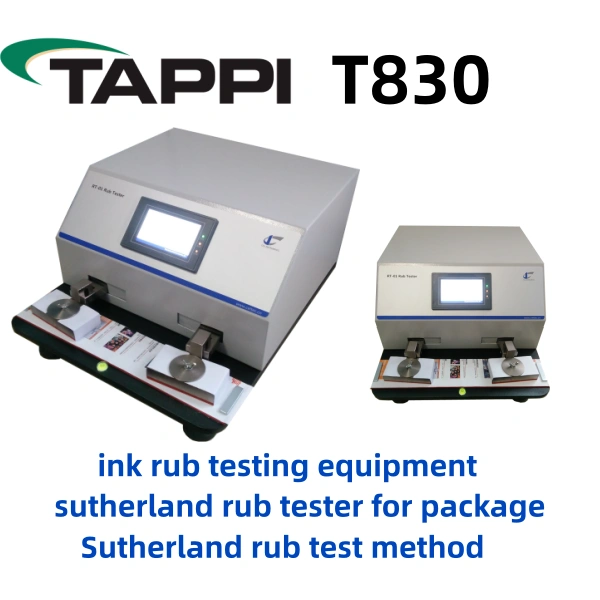
Cell Instruments’ RT-01 Rub Tester is designed to support TAPPI T830 testing requirements by providing controlled reciprocating rubbing motion, selectable test loads, and repeatable test conditions. As professional ink rub testing equipment, the RT-01 helps packaging manufacturers, printing companies, and quality laboratories verify print durability and improve product reliability.
What Is TAPPI T830 Rub Testing?
TAPPI T830 is a recognized test method used to evaluate the abrasion resistance of printed surfaces, especially for paperboard, packaging materials, labels, and printed products. The method is commonly associated with the Sutherland rub test method, which uses a weighted receptor material that moves back and forth across a printed sample under controlled pressure.
The purpose of TAPPI T830 testing is not only to determine whether ink remains visually acceptable after rubbing but also to assess the overall durability of the printed layer, coating system, and substrate interaction.
During the test, a printed specimen is placed on the test platform while a weighted receptor performs repeated rubbing cycles. After a defined number of strokes, the sample and receptor are examined to evaluate:
- Ink transfer
- Color loss
- Smearing tendency
- Coating damage
- Surface abrasion resistance
This information allows manufacturers to identify printing weaknesses before products reach customers.
Why Ink Rub Testing Is Important for Packaging Quality Control
Packaging materials often experience mechanical stress throughout their lifecycle. Cartons may slide against each other during transportation, labels may contact filling equipment, and consumer handling may repeatedly touch printed surfaces.
Without proper abrasion testing, several quality problems may occur:
- Poor brand appearance: Faded graphics or transferred ink can reduce perceived product quality.
- Barcode readability issues: Damaged printed codes may affect tracking and inventory management.
- Customer complaints: Ink smearing or color migration can create dissatisfaction.
- Production losses: Detecting printing failures after mass production increases waste and costs.
Using professional ink rub testing equipment allows companies to measure print durability objectively rather than relying only on visual inspection.
Typical applications include:
- Food packaging cartons
- Pharmaceutical boxes
- Beverage labels
- Flexible packaging films
- Consumer product packaging
- Printed paper materials
For packaging manufacturers, abrasion testing provides valuable quality control data during ink selection, coating development, and production verification.
Understanding the Sutherland Rub Test Method
The Sutherland rub test method is widely used because it simulates real-world abrasion conditions through controlled mechanical rubbing.
The basic testing principle involves three key factors:
Controlled Rubbing Motion
A receptor material moves across the test specimen using a reciprocating arc-stroke motion. The movement creates repeatable friction between the printed surface and the receptor.
The RT-01 Rub Tester uses an arc rubbing mechanism with:
- Arc length: 57 mm ± 1 mm
- Rotation radius: 185 mm
This controlled motion helps achieve consistent results between different samples and laboratories.
Defined Applied Pressure
The rubbing force is controlled by standardized weights. Different pressure levels can simulate different handling conditions.
The RT-01 supports:
| Test Weight | Applied Force |
|---|---|
| 908 g (2 lb) | 8.9 N |
| 1816 g (4 lb) | 17.8 N |
Selecting the appropriate load helps users compare material performance under different abrasion conditions.
Repeatable Stroke Cycles
The number of rubbing cycles directly affects abrasion evaluation. A higher number of cycles represents more severe mechanical exposure.
The RT-01 allows users to set:
- Testkiirus
- Stroke count
- Test mode
- Optional heating conditions
This flexibility supports different packaging and printing applications.
How to Perform TAPPI T830 Rub Testing
A typical TAPPI T830 rub test procedure includes the following steps:
1. Prepare the Test Specimen
Cut the printed sample into the required size and ensure the printed area represents the actual production material.
Common samples include:
- Printed paperboard
- Coated paper
- Packaging labels
- Printed films
The specimen should be conditioned according to laboratory requirements before testing.
2. Mount the Sample
Secure the specimen onto the testing platform. The printed surface should face the rubbing receptor.
Proper positioning ensures uniform contact pressure and prevents inaccurate results caused by sample movement.
3. Select Test Parameters
Using the touchscreen HMI, operators can configure:
- Testkiirus
- Number of rubbing cycles
- Weight selection
- Heating temperature (for customized heated rub testing)
The RT-01 supports a speed range of:
20–120 cycles per minute (cpm)
4. Start the Rubbing Process
The weighted receptor moves repeatedly across the specimen. The instrument maintains consistent movement throughout the test.
The rubbing process evaluates how well the printed surface withstands mechanical wear.
5. Evaluate Results
After testing, users inspect:
- The tested specimen
- The receptor surface
- Ink transfer level
- Color change
- Surface damage
Results can be used for material approval, supplier evaluation, and production quality monitoring.
RT-01 Rub Tester: Professional Equipment for TAPPI T830 Testing
Cell Instruments’ RT-01 is developed as a reliable sutherland rub tester for package applications, supporting packaging and printing laboratories that require accurate abrasion evaluation.
Key features include:
Adjustable Test Parameters
The instrument provides flexible control over:
- Rubbing speed
- Stroke quantity
- Test weight
- Testing conditions
This allows engineers to reproduce different handling environments.
Multiple Rub Testing Modes
The RT-01 supports various evaluation applications:
Dry Rub Testing
Measures abrasion resistance under normal dry conditions.
Wet Rub Testing
Evaluates ink durability when moisture is present.
Heated Rub Testing
Assesses coating and ink performance under elevated temperatures. (Heating customization available.)
Wet Bleed and Transfer Testing
Detects ink migration and transfer behavior.
Wet Smear Testing
Measures the tendency of printed surfaces to smear under wet contact conditions.
Functional Rub Testing
Customized configurations can simulate specific customer applications.
Stable Mechanical Structure
The RT-01 provides repeatable mechanical movement through:
- Precise rubbing control
- Stable specimen positioning
- Adjustable test conditions
- Durable laboratory construction
These features make it suitable for quality control laboratories and production verification environments.
Applications of TAPPI T830 Rub Testing Across Industries
Pakenditööstus
Packaging companies use TAPPI T830 testing to verify printed carton and label durability.
Applications include:
- Folding cartons
- Corrugated packaging
- Paper bags
- Food packaging
- Pharmaceutical packaging
Printing Industry
Printing companies use rub testing to optimize:
- Ink formulation
- Printing processes
- Pinnakatted
- Finishing treatments
Ravimite pakendamine
Pharmaceutical packaging requires clear and durable printing for:
- Product identification
- Batch information
- Expiration dates
- Regulatory labels
Rub testing helps confirm that critical information remains readable.
Consumer Goods Industry
Products with printed packaging require abrasion resistance to maintain appearance during distribution and retail handling.
Materials Suitable for TAPPI T830 Testing
The TAPPI T830 rub test method can be applied to various printed materials, including:
| Material Type | Tüüpilised rakendused |
|---|---|
| Papp | Folding cartons, pharmaceutical boxes |
| Coated paper | Labels and printed packaging |
| Corrugated board | Shipping containers |
| Plastic films | Flexible packaging |
| Laminated materials | Multi-layer packaging |
| Printed coatings | Decorative and protective surfaces |
Related Standards for Rub and Abrasion Testing
The RT-01 Rub Tester supports testing related to several industry standards, including:
| Standard | Taotlus |
|---|---|
| TAPPI T830 | Rub resistance testing of printed materials |
| ASTM D5264 | Abrasion resistance of printed materials |
| ASTM F1571 | Printing quality evaluation applications |
| ASTM F2497 | Packaging print durability evaluation |
While standards may define specific test conditions, laboratories may also customize test parameters based on product requirements and internal quality specifications.
Benefits of Using Professional Ink Rub Testing Equipment
Investing in dedicated rub testing equipment provides several advantages:
Improved Product Reliability
Manufacturers can identify weak printing systems before products enter the market.
Better Material Selection
Testing helps compare:
- Different inks
- Coating systems
- Substrate materials
- Printing processes
Reduced Production Risk
Early detection of abrasion problems minimizes:
- Product returns
- Customer complaints
- Rework costs
Support for Quality Certification
Reliable test data supports supplier qualification, internal quality systems, and customer validation processes.
Technical Specifications of RT-01 Rub Tester
| Parameeter | Spetsifikatsioon |
|---|---|
| Test Weight | 908 g (2 lb) / 8.9 N; 1816 g (4 lb) / 17.8 N |
| Kiiruse vahemik | 20–120 cpm |
| Isendite arv | 1–2 |
| Pöörlemisraadius | 185 mm |
| Kaare pikkus | 57 mm ± 1 mm |
| Mõõtmed | 390 × 480 × 220 mm (L × W × H) |
| Toiteallikas | 110–220 V, 50/60 Hz |
Choosing the Right Rub Tester for Packaging Applications
When selecting a rub tester, laboratories should consider:
- Applicable testing standards
- Sample types
- Required test loads
- Testing frequency
- Production environment
- Data management requirements
For companies producing packaging materials, labels, or printed products, a reliable sutherland rub tester for package applications provides essential information about print durability and surface performance.
Cell Instruments provides standard rub testing equipment as well as customized testing solutions, including special fixtures, automated systems, and application-specific configurations for advanced quality control requirements.
Kokkuvõte
Reliable print durability testing helps manufacturers prevent ink failure, improve packaging quality, and maintain consistent product appearance throughout distribution. Cell Instruments provides advanced rub testing solutions for packaging, printing, and material evaluation applications. Our RT-01 hõõrumistesti supports TAPPI T830 and related abrasion testing requirements with accurate control, stable operation, and customizable configurations. Contact our technical team to learn how professional rub testing equipment can support your quality control and product development needs.