
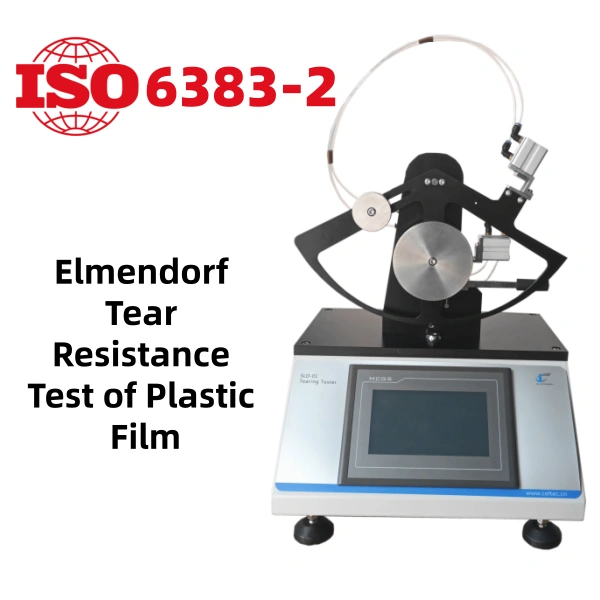
Plastic films and flexible sheeting are widely used in packaging, medical, agricultural, industrial, and consumer applications. While tensile strength indicates how much force a material can withstand before breaking, it does not always reflect how a material behaves once a small cut or defect appears. ISO 6383-2 addresses this important performance characteristic by specifying the Elmendorf method para determinar el tear resistance of plastic film.
Comprender ISO 6383-2 helps manufacturers evaluate product durability, optimize material structures, improve quality control, and compare different film formulations under standardized conditions. Whether producing polyethylene packaging film, flexible PVC sheeting, or multilayer barrier structures, reliable tear resistance testing plays a critical role in ensuring product performance throughout manufacturing, transportation, and end use.
What Is ISO 6383-2?
ISO 6383-2 specifies a standardized procedure for determining the force required to propagate a tear through a thin flexible plastic film or sheeting after an initial slit has been introduced.
Unlike tensile testing, which measures resistance to complete rupture under continuous loading, this standard evaluates the energy required to continue an existing tear. This makes it especially valuable for predicting how packaging materials behave when accidentally punctured or cut during handling.
The standard is based on the Resistencia al desgarro según el método de Elmendorf principle, where a calibrated pendulum supplies the energy necessary to propagate the tear through a specified distance.
Why Tear Resistance Matters
In practical applications, plastic films rarely fail because of uniform tensile loading. Instead, failures often begin from:
- Small cuts during converting
- Edge damage during transportation
- Punctures during packaging
- Mechanical impacts during handling
- Stress concentration around notches
A film with excellent tensile strength may still exhibit poor tear propagation resistance. Measuring tear strength of plastic film allows manufacturers to:
- Improve package durability
- Reduce product waste
- Compare material formulations
- Verify supplier consistency
- Optimize multilayer film design
- Ensure compliance with customer specifications
The Elmendorf Method Explained
En Elmendorf method determines the energy required to propagate a pre-cut tear using a calibrated pendulum.
Basic Testing Principle
The procedure consists of several simple steps:
- A standard specimen is prepared with a precisely cut initial slit.
- The specimen is clamped securely between fixed and moving jaws.
- The pendulum is raised to its starting position.
- The pendulum is released.
- The stored potential energy tears the specimen.
- The remaining pendulum energy is measured.
- Tear resistance is calculated from the energy consumed during tearing.
Because the energy loss corresponds directly to the work required to continue the tear, the method provides an accurate measurement of material tear propagation resistance.
Materials Suitable for ISO 6383-2
The standard is intended primarily for thin flexible plastic films and sheeting.
Typical materials include:
| Suitable Materials | Notes |
|---|---|
| Láminas de polietileno (PE) | Excellent application |
| Polypropylene (PP) films | Common packaging material |
| Flexible PVC films | Specifically referenced in the standard |
| Polyolefin films | Suitable for routine testing |
| Laminated flexible films | Frequently evaluated for packaging |
Materials with Limitations
Some materials may produce less reproducible results because of their mechanical behavior:
- Highly extensible films
- Films exhibiting significant elongation before tearing
- Materials prone to oblique tear propagation
The standard also notes that more rigid materials such as rigid PVC, nylon, and polyester films may not be suitable for this test because they do not exhibit the tear characteristics assumed by the method.
ISO 6383-2 Test Procedure
Although laboratories should always follow the complete standard, the general workflow includes several critical steps.
Equipment Verification
Before testing:
- Confirm the Elmendorf tear strength tester is level.
- Raise and lock the pendulum.
- Verify the pointer returns to zero.
- Perform zero adjustment if necessary.
Proper calibration is essential for obtaining reliable and repeatable results.
Selecting the Correct Pendulum Capacity
The tearing force should normally fall between 20% and 80% of the pendulum’s full-scale capacity.
If required, laboratories may:
- Install additional weights
- Select another pendulum range
- Test multiple specimens simultaneously
Operating within the recommended measurement range minimizes uncertainty and improves accuracy.
Specimen Mounting
The specimen is carefully positioned so that:
- The slit is centered between the clamps.
- Both jaws firmly grip the specimen.
- Alignment is maintained throughout the test.
Improper alignment can significantly influence tear propagation and result accuracy.
Tear Propagation
After releasing the pendulum:
- The tear propagates across the specimen.
- The instrument measures the energy consumed.
- Tear resistance is calculated according to the manufacturer’s calibration.
Valid Test Results
Certain specimens should be rejected:
- Tears deviating excessively from the intended path
- Irregular fracture behavior
- Specimens with improper tear propagation
Replacement specimens are tested until sufficient valid data are obtained.
Understanding Test Results
Según ISO 6383-2, each specimen produces an individual tear resistance value expressed as force.
Laboratories generally calculate:
- Individual tear resistance
- Arithmetic mean
- Machine Direction (MD) average
- Transverse Direction (TD) average
Since plastic films often exhibit directional properties due to manufacturing orientation, reporting both principal directions provides a more complete understanding of material performance.
Aplicaciones típicas
En Elmendorf method is widely adopted across numerous industries.
| Industry | Typical Products |
|---|---|
| Envases flexibles | Bags, pouches, wrapping films |
| Envasado de alimentos | Barrier films, frozen food packaging |
| Médico | Sterilization pouches, medical packaging |
| Pharmaceutical | Blister backing films, protective packaging |
| Agriculture | Greenhouse films, mulch films |
| Industrial | Protective films, liners |
| Consumer Goods | Shopping bags, retail packaging |
In all of these applications, tear propagation performance directly influences product durability and usability.
Quality Control Benefits
Routine ISO 6383-2 testing supports manufacturing quality assurance by helping organizations:
- Verify incoming raw materials
- Monitor production consistency
- Compare resin suppliers
- Validate process changes
- Optimize multilayer structures
- Reduce customer complaints
- Support product development
- Meet customer specifications
When combined with tensile, puncture, friction, sealing, and thickness testing, tear resistance forms part of a comprehensive mechanical characterization program for flexible packaging materials.
ISO 6383-2 Compared with Related Standards
Although ISO 6383-2 is one of the most widely recognized methods for plastic films, other tear testing standards serve different materials and applications.
| Estándar | Método | Typical Materials |
|---|---|---|
| ISO 6383-2 | Elmendorf pendulum | Plastic films and sheeting |
| ISO 6383-1 | Trouser tear | Plastic films |
| ASTM D1922 | Elmendorf tear | Plastic film |
| ASTM D1004 | Graves tear | Flexible plastics |
| ISO 1974 | Elmendorf tear | Paper and board |
| TAPPI T414 | Elmendorf tear | Productos de papel |
Selecting the appropriate standard depends on material type, product requirements, and customer specifications.
Choosing an Elmendorf Tear Strength Tester
An effective Elmendorf tear strength tester should deliver accurate, repeatable measurements while simplifying laboratory operation.
Key features to consider include:
- Multiple pendulum capacities for a wide testing range
- Stable mechanical construction
- Automatic pendulum release to reduce operator variability
- Reliable specimen clamping
- Calibration verification capability
- Statistical data processing
- Digital result display
- Data export for traceability
For laboratories performing routine quality control or product development, automation features can significantly improve testing efficiency and repeatability.
Cell Instruments SLD-01 Elmendorf Tear Strength Tester
En SLD-01 Elmendorf Tear Strength Tester from Cell Instruments is designed for standardized tear resistance testing of plastic films, flexible sheeting, paper, and related materials in accordance with the Elmendorf method.
Notable technical features include:
- PLC control with HMI touchscreen for intuitive operation and stable industrial performance.
- Pneumatic specimen clamping to provide uniform gripping force and improve repeatability.
- Automatic pendulum release to minimize operator influence.
- Calibration weight system supporting verification across multiple force ranges.
- Automated statistical analysis for efficient quality control reporting.
- Optional micro-printer and RS-232 communication for documentation and traceability.
- Optional professional software for advanced data analysis and report generation.
- Paper-specific output units, including mN and tear index, for laboratories testing pulp and paper materials.
The instrument supports multiple pendulum capacities ranging from 200 gf to 6400 gf, enabling laboratories to evaluate a broad range of flexible materials while maintaining measurements within the recommended operating range specified by the standard.
Best Practices for Reliable ISO 6383-2 Testing
To achieve consistent and reproducible results:
- Use specimens prepared according to the standard.
- Verify instrument calibration before testing.
- Select the appropriate pendulum capacity.
- Ensure proper specimen alignment.
- Reject tests with unacceptable tear deviation.
- Test sufficient specimens in both machine and transverse directions.
- Maintain regular preventive maintenance and calibration schedules.
Following these practices helps laboratories generate reliable data for product development, supplier qualification, and routine quality assurance.
Conclusión
ISO 6383-2 provides a practical and internationally recognized method for evaluating the tear resistance of plastic film using the proven Elmendorf method. By measuring the force required to propagate an existing tear, manufacturers gain valuable insight into real-world material performance that tensile testing alone cannot provide.
Whether used for flexible packaging development, process optimization, supplier qualification, or production quality control, standardized Resistencia al desgarro según el método de Elmendorf testing enables more informed material selection and contributes to improved product durability and customer satisfaction.