
Inleiding tot ASTM D6636
ASTM D6636 definieert een gestandaardiseerde procedure om de hechtsterkte van de lagen van versterkte geomembranen met behulp van een 180° schilconfiguratie. Ingenieurs en kwaliteitscontroleurs vertrouwen op deze methode om de hechting tussen lagen in meerlaagse geomembraanconstructies te beoordelen.
Versterkte geomembranen worden veel gebruikt in insluitsystemen zoals stortplaatsen, mijnvijvers en waterreservoirs. Hun prestaties zijn sterk afhankelijk van de hechting tussen de lagen. ASTM D6636 geeft een kwantificeerbare en herhaalbare indextest om een consistente productkwaliteit te garanderen.
Geomembraan 180 Schiltest
De geomembraan 180 afpeltest meet de kracht die nodig is om gelijmde lagen te scheiden onder een constante hoek en snelheid. De test simuleert echte spanningen waarbij delaminatie kan optreden.
Sleutelbegrip:
- Een preparaat wordt gedeeltelijk handmatig gescheiden (25-50 mm)
- Beide uiteinden worden in een trekbank geklemd
- De lagen worden uit elkaar getrokken op 180°
- Kracht vs. verplaatsing wordt continu geregistreerd
Waarom 180°?
Deze configuratie zorgt voor een uniforme verdeling van de spanning over de verbindingsinterface, waardoor de resultaten betrouwbaarder zijn voor vergelijking.
Hechtsterkte van geomembranen
De hechtsterkte van geomembranen rechtstreeks beïnvloedt:
- Duurzaamheid op lange termijn
- Weerstand tegen delaminatie
- Structurele integriteit onder stress
- Prestaties op het gebied van milieubescherming
ASTM D6636 benadrukt dat aanvaardbare hechtingswaarden variëren per producttype. Daarom moeten fabrikanten en klanten het volgende definiëren aanvaardbare minimumdrempels gebaseerd op de vereisten van de toepassing.
Belangrijk inzicht: Als er scheuren optreden in plaats van scheiding, is de adhesiesterkte groter dan de scheursterkte van het materiaal - een indicator van een sterke hechting.
Overzicht testprocedure ASTM D6636
Monstervoorbereiding
- Lagen handmatig voorschillen (25-50 mm)
- Zorg voor schone, onbeschadigde randen
- Consistente breedte van het monster behouden
Testomstandigheden
- Temperatuur: 21 ± 2°C
- Vochtigheid: 50-70% RH
- Snelheid: 50 mm/min (constant)
Uitvoeringsstappen
- Klem beide geschilde uiteinden stevig vast
- Lijn het preparaat uit om verdraaiing te voorkomen
- onderhouden 180° scheidingshoek
- Start de test en registreer de kracht over ten minste 100 mm scheidingsafstand
Behandeling van speciale gevallen
- Als er scheuren optreden:
- Snijd de scheurlaag door en ga verder
- Noteer de maximale kracht
- Rapporteren als scheur-beperkt resultaat
Berekening van de hechtsterkte van de bekleding
De hechtsterkte wordt als volgt berekend:
SPA = F / W
Waar:
- SPA = Hechtsterkte van de laag (N/m)
- F = uitgeoefende kracht (N)
- W = Breedte monster (m)
Resultaten worden meestal gerapporteerd als een gemiddelde van meerdere exemplaren om statistische betrouwbaarheid te garanderen.
Sterkte tester voor schil van geomembraan: Materiaalkeuze
Een betrouwbare tester voor de afpelsterkte van geomembranen is essentieel voor nauwkeurige ASTM D6636 resultaten. Het testsysteem moet leveren:
- Nauwkeurige snelheidsregeling (50 mm/min)
- Stabiele krachtmeting
- Consistente verplaatsingsnauwkeurigheid
- Soepele beweging zonder trillingen
Aanbevolen oplossing: Cell Instruments Treksterkte Tester
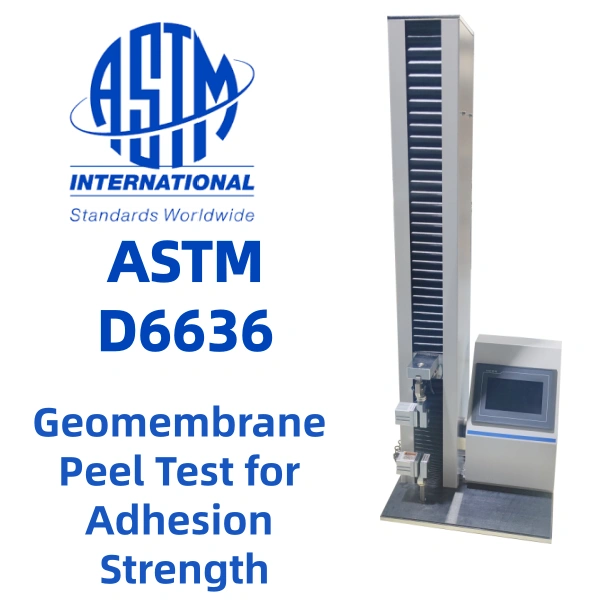
De TST-01 Trekbank is zeer geschikt voor ASTM D6636-toepassingen vanwege:
- Zeer nauwkeurig kogelomloopspilsysteem Zorgen voor een soepele schilbeweging
- Breed snelheidsbereik (1-500 mm/min) voor flexibel testen
- PLC-gestuurd systeem met real-time curveweergave
- Compatibel met meerdere armaturen voor afpel- en trektests
- Nauwkeurige krachtmeting (±0,5% FS)
Het modulaire armatuurontwerp maakt naadloze aanpassing aan 180° schilconfiguraties, waardoor het ideaal is voor laboratoria die geomembranen testen.
Verzeker u van betrouwbare geomembraanprestaties met ASTM D6636-tests. Deze methode meet nauwkeurig de adhesiesterkte van de lagen met behulp van een gecontroleerde 180°-afpeltest, zodat u de integriteit van de hechting kunt controleren en aan de projectnormen kunt voldoen. Met de geavanceerde trektestoplossingen van Cell Instruments kunt u nauwkeurige, herhaalbare resultaten bereiken en de efficiëntie van de kwaliteitscontrole verbeteren. Upgrade uw testmogelijkheden vandaag nog om consistente productprestaties te garanderen in veeleisende milieutoepassingen.
Interpretatie van testresultaten
Om de resultaten van ASTM D6636 te begrijpen, moet aandacht worden besteed aan de faalwijzen:
Falen van lijm
- Schone scheiding tussen de lagen
- Geeft de werkelijke hechtsterkte aan
Cohesie/Scheurfalen
- Materiaal scheurt voor scheiding
- Suggereert hechting overschrijdt materiaalsterkte
Variabiliteitsoverwegingen
- Hechting kan variëren:
- Tussen lagen
- Langs hetzelfde exemplaar
- Test altijd meerdere monsters voor nauwkeurigheid
FAQs
1. Wat meet ASTM D6636?
Het meet de kracht die nodig is om gelijmde lagen te verwijderen in versterkte geomembranen onder een 180° configuratie.
2. Wat is de standaard testsnelheid in ASTM D6636?
De test draait met een constante snelheid van 50 mm/min om consistentie te garanderen.
3. Wat gebeurt er als het monster scheurt tijdens het testen?
Scheuren geeft aan dat adhesiesterkte overtreft scheursterkte, en het resultaat moet dienovereenkomstig worden gerapporteerd.
4. Waarom wordt een schilhoek van 180° gebruikt?
Een hoek van 180° biedt gelijkmatige spanningsverdeling, Dit verbetert de betrouwbaarheid en herhaalbaarheid van de resultaten.
5. Hoeveel monsters moeten er getest worden?
Er moeten meerdere monsters worden getest en de resultaten moeten worden gerapporteerd als een gemiddelde waarde om nauwkeurigheid te garanderen.