
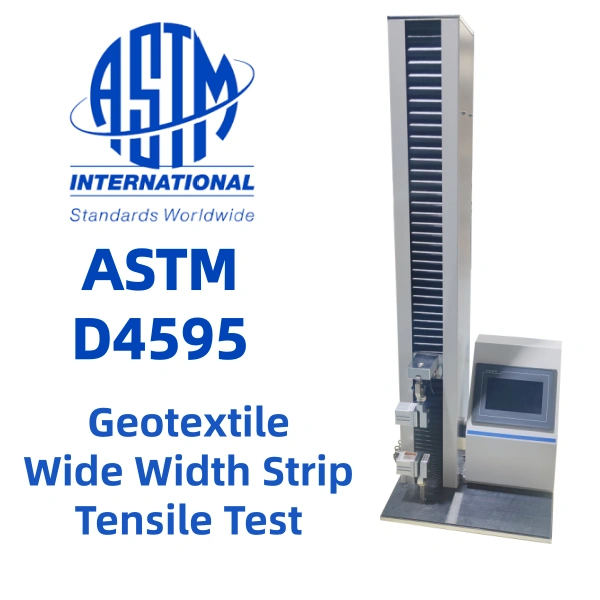
Wat is ASTM D4595 en waarom is het belangrijk?
ASTM D4595 definieert een gestandaardiseerde methode om de trekeigenschappen van geotextiel met behulp van een breed monster. In tegenstelling tot smalle strooktesten minimaliseert deze methode randeffecten zoals halsvorming, wat resultaten oplevert die een betere weerspiegeling zijn van ingenieursgedrag in de echte wereld.
Ingenieurs vertrouwen op ASTM D4595 voor het verkrijgen van belangrijke parameters zoals:
- Treksterkte
- Rek bij breuk
- Initiële en secante modulus
- Brekende taaiheid
Deze waarden ondersteunen het ontwerp van versterkte grondconstructies, taluds en rijwegen, waar geotextiel moet presteren onder trekspanning.
Principe van de trekproef voor brede stroken
De trektest voor brede strook maakt gebruik van een relatief groot proefstuk dat over de volledige breedte wordt vastgeklemd en met een constante snelheid wordt uitgerekt totdat het breekt.
De belangrijkste kenmerken zijn:
- Breedte van monster vermindert plaatselijke vervorming
- Belasting wordt gelijkmatiger verdeeld over de vezels
- De resultaten komen sterk overeen met prestaties in het veld
Tijdens het testen registreert het systeem de kracht-verlengingscurve, die de basis vormt voor alle berekende mechanische eigenschappen.
Treksterkte van geotextiel in de breedte en belangrijkste berekeningen
De geotextiel brede treksterkte vertegenwoordigt de maximale kracht per breedte-eenheid die nodig is om het proefstuk te breken.
Formule voor treksterkte
σf=WsFf
Waar:
- σf = treksterkte
- Ff = breekkracht
- Ws = breedte monster
Rekberekening
Rek geeft aan hoeveel het materiaal uitrekt voordat het bezwijkt:ε=LsΔL×100
Modulus evaluatie
ASTM D4595 definieert meerdere modulustypen:
- Initiële modulus - stijfheid bij vroege belasting
- Offset modulus - aangepaste stijfheidsreferentie
- Secante modulus - stijfheid bij gespecificeerde rek (bijv. 2%, 5%, 10%)
Deze parameters zijn cruciaal voor ontwerpmodellering en voorspelling van vervorming.
Vereisten voor CRE trekbank
A CRE trekbank (Constante snelheid van verlenging) is essentieel om te voldoen aan ASTM D4595. Het past een gecontroleerde en uniforme reksnelheid toe om reproduceerbaarheid te garanderen.
Belangrijkste vereisten:
- Constante reksnelheid: 10 ± 3 %/min
- Nauwkeurige krachtmeting binnen 10-90% van volle schaal
- Goed klemsysteem om slippen of breken van de bek te voorkomen
- Vermogen om vast te leggen kracht-verlenging curves
Aanbevolen apparatuur: Cell Instruments Treksterkte Tester
Voor laboratoria die op zoek zijn naar precisie en efficiëntie, de Cell Instruments TST-01 Trekbank biedt een betrouwbare oplossing voor ASTM D4595 testen.
Waarom het past bij ASTM D4595 toepassingen:
- Stabiele PLC-besturing + 7” HMI voor real-time curve-visualisatie
- Breed snelheidsbereik (1-500 mm/min) om te voldoen aan de vereisten voor reksnelheid
- Hoge nauwkeurigheid (0,5% FS) zorgt voor geloofwaardige resultaten
- Aanpasbare armaturen voor verschillende geotextielstructuren
- Vloeiend bewegingssysteem vermindert de testvariabiliteit
Het robuuste ontwerp ondersteunt industrieel gebruik op lange termijn, waardoor het ideaal is voor QC labs en onderzoeksinstellingen die geotextielmaterialen verwerken.
Overzicht testprocedure
Een typische ASTM D4595 test omvat de volgende stappen:
Monstervoorbereiding
- Gebruik brede preparaten om krimpen van de randen te minimaliseren
- Monsters conditioneren onder gecontroleerde atmosfeer
Machine instellen
- Stel de lengte van de meter in (meestal 100 mm)
- Lijn het preparaat zorgvuldig uit om verkeerd belasten te voorkomen
- Pas minimale voorspanning toe (<1% breekkracht)
Testen
- Voer de test uit tot breuk
- Continu kracht en rek registreren
Resultaatvalidatie
- Verwijder ongeldige resultaten veroorzaakt door:
- Kaak breekt
- Uitglijders
- Abnormale afwijkingen
Betekenis van ASTM D4595 in technische toepassingen
ASTM D4595 speelt een essentiële rol in:
- Ontwerp van versterkte grond
- Stabilisatiesystemen voor hellingen
- Versterking van steunmuur
- Wegen- en bestratingstechniek
Vergeleken met smalle strooktesten biedt deze methode betrouwbaardere ontwerpparameters, vooral voor niet-geweven geotextiel.
FAQs
1. Waarin verschilt ASTM D4595 van trekproeven met grijpers?
ASTM D4595 gebruikt een breed proefstuk, waardoor randeffecten worden verminderd en een realistischer trekgedrag wordt verkregen dan bij grijpertests.
2. Kan ASTM D4595 zowel geweven als niet-geweven geotextiel testen?
Ja, het geldt voor geweven, niet-geweven, gelaagd en gebreid geotextiel.
3. Waarom is een CRE-trekbank nodig?
Een CRE-systeem zorgt voor constante reksnelheid, wat cruciaal is voor reproduceerbaarheid en naleving van standaarden.
4. Wat veroorzaakt ongeldige testresultaten?
Veel voorkomende oorzaken zijn gebroken kaken, uitglijden en onjuiste uitlijning van het monster.
5. Is nat testen toegestaan in ASTM D4595?
Ja, de methode bevat procedures voor zowel geconditioneerde (droge) als natte monsters.